 PARDESCO
Fractals & coloring
What Are Fractals? A Visual Introduction
A fractal is a shape that keeps showing detail as you zoom in, often repeating copies of itself at smaller scales. Here is what that means, why it happens, and where to see it live.
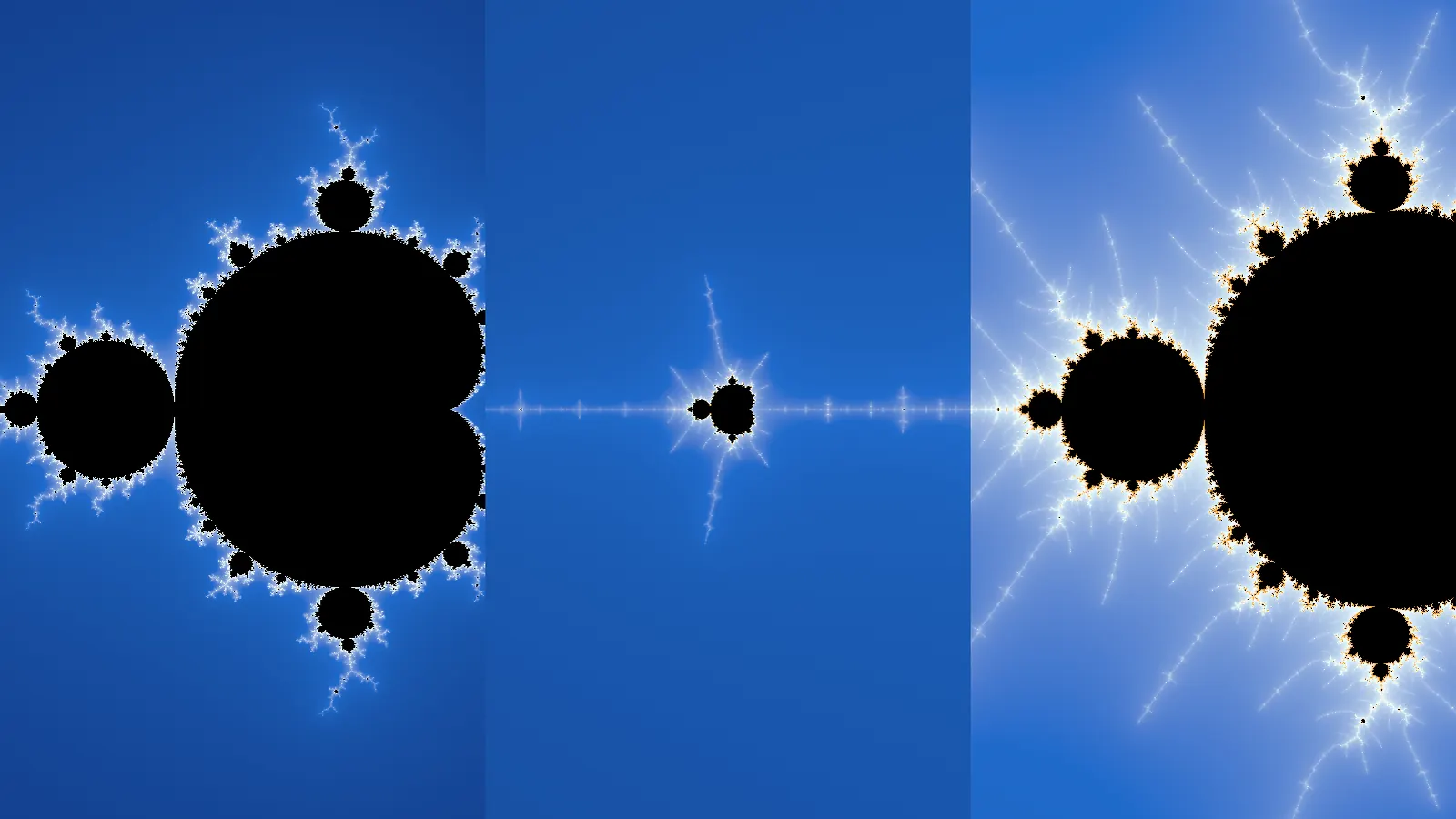
A fractal is a shape that keeps showing new detail however far you zoom in. Many fractals contain smaller copies of themselves, so a piece of the shape looks like the whole. Most are made by repeating one simple rule over and over.
That is the whole idea. The rest of this page shows each part of it with a live example you can open, zoom, and change. The Mandelbrot set is the most famous fractal and a good place to start, but it is one of many. Fractal Zoom Studio is a pattern studio, so the same tools also work on Julia sets, spiral tilings, hyperbolic tilings, and kaleidoscope patterns.
◆ Open in StudioOpen the Mandelbrot setDrag to pan and scroll to zoom. Every view is recalculated from the formula, so the detail never runs out.A simple definition of a fractal
The word comes from the mathematician Benoit Mandelbrot, who coined it in 1975 from the Latin fractus, meaning broken or fractured. He needed a name for shapes that classical geometry handled badly: rough, jagged, or endlessly branching forms that look complicated at every size.
A working definition that fits most cases:
A fractal is a shape with fine structure at every scale, usually with some form of self-similarity, whose roughness can be measured by a dimension that is often not a whole number.
Mathematicians have argued about a strict definition for decades. Mandelbrot's early formal version said a fractal is a set whose fractal (Hausdorff) dimension is larger than its ordinary topological dimension. He later preferred a looser description, because some shapes everyone calls fractals fail the strict test. For looking at pictures and making them, three properties do most of the work: self-similarity, iteration, and fractal dimension.
Self-similarity: the part looks like the whole
A shape is self-similar when a small piece of it resembles the entire shape. Cut a branch off a fern and it looks like a smaller fern. Zoom into the edge of a Koch snowflake and you find the same bump pattern again, exactly.
There are three kinds, from strict to loose:
- Exact self-similarity. The shape is made of scaled copies of itself with no variation. The Koch snowflake and Sierpinski triangle work this way.
- Quasi-self-similarity. Smaller copies appear, but distorted or decorated. The Mandelbrot set is the classic case: miniature copies of the full set, often called minibrots, appear all along its boundary, each surrounded by slightly different filaments.
- Statistical self-similarity. No exact copies, but the roughness looks the same at different scales. Coastlines, mountain profiles, and clouds fit here.
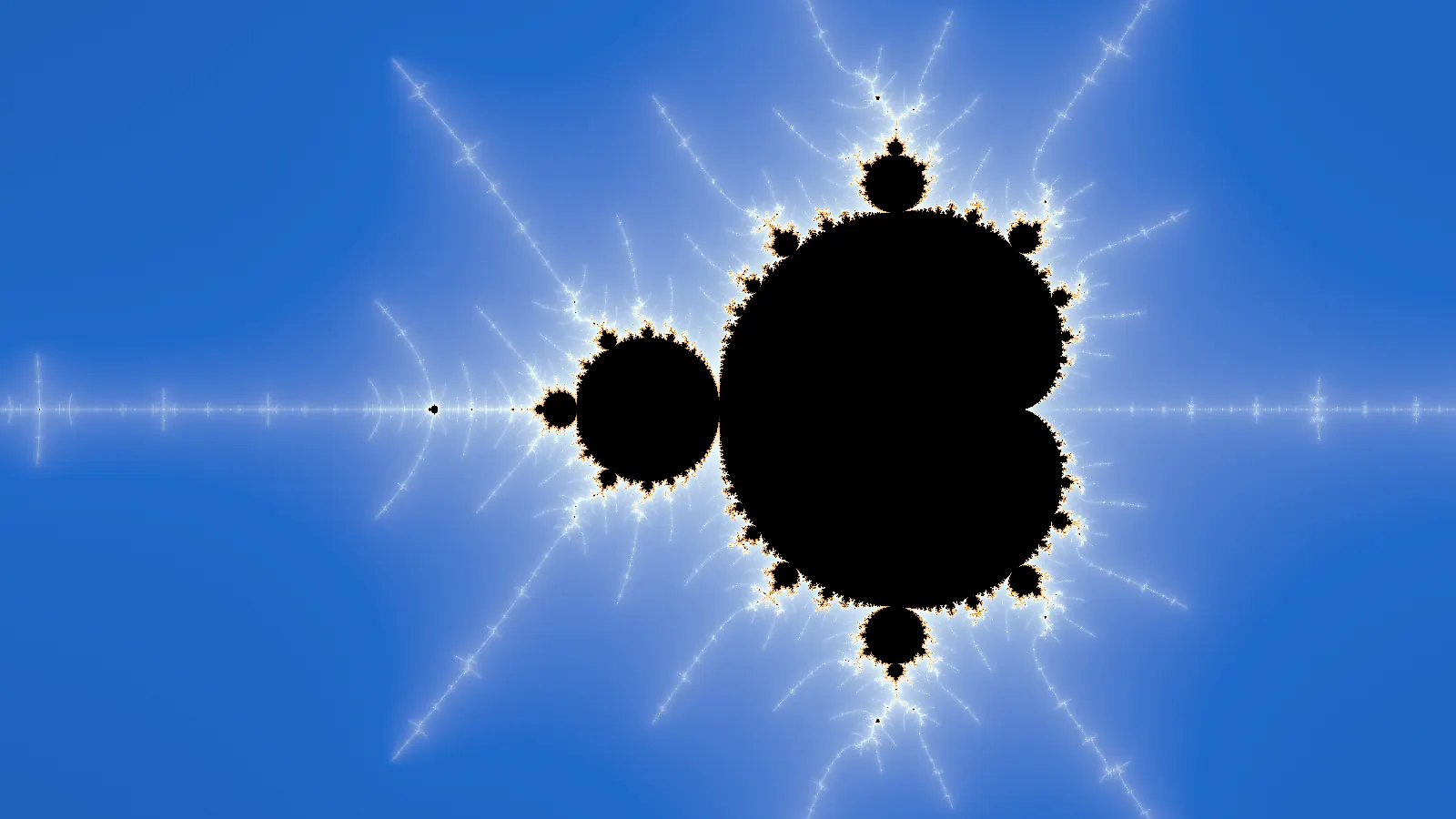
Here is that miniature Mandelbrot set as a live view. It sits on the thin antenna that runs left from the main body, roughly 60 times smaller than the whole set, and it has its own antenna with even smaller copies on it.
◆ Open in StudioZoom to a miniature Mandelbrot setA smaller copy of the whole set, sitting on the antenna that runs left from the main body.Iteration: a simple rule, repeated
Most fractals come from iteration: apply a rule, feed the result back in, and repeat. The rule itself is usually short.
- The Koch snowflake starts with a triangle. Replace the middle third of every edge with two sides of a smaller triangle. Repeat on every new edge.
- The Sierpinski triangle starts with a filled triangle. Cut out the middle quarter, leaving three corner triangles. Repeat on each of those.
- The Mandelbrot set takes a complex number c, starts at z = 0, and repeats z → z² + c. If the numbers stay bounded, c is in the set.
The first two are geometric and build the shape step by step. The third is an escape-time fractal: the computer runs the rule for every pixel and colors it by how fast the numbers grow. The full walkthrough is in The Mandelbrot Set, Explained Visually.
Iteration explains why fractals have detail at every scale. Each round of the rule adds structure at a smaller size than the round before. Carry it on forever and there is no smallest level of detail.
Fractal dimension and the coastline paradox
In 1967 Mandelbrot published a paper titled How Long Is the Coast of Britain? It built on measurements by Lewis Fry Richardson, who noticed that the measured length of a coastline keeps growing as the ruler gets shorter. A 100 km ruler skips over bays that a 1 km ruler follows, and a 1 m ruler follows rocks the 1 km ruler skips. There is no single correct length. This is the coastline paradox.
Fractal dimension turns that behavior into a number. For an exactly self-similar shape it has a simple form: if the shape is made of N copies of itself, each scaled down by a factor r, its dimension is log N / log r.
| Shape | Built from | Dimension |
|---|---|---|
| Straight line | 2 copies at 1/2 size | 1 |
| Filled square | 4 copies at 1/2 size | 2 |
| Cantor set | 2 copies at 1/3 size | log 2 / log 3 ≈ 0.6309 |
| Koch curve | 4 copies at 1/3 size | log 4 / log 3 ≈ 1.2619 |
| Sierpinski triangle | 3 copies at 1/2 size | log 3 / log 2 ≈ 1.585 |
| Sierpinski carpet | 8 copies at 1/3 size | log 8 / log 3 ≈ 1.8928 |
A dimension between 1 and 2 means the shape is more than a line but less than a surface. The Koch curve is a good example of how strange this gets. Each step multiplies the length by 4/3, so the finished snowflake has an infinitely long boundary, yet it encloses a finite area: exactly 8/5 of the starting triangle.
Richardson's data gave the west coast of Britain a dimension of about 1.25, close to the Koch curve. The boundary of the Mandelbrot set is rougher still. In 1998 Mitsuhiro Shishikura proved its Hausdorff dimension is exactly 2, the largest value a curve in the plane can have.
Famous fractals and simple examples
These are the fractals you will meet most often, from simplest to most complex:
- Cantor set (1883). Remove the middle third of a line segment, then the middle third of each piece, forever. What remains is a dust of points.
- Koch snowflake (1904). The bumpy triangle described above.
- Sierpinski triangle and carpet (1915–1916). Triangles or squares with their middles removed, recursively. The Koch and Sierpinski fractals guide covers both families.
- Julia sets (Gaston Julia and Pierre Fatou, around 1918). Fix the number c in z → z² + c and test every starting point. Each c gives a different shape, from connected webs to scattered dust. See Julia Sets, Interactively.
- Mandelbrot set (first detailed computer images around 1980). The map of which values of c give connected Julia sets.
- Newton fractals. Use Newton's root-finding method on an equation such as z³ = 1 and color each starting point by the root it reaches. The borders between those regions are fractal. More in the Newton fractal guide.
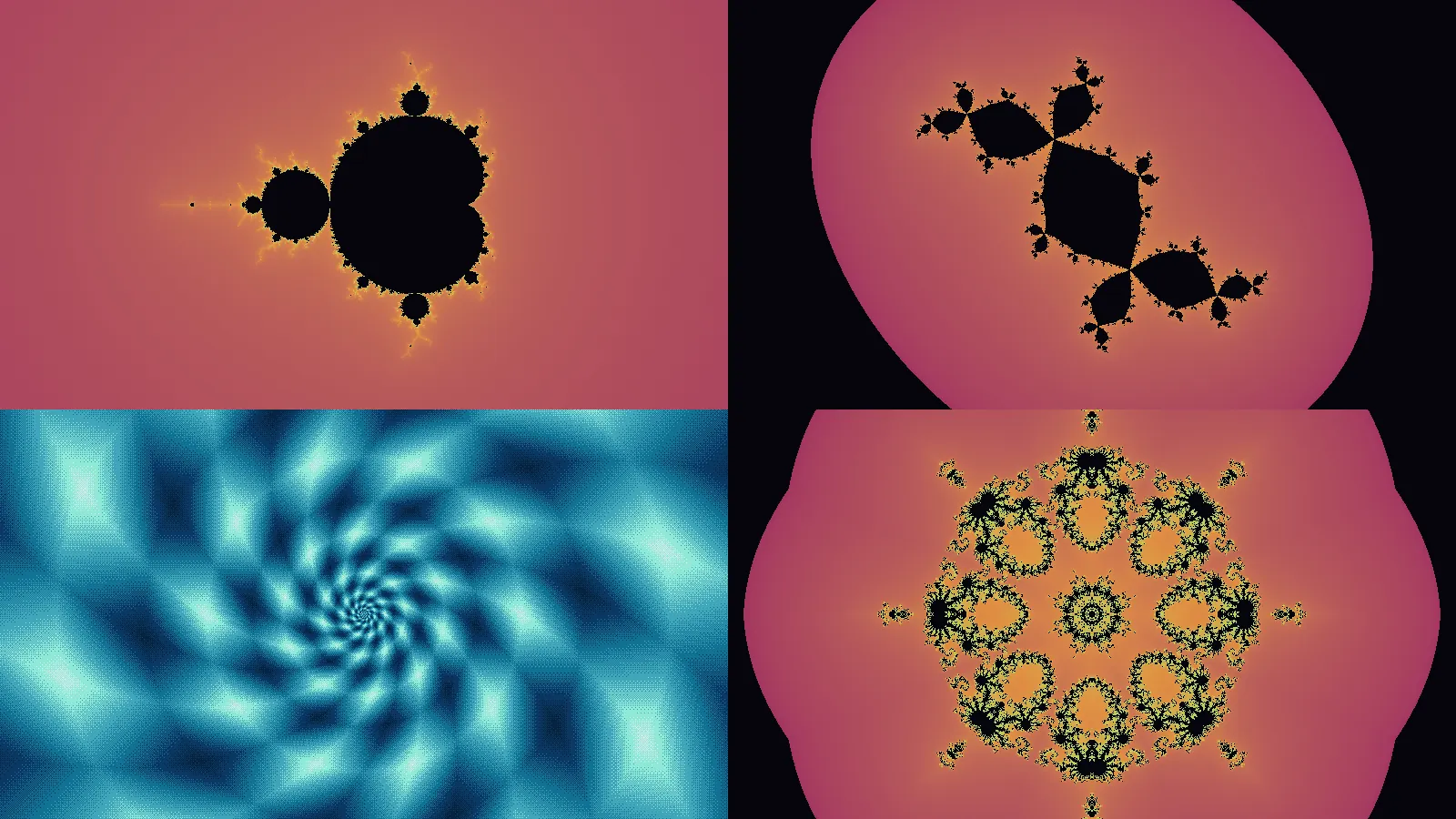
The Douady rabbit is a good Julia set to start with. Every junction repeats the same three-lobed pattern, which is quasi-self-similarity you can check yourself by zooming:
◆ Open in StudioOpen the Douady rabbit Julia setZoom into any junction and you find the same three-lobed pattern again. In Effects, change Seed re or Seed im to get a different Julia set.Self-similar tilings, symmetry, and fractal-like patterns
A lot of patterns look fractal without meeting the strict definition. It helps to know which is which.
A logarithmic spiral tiling is exactly self-similar about its center: zoom in by the right factor and it lands on a copy of itself. That is why the loop below can fall inward forever and return to its first frame. It has no rough boundary, though, so its dimension is an ordinary 2.
◆ Open in StudioOpen Spiral Lattice, a self-similar tilingThe loop zooms inward forever and lands back where it started, because the tiling is a scaled copy of itself.A hyperbolic tiling fits an infinite tiling of the hyperbolic plane inside a circle. The tiles shrink without limit toward the edge, so the picture has detail at every scale near the rim. It is a tiling with a lot of symmetry rather than a fractal in the strict sense.
◆ Open in StudioOpen Hyperbolic BloomAn infinite {7,3} tiling squeezed into a disk. Change p and q in Effects to get a different symmetry.Aperiodic tilings such as the Penrose tiling never repeat, and they can be built by substitution: replace each tile with smaller tiles of the same kinds, again and again. That substitution rule gives them a self-similar hierarchy. The Penrose tiling guide explains the construction.
A kaleidoscope adds mirror symmetry and does not make anything fractal on its own. Apply it to a Julia set, though, and you get a mandala whose edges keep the Julia set's infinite detail.
For a hands-on tour of all of these side by side, open the cool fractals gallery.
Fractals in mathematics and in nature
Mathematical fractals have detail at every scale, all the way down. Natural objects only have it over a limited range. A fern stops branching after a few levels. A coastline stops being jagged at the scale of sand grains. Within that range, though, fractal geometry describes them far better than smooth shapes do.
Common examples of fractal-like structure in nature:
- coastlines, mountain ridges, and river networks
- ferns, trees, and Romanesco broccoli
- lungs and blood vessels, which branch to fill a volume
- lightning, cracks, and frost patterns
- clouds, whose outlines have a measured dimension near 1.35
This is the practical reason fractals matter outside mathematics. They give a way to describe and simulate rough, branching, irregular forms, which is why fractal methods show up in terrain generation for films and games, antenna design, and the analysis of medical images.
How to explore fractals yourself
The fastest way to understand a fractal is to zoom into one. A short routine:
- Open the Mandelbrot set and zoom into any spot on the black boundary. Keep zooming until you find a miniature copy.
- Open a Julia set and change the seed in small steps. Watch the shape go from connected to broken.
- Change the gradient. The color changes the picture, while the mathematical set stays exactly the same.
- Add a transform such as a kaleidoscope or spiral tiling and see how symmetry and self-similarity combine.
Once you have a view you like, the finish effects can turn it into print-style artwork with ordered dithering or a pixel-art filter. For how people turn fractals into finished pieces, prints, and loops, read Fractal Art: When Algorithms Make Pictures.
Every view on this page is calculated live in your browser, and the URL stores the full state. Save it when you find something worth coming back to.
Frequently asked
What is a fractal in simple terms?
A fractal is a shape with detail at every scale. Zoom in on part of it and you find more structure instead of a smooth edge, often including smaller copies of the whole. Most fractals come from repeating one simple rule many times.
Who invented fractals?
Mathematicians studied fractal shapes such as the Cantor set (1883), the Koch curve (1904), and the Sierpinski triangle (1915) long before they had a common name. Benoit Mandelbrot coined the word fractal in 1975, from the Latin fractus, meaning broken, and made the idea widely known.
What are some famous examples of fractals?
The best-known mathematical fractals are the Mandelbrot set, Julia sets, the Koch snowflake, the Sierpinski triangle and carpet, the Cantor set, the dragon curve, and Newton fractals. In nature, coastlines, ferns, river networks, lightning, and Romanesco broccoli have fractal-like structure over a limited range of scales.
What is fractal dimension?
Fractal dimension measures how quickly a shape's detail grows as you measure it more finely. A smooth line has dimension 1 and a filled square has dimension 2. The Koch snowflake's edge has dimension about 1.2619 and the Sierpinski triangle about 1.585, so both sit between a line and a surface.
Are fractals infinite?
A mathematical fractal usually fits inside a finite region but has unlimited detail. The Koch snowflake encloses a finite area with an infinitely long boundary. Real objects stop being fractal at some scale, such as the size of a grain of sand on a coastline.
Can I explore fractals online for free?
Yes. Every Open in Studio link on this page opens an exact view in a free browser tool. You can pan, zoom, recolor, animate, and export without an account or install.
Studio dispatches
New work, new writing — straight to you
Occasional letters from the studio. No spam, unsubscribe anytime.