 PARDESCO
Fractals & coloring
Cool Fractals: Mesmerizing Patterns to Explore Free
A hands-on gallery of spirals, hyperbolic blooms, quasicrystals, Julia sets, and non-repeating tilings. Every pattern is live, editable, and free.
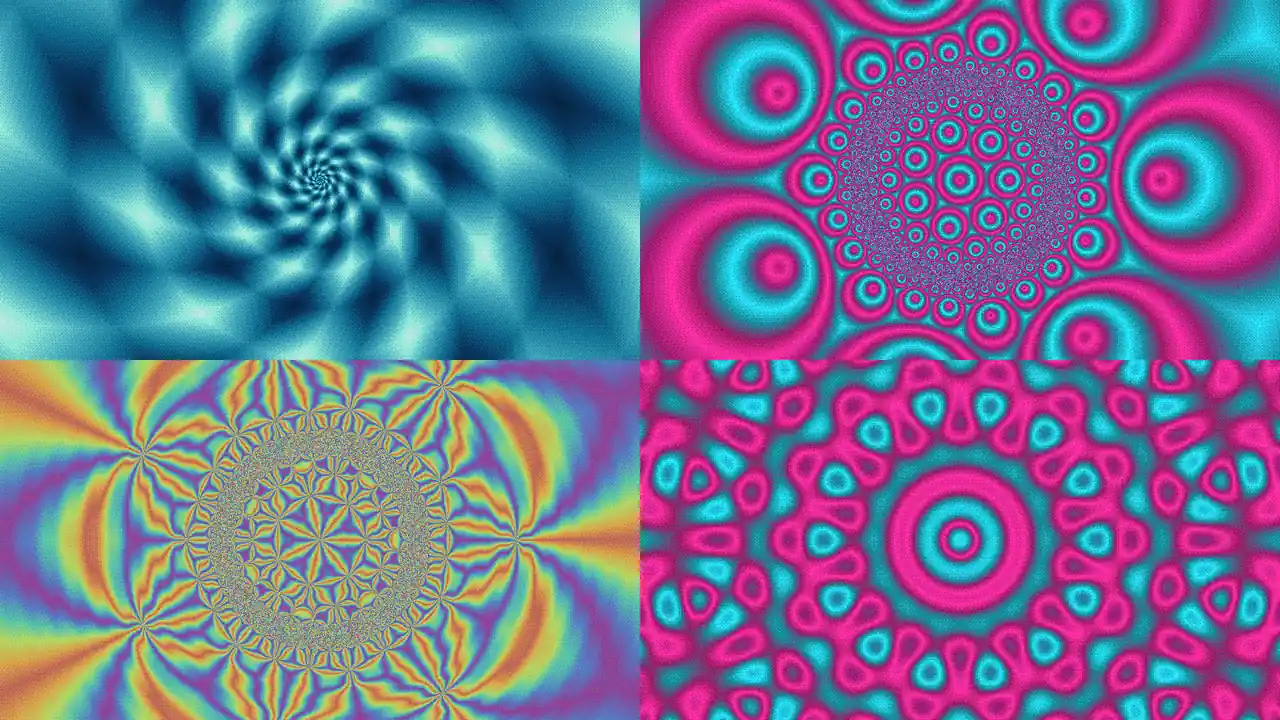
Looking for cool fractals usually means you want pictures first—not a long definition before the gallery. Start anywhere below. Every image opens as a real Studio state you can zoom, recolor, animate, and export.
This collection mixes strict mathematical fractals with related infinite and non-repeating patterns. That distinction matters: a Julia set is an escape-time fractal; a Penrose tiling is aperiodic; a quasicrystal is quasiperiodic. They share the visual pleasure of structure that keeps revealing more than a simple repeating tile.
1. Spiral Lattice: an infinite fractal-like tunnel
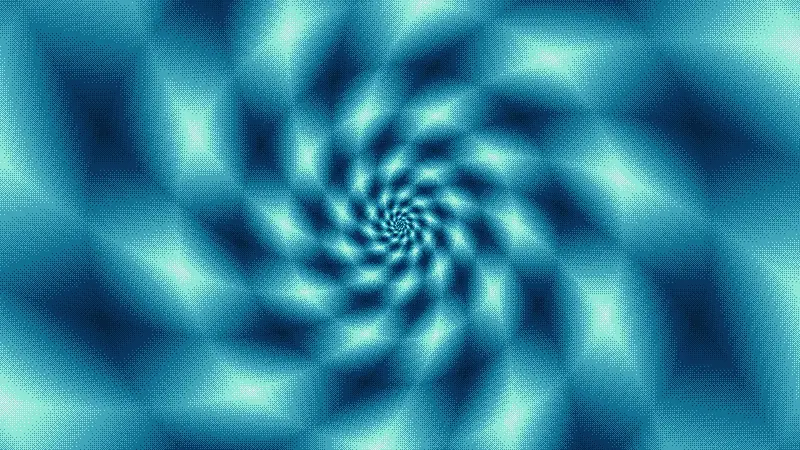
Log-polar tiling turns square distance bands into a spiral that reproduces its layout as the camera moves inward. Ocean color and slow gradient flow give it the feel of an infinite light tunnel.
◆ Open in StudioOpen Spiral LatticeZoom, recolor, or export its built-in seamless loop.2. Hyperbolic Bloom: neon geometry in a Poincaré disk
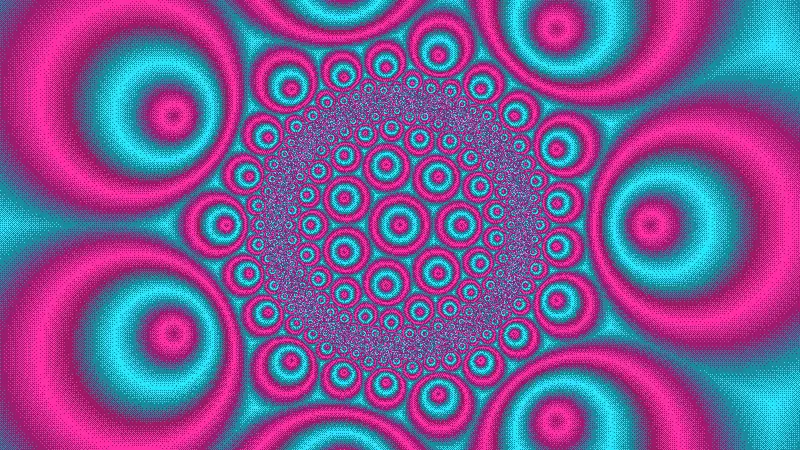
Hyperbolic geometry fits an infinite tiling inside a finite circle. Shapes shrink toward the edge because the disk represents more and more hyperbolic distance in less screen space.
◆ Open in StudioOpen Hyperbolic BloomChange the {p,q} symmetry, ring spacing, or neon gradient.3. Ray Vortex: a trippy rotating fractal
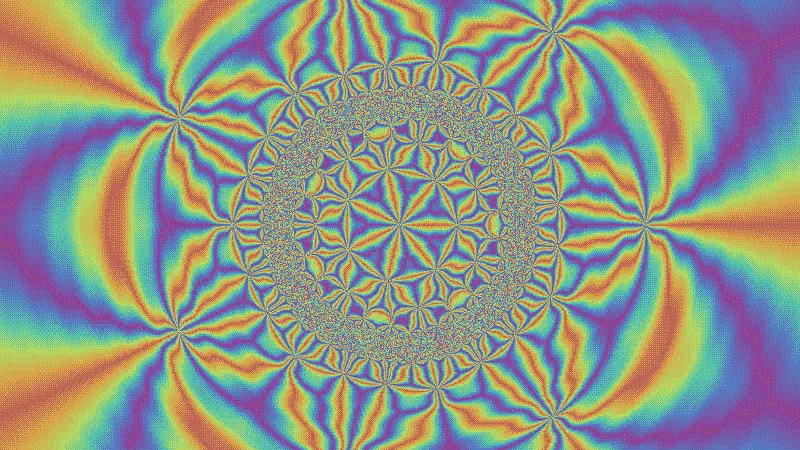
Ray Vortex layers angular repetition, radial ripples, and hyperbolic folding. It is designed for motion: phase and color cycle together so the end state matches the beginning.
◆ Open in StudioOpen Ray VortexA trippy fractal-like loop built from rays, ripples, and hyperbolic folding.4. Interference: seven-fold quasicrystal light
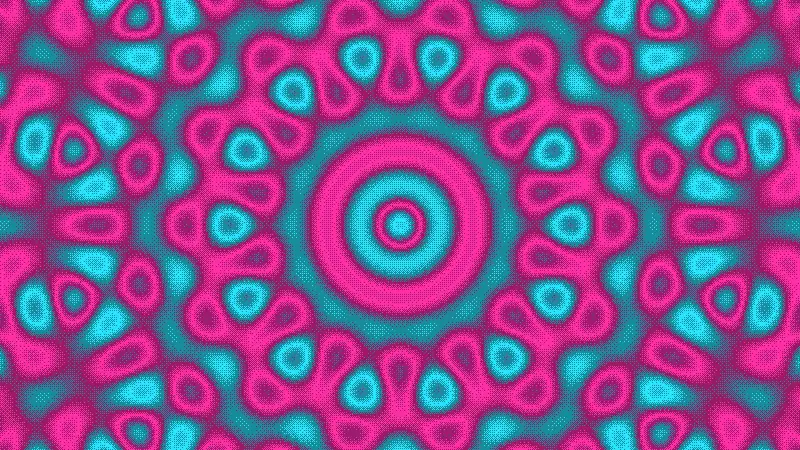
Seven plane waves overlap at evenly spaced angles. Their interference creates local motifs that recur without forming an ordinary repeating grid—a useful bridge between beautiful fractals and crystallographic pattern.
◆ Open in StudioOpen InterferenceAdjust the wave symmetry and phase to make a new quasicrystal.5. Star Weave: an infinite multigrid web
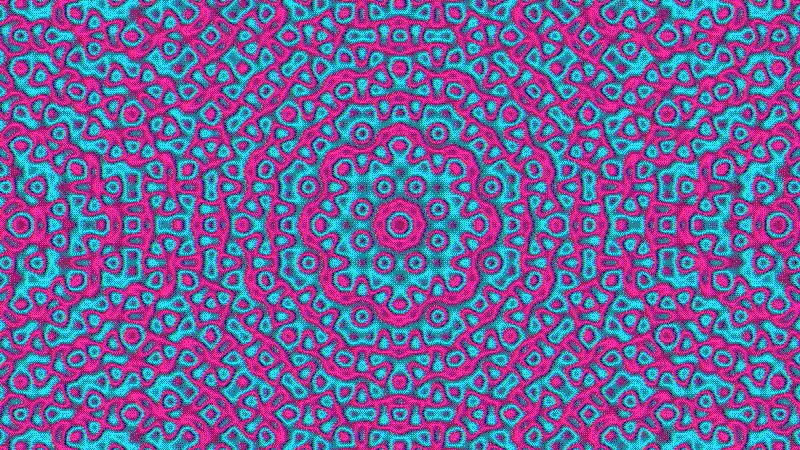
Star Weave uses several families of parallel lines to build a dense eight-fold web. A split-color finish turns the fine geometry into a glowing woven surface.
◆ Open in StudioOpen Star WeaveSlide the multigrid offset and watch the star web reorganize.6. A Julia set that changes with one number
Julia sets come from repeating z² + c. Changing the complex seed c can turn a connected dendrite into separate islands or dust. The interactive Julia set guide includes three exact seeds, original images, and a plain-language explanation of why the shapes change.
7. The Mandelbrot set at its infinite boundary
The Mandelbrot set is the map behind the connected Julia family and the most recognizable fractal in mathematics. Its boundary produces spirals, filaments, and miniature copies at every zoom level. Open the full set and Seahorse Valley in The Mandelbrot Set, Explained.
8. Penrose Ink: order without repetition
Penrose tilings cover the plane with two tile shapes and never repeat periodically. Five-fold rosettes and golden-ratio substitution make them feel fractal even though they are a different mathematical object.
◆ Open in StudioOpen Penrose InkA black-and-paper aperiodic tiling with a living dither finish.The visual guide to Penrose tilings explains the P2 and P3 tile families and their matching rules.
9. Pixel Drift and Ink Spiral
Two finish treatments can make the same infinite spiral feel like completely different artwork:
◆ Open in StudioOpen Pixel DriftA moving infinite spiral quantized into chunky scene-color pixels. ◆ Open in StudioOpen Ink SpiralThe spiral lattice reduced to a stark two-ink print.Pixel Drift keeps the scene's ocean gradient while quantizing it into chunky steps. Ink Spiral removes most color and reads like a moving screen print. For the rendering techniques behind them, compare pixel-art filters and ordered dithering.
What makes these patterns feel infinite?
Different constructions create “infinite” visual depth in different ways:
- Escape-time fractals calculate an orbit for every point and reveal new boundary structure as you zoom.
- Self-similar transforms map a pattern back onto itself at a new scale.
- Hyperbolic folds fit an unbounded geometry into a bounded disk.
- Substitution tilings replace shapes with smaller arrangements of the same families.
- Quasiperiodic fields recur without a finite repeating tile.
That variety is why this is a fractals website rather than a single Mandelbrot viewer. Formula, geometry, color, motion, and finish are independent choices.
Make your own moving fractal loop
Open the pattern closest to what you want, then change one axis at a time:
- Choose the source or field that supplies the base structure.
- Add or edit transforms for spirals, ripples, or hyperbolic symmetry.
- Pick a gradient and adjust its density.
- Add cyclic tracks for rotation, phase, gradient flow, or self-similar zoom.
- Preview the loop before exporting.
The presets are starting points, not locked artworks. Every control remains editable, and the URL preserves the complete state when you find a version worth sharing.
Frequently asked
Where can I explore cool fractals online?
Every design on this page opens in Fractal Zoom Studio, a free browser-based fractal and mathematical-pattern tool. No install or account is required.
Can I change the fractals in this gallery?
Yes. Open any pattern to change its source, transform stack, gradient, coloring, animation, and finish effects. The resulting state can be shared through its URL.
Are all of these patterns technically fractals?
The gallery deliberately includes true escape-time fractals alongside fractal-like recursive tilings, hyperbolic patterns, and quasicrystals. Each card identifies the construction instead of labeling every mathematical pattern as the same thing.
Can these moving fractals loop seamlessly?
The featured presets use cyclic parameter tracks designed to return to their starting state. You can preview them in the Studio and export the animation as a seamless MP4 loop.
What makes a fractal look beautiful or trippy?
Repeated structure, scale changes, symmetry, sensitive motion, and color contrast all contribute. The formula or field supplies structure; transforms, gradients, and animation determine the final visual character.
Studio dispatches
New work, new writing — straight to you
Occasional letters from the studio. No spam, unsubscribe anytime.