 PARDESCO
Fractals & coloring
Newton Fractal: Roots, Basins and Boundaries
Start Newton's method at every point in the complex plane and color each point by the root it reaches. For z³ − 1, the three colors meet on a fractal boundary.
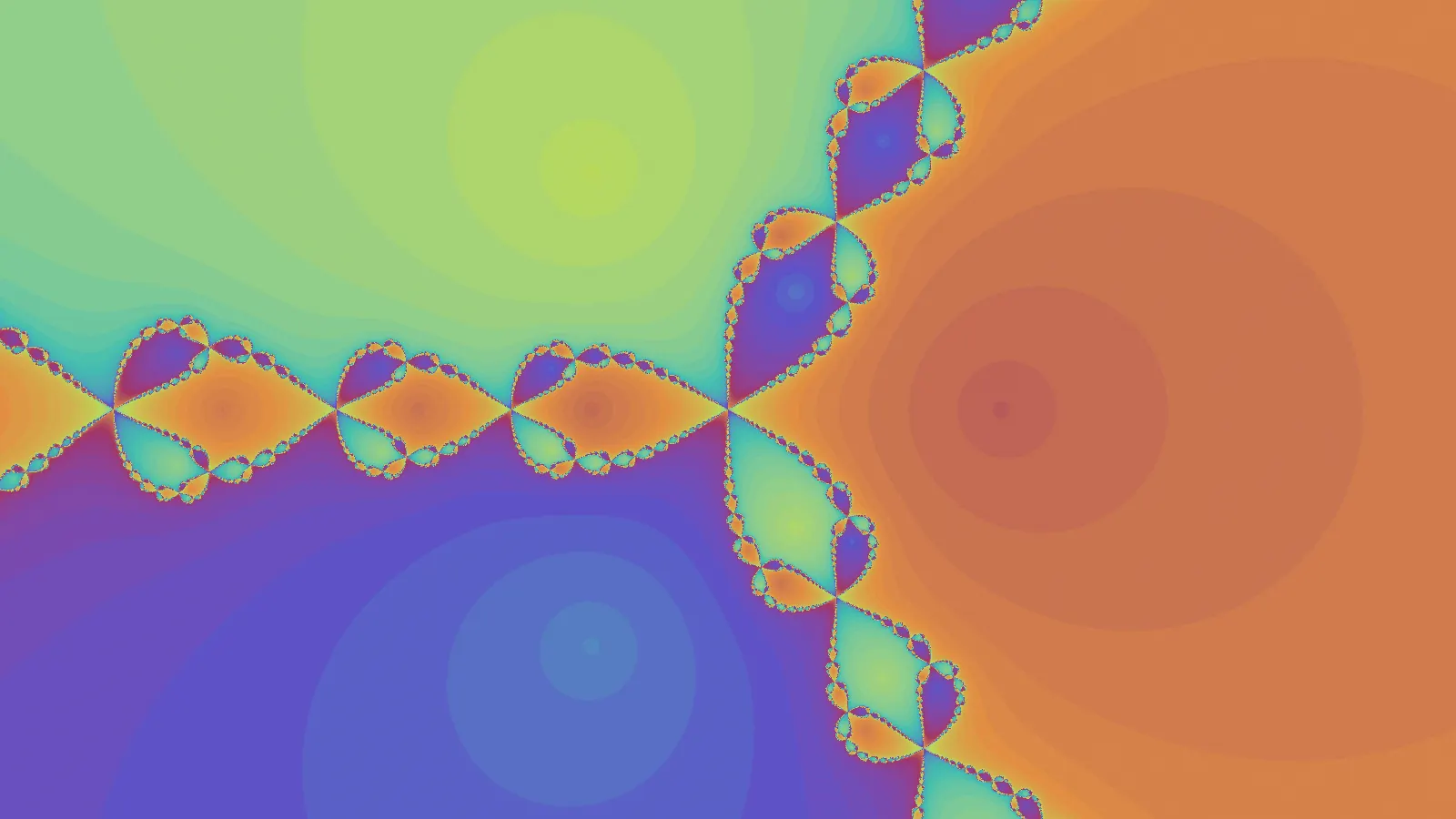
A Newton fractal colors each starting point by the root that Newton's method reaches. With real numbers, the answer is usually straightforward. In the complex plane, the equation z³ − 1 = 0 has three solutions. Color every point by the solution it reaches and the three regions meet along branching chains of beads.
◆ Open in StudioOpen the Newton fractal for z³ − 1Each color is one root. Lighter and darker shades show how many steps a point needed.Newton's method
Newton's method finds a root of a function f by following a tangent line from one guess to the next. Starting at z, the next guess is:
z → z − f(z) / f′(z)
Near a simple root, the error roughly squares at each step: 0.1 becomes about 0.01, then 0.0001, then 0.00000001. This quadratic convergence makes the method useful in calculators and physics engines.
For f(z) = z³ − 1, the derivative is f′(z) = 3z². The step becomes:
z → (2z³ + 1) / (3z²)
The three roots are the cube roots of 1: 1 and −1/2 ± (√3/2)i. They sit evenly spaced on the unit circle, 120° apart.
Basins of attraction
Every starting point that converges to a root belongs to that root's basin of attraction. The Studio's Newton source runs the step for each pixel. It chooses a color band from the root reached and shifts the shade according to the number of steps.
Points right next to a root converge in a few steps and show one flat shade. Points farther out take longer, producing lighter and darker rings inside each basin. A point that never settles gets a single fallback color.
Near a root, its basin is a large solid region. The boundary between basins has much finer structure.
Why the boundary is fractal
Arthur Cayley worked out the quadratic case in 1879. For a polynomial with two distinct roots, the plane splits into two half-planes along their perpendicular bisector. Cayley noted that the cubic case looked much harder.
For z³ − 1, the boundary is the Julia set of the Newton step map. Any disk centered on it, however small, contains points from all three basins. An edge between two colors is also an edge of the third; no clean line separates only two colors.
This is the Wada property, named after the "Lakes of Wada" topology example of three regions with a common boundary. It gives the Newton fractal its beads: where two basins appear to meet, smaller beads of the third color lie between them. Those beads contain smaller beads.
Near the boundary, the Newton map magnifies small regions. After a few steps, a tiny disk spreads across most of the plane and contains points headed to every root. Tracing the map backward shows why even a tiny disk on the boundary already holds points from all three basins.
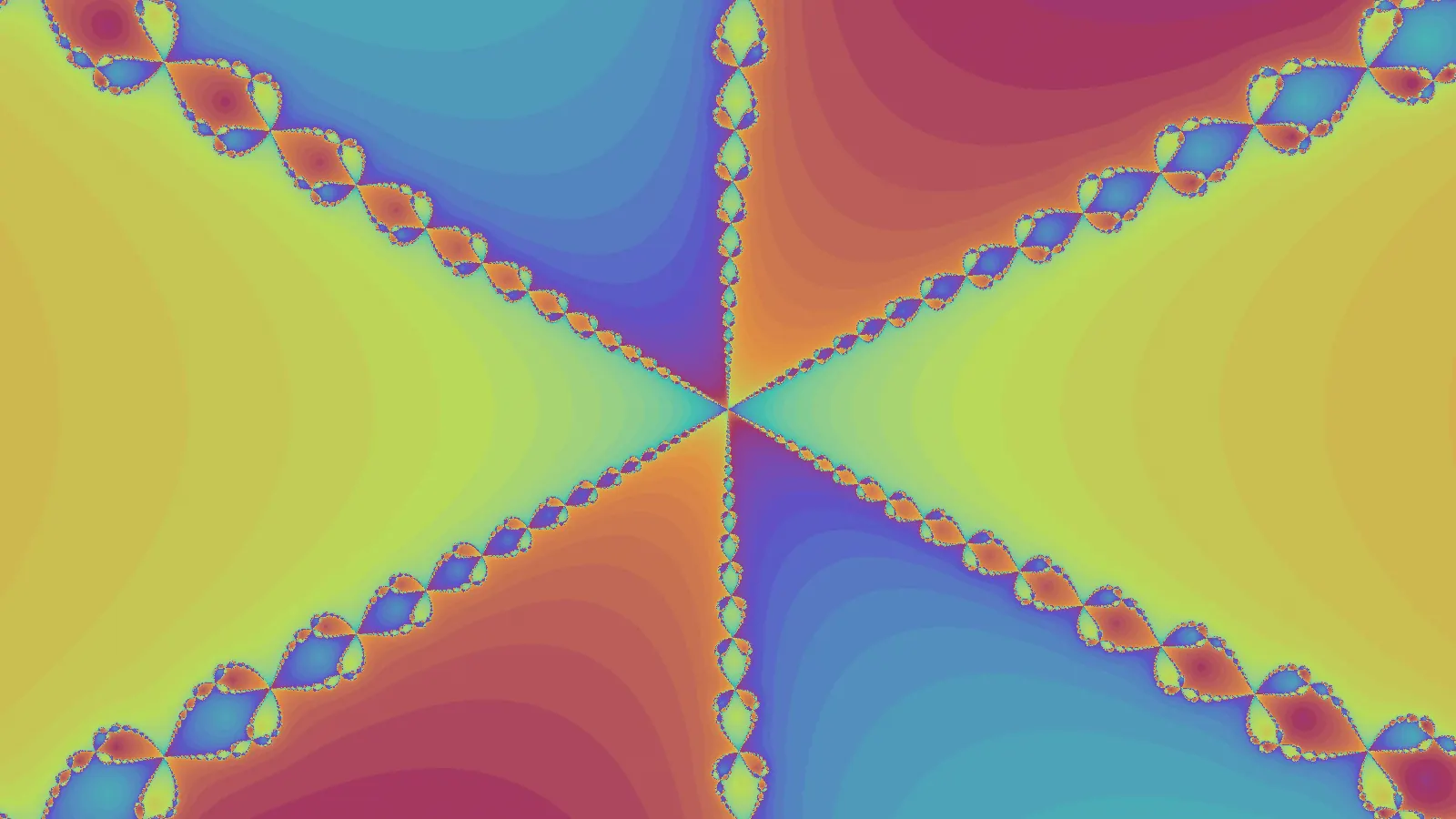
◆ Open in StudioZoom into a point where all three basins meetCentered on the real cube root of −1/2. Keep zooming: the same meeting pattern repeats.The zoom above centers on z ≈ −0.7937, the real cube root of −1/2. The step map sends that point exactly to 0. There, f′(z) = 0, so the next step divides by zero. Points that eventually land on 0 lie densely along the boundary. Zooming into one reveals the three-way meeting pattern again.
The relaxation parameter
Relaxed Newton's method scales every step by a factor a:
z → z − a · f(z) / f′(z)
At a = 1, this is the standard method. Near a simple root, the error is multiplied by about (1 − a) each step:
For 0 < a < 2, |1 − a| is less than 1, so the method still converges near each root. Only a = 1 keeps quadratic convergence; every other value converges linearly, by a steady fraction per step.
Below 1, the steps are damped. Points take longer to converge, more shading rings appear, and the bead chains along the boundary thin out. Above 1, the steps overshoot the root and correct from the other side, swelling the boundary into broad, lacy regions.
For a root of multiplicity m, standard Newton's method slows to linear convergence. Setting a = m restores the quadratic rate.
The Studio's Relaxation slider runs from 0.5 to 2:
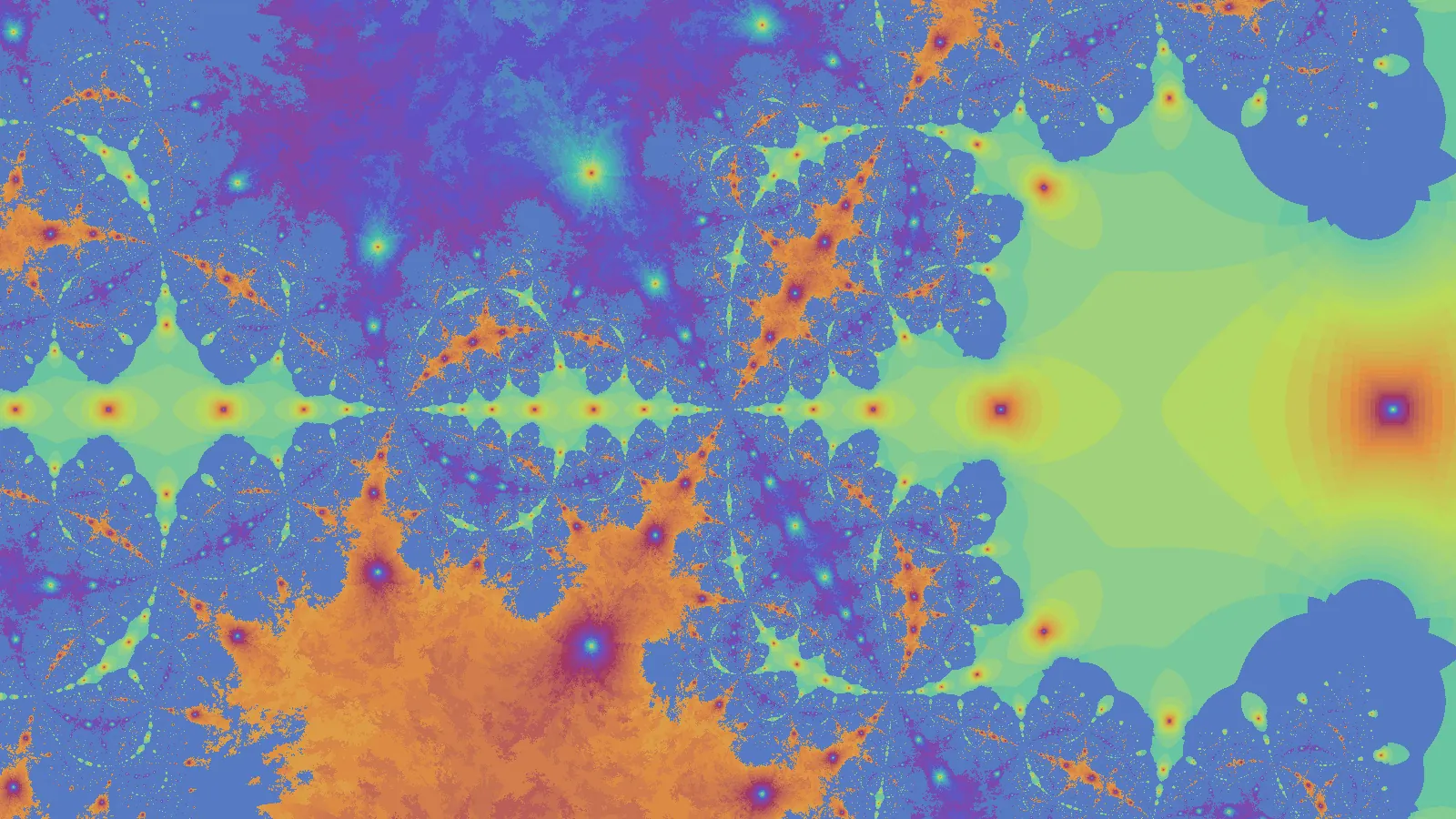
◆ Open in StudioSee z³ − 1 with relaxation 1.5Drag Relaxation between 0.5 and 2 and watch the basin boundaries swell and fray.Near 2, each step lands almost as far on the other side of the root as it started. Convergence becomes very slow, and iteration counts vary sharply between neighboring pixels. Smooth shading breaks into speckle:
Higher degrees: zⁿ − 1
The Studio's Degree control sets n in zⁿ − 1 from 3 to 8. Its roots are the n-th roots of unity, evenly spaced on a circle. The picture has n-fold rotational symmetry and, because the polynomial has real coefficients, mirror symmetry across the real axis.
Each extra root adds another basin and another arm of boundary. At degree 5 the arms look like petals:
◆ Open in StudioOpen Newton Petals (z⁵ − 1)Five roots, five basins, with the roots rotating one full turn per seamless loop.The Newton Petals preset adds a loop track to Rotation. It turns the roots one full revolution per loop. The pattern repeats every 1/5 of a turn, so the loop is seamless and exports as MP4 or WebM.
At degree 8 the boundary arms thicken into bands where the eight colors cycle in order:
◆ Open in StudioOpen the Newton fractal for z⁸ − 1Eight roots on the unit circle. The boundary arms thicken into bands of alternating colors.Controls
- Degree picks n in zⁿ − 1.
- Relaxation is the step factor a.
- Rotation turns the roots around the center.
- Scale sets the distance from the center to the roots, in world units.
The Newton source produces a field that the gradient maps directly. At density 1, each root gets an equal slice of the palette. Changing the gradient's rotation reassigns colors; raising its density adds more convergence rings inside each basin.
Related reading
The boundary in each Newton fractal here is the Julia set of its Newton step map; Julia sets explains the connection. Mandelbrot set covers an escape-time fractal, and cool fractals has more examples to try in the same Studio.
Frequently asked
What is a Newton fractal?
A Newton fractal colors each point of the complex plane by the root that Newton's method reaches when it starts there. The regions of each color are basins of attraction, and the boundary between them is a fractal.
Why does the z³ − 1 Newton fractal have a branching boundary?
Near the boundary, repeated Newton steps stretch a tiny region until it covers points headed to every root. Any small disk on the boundary contains points of all three basins, so detail continues at every scale.
What is the Wada property in Newton fractals?
It means every boundary point of one basin is also a boundary point of all the others. For z³ − 1 the three basins share a single common boundary, so you never find a stretch of edge that separates only two colors.
What does the relaxation parameter do?
Relaxed Newton's method multiplies each step by a factor a. At a = 1 it is the standard method with fast quadratic convergence. Other values in the range 0 to 2 still converge near a simple root, but more slowly, and the basin shapes change.
Does the quadratic z² − 1 give a Newton fractal?
No. Arthur Cayley showed in 1879 that for a quadratic with two distinct roots, the basins are two half-planes split by a straight line. Fractal boundaries start with cubics such as z³ − 1.
Studio dispatches
New work, new writing — straight to you
Occasional letters from the studio. No spam, unsubscribe anytime.