 PARDESCO
Aperiodic tilings & tessellation
Wallpaper Groups: All 17 Symmetries of a Pattern
Wallpaper, tiled floors, fabric prints and Islamic star patterns repeat in 17 distinct ways. Apply each wallpaper group to the same fractal motif to compare their symmetries.
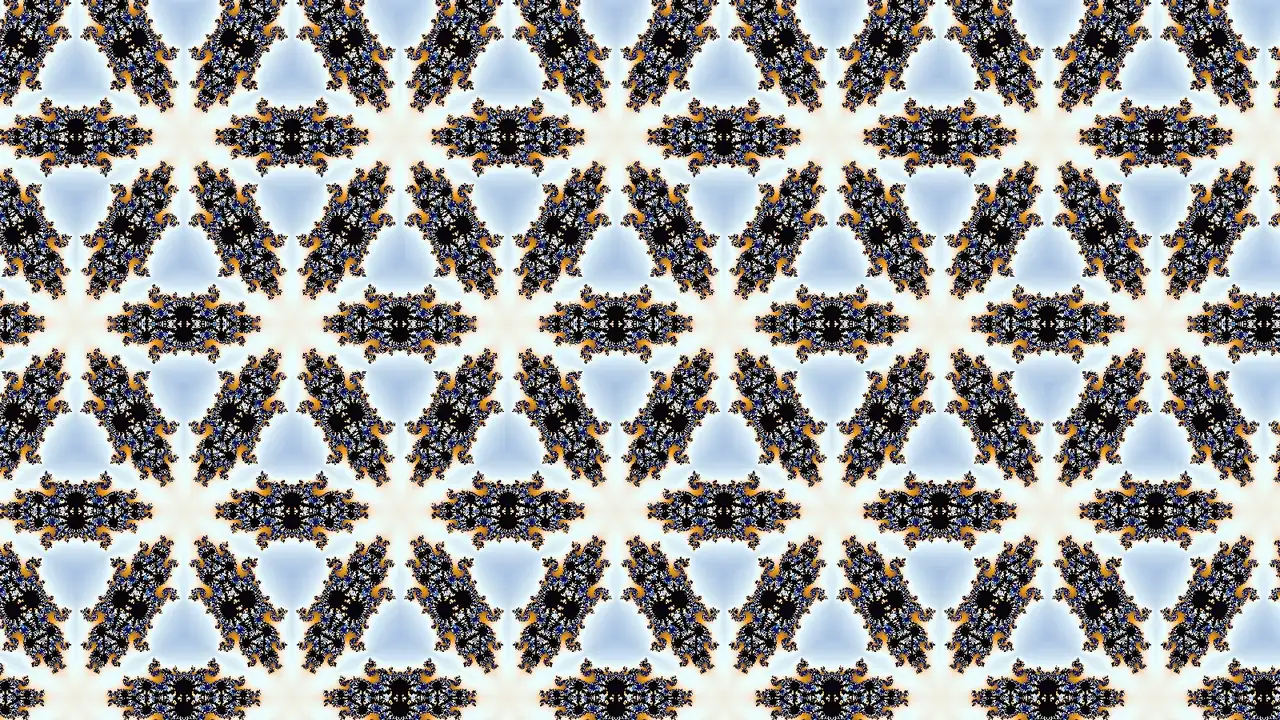
Every pattern that repeats across a flat plane belongs to one of 17 wallpaper groups. A group lists the moves that carry a pattern onto itself: slides, turns, reflections and glides. Bathroom tiles and printed fabric can use different motifs yet have the same group. The same motif can also be arranged into different groups.
The examples here use one asymmetric motif, a patch of the Julia set for c = −0.8 + 0.156i. Changing the group changes its arrangement.
◆ Open in StudioStart with p1: one Julia motif, translated onlyOpen Operators and change the Wallpaper Symmetry group. The motif stays the same, only the symmetry changes.The four symmetry moves
A symmetry is a rigid motion that leaves a pattern unchanged. Four kinds occur in the plane:
- Translation. Slide the pattern a fixed distance in a fixed direction. Every wallpaper pattern has translations in two independent directions. A single rosette or strip lacks this two-directional repetition.
- Rotation. Turn the pattern about a point by 1/n of a full turn. The point is a rotation center of order n.
- Reflection. Flip the pattern across a mirror line.
- Glide reflection. Flip across a line and then slide along it. The slide is part of the move, so the glide line is not a mirror by itself.
The two translations define a lattice, the grid of points reached by repeating them. Its smallest repeating parallelogram is the unit cell. The five lattice shapes are oblique, rectangular, centered rectangular (rhombic), square and hexagonal.
The first example is p1, which has translations alone. Every spiral points the same way.
Glide reflections
Footprints on a beach illustrate a glide reflection. Left and right prints are mirror images, each shifted half a stride along the walking line. A flip followed by a slide maps the trail onto itself; a mirror alone does not.
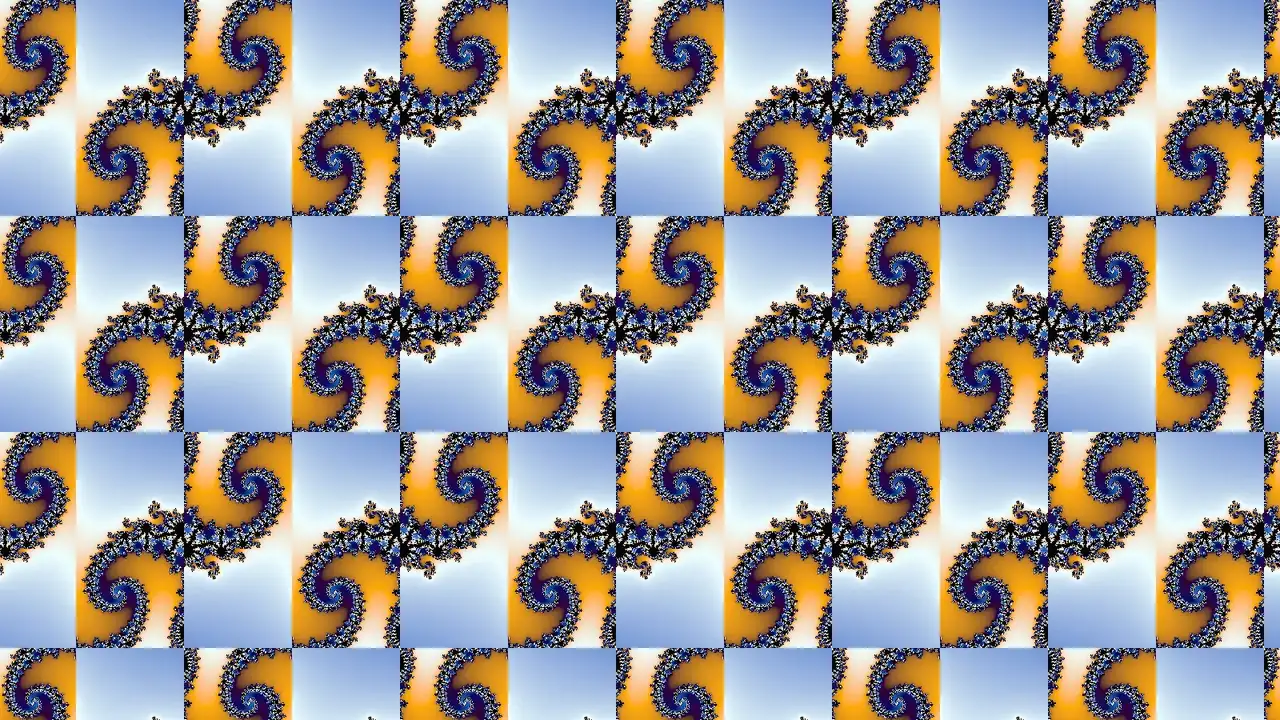
The pg group has translations and parallel glide reflections:
◆ Open in StudioSee a glide reflection (pg)Alternate rows are left-right mirror images. A flip and a half-row vertical slide map each row onto the next.Only 2-, 3-, 4- and 6-fold rotations
A rosette can have any number of arms. On a repeating lattice, rotation centers have order 2, 3, 4 or 6. This is the crystallographic restriction.
The short proof uses the lattice. A rotation that maps the lattice onto itself can be written as a matrix with integer entries in the lattice basis, so its trace is an integer. The trace of a rotation by angle θ is 2 cos θ, and the only angles with 2 cos θ an integer between −2 and 2 are full turns, half turns, third turns, quarter turns and sixth turns.
This rules out tilings by regular pentagons. Five-fold symmetry appears in non-repeating patterns such as Penrose tilings and quasicrystals.
Mirrors also distinguish the groups. Compare p4m, with quarter-turns and mirror lines, with p6, which has six-fold turns and no mirrors:
◆ Open in StudioOpen the same motif with p4m symmetryQuarter-turns plus mirrors. Rotation is 0°, so the Seamless tile PNG and tile heightmap exports work. ◆ Open in StudioCompare p6: six-fold turns, no mirrorsIn p6, every pinwheel spins the same way. In p6m, pinwheels pair with their mirror images.In p6, every pinwheel spins the same way. Switch to p6m and some spin the other way because the group includes mirrors. The hero image uses p6m.
Reading the names: IUC and orbifold notation
Each group has an International (IUC) name used in crystallography and an orbifold name introduced by John Conway. The IUC name starts with p for a primitive cell or c for a centered cell. The next digit gives the highest rotation order; m marks a mirror and g a glide. For example, p4g has four-fold rotation and glides in its first symmetry direction instead of mirrors.
Orbifold notation describes the pattern folded down to one copy of its motif:
- A digit before a star is a rotation center that no mirror passes through.
- A star (*) marks mirror lines.
- Digits after the star mark points where mirrors meet at angles of 180°/n.
- An x marks a glide reflection with no mirror nearby.
- An o means translations only.
The name *632 (p6m) has mirrors meeting at 6-, 3- and 2-fold points. The name 632 (p6) has the same rotations without mirrors.
All 17 wallpaper groups
| IUC | Orbifold | Lattice | Rotation orders | Mirrors | Glides |
|---|---|---|---|---|---|
| p1 | o | oblique | none | no | no |
| p2 | 2222 | oblique | 2 | no | no |
| pm | ** | rectangular | none | yes, parallel | no |
| pg | xx | rectangular | none | no | yes, parallel |
| cm | *x | rhombic | none | yes, parallel | yes |
| pmm | *2222 | rectangular | 2 | yes, two directions | no |
| pmg | 22* | rectangular | 2 | yes, one direction | yes |
| pgg | 22x | rectangular | 2 | no | yes, two directions |
| cmm | 2*22 | rhombic | 2 | yes, two directions | yes |
| p4 | 442 | square | 4, 2 | no | no |
| p4m | *442 | square | 4, 2 | yes, four directions | yes |
| p4g | 4*2 | square | 4, 2 | yes, two directions | yes |
| p3 | 333 | hexagonal | 3 | no | no |
| p3m1 | *333 | hexagonal | 3 | yes, three directions | yes |
| p31m | 3*3 | hexagonal | 3 | yes, three directions | yes |
| p6 | 632 | hexagonal | 6, 3, 2 | no | no |
| p6m | *632 | hexagonal | 6, 3, 2 | yes, six directions | yes |
Several groups differ by where their mirrors or glides fall:
- p3m1 and p31m both have three-fold turns and mirrors in three directions. Every rotation center in p3m1 lies on a mirror; some in p31m sit between mirrors.
- p4m and p4g both have four-fold turns. In p4m, the four-fold centers lie on mirrors. In p4g, they do not, and the pattern looks like a woven pinwheel.
- pmg and pgg both have half-turns. pmg has mirrors in one direction and glides in the other; pgg has only glides.
Russian crystallographer Evgraf Fedorov proved in 1891 that the list is complete. George Pólya independently rediscovered it in 1924.
How the Studio builds each group
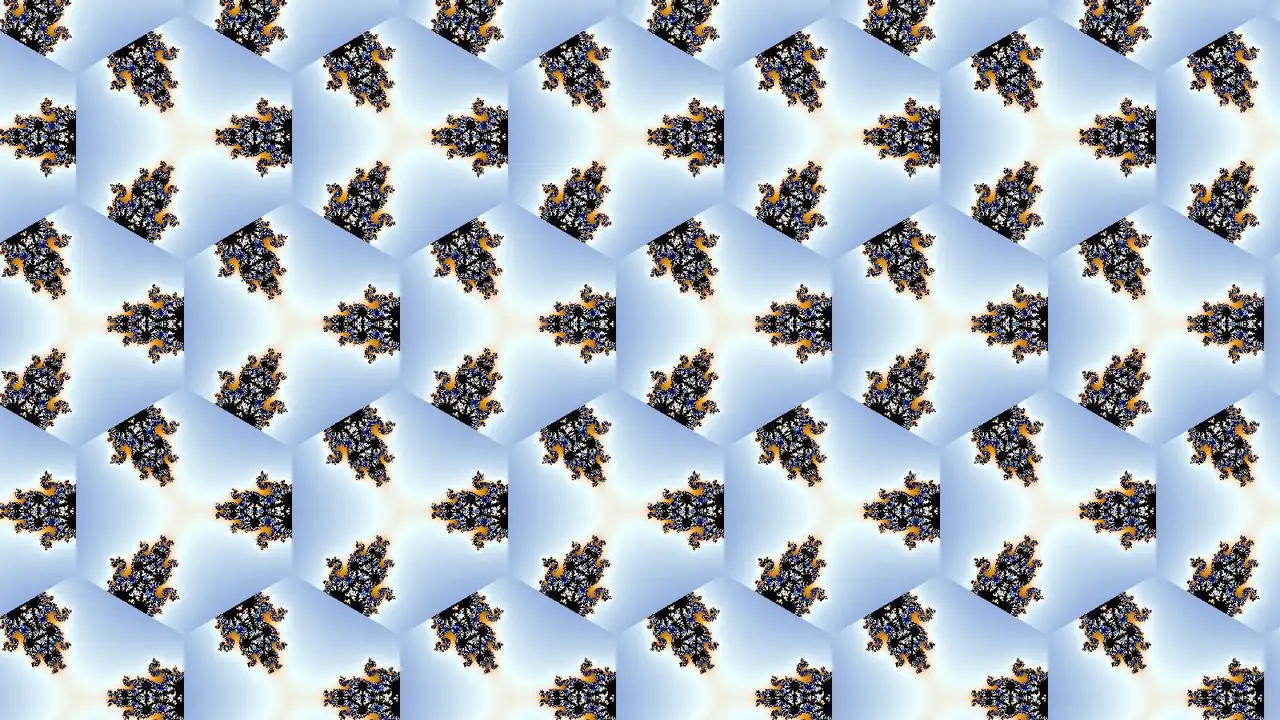
The Wallpaper Symmetry operator finds the lattice cell for each pixel and folds the pixel into the chosen group's fundamental region. This is the smallest piece of a cell that the group's moves copy across the plane. The source, here a Julia set, is sampled inside that region, so the result follows the selected symmetry exactly.
- Group picks one of the 17, in the order of the table above.
- Cell size sets the lattice spacing in world units.
- Rotation turns the whole lattice.
- The operator's center selects the part of the source used as the motif. Moving it shows a different fractal patch under the same symmetry.
Groups with square, rectangular or rhombic lattices use a square cell, a special case of each lattice. The five three- and six-fold groups use a hexagonal cell. The source can be Voronoi cells, Truchet tiles or a Mandelbrot patch in place of the Julia set. You can also add operators after the wallpaper fold, such as a kaleidoscope or a noise warp.
Seamless tiles for textiles, tiles and CNC panels
A wallpaper pattern repeats exactly; one period makes a seamless tile. The Export section has two buttons for this. They work when Wallpaper Symmetry is the first operator in the stack and its rotation is a multiple of 90°:
- Seamless tile PNG renders one exact lattice period. Square-lattice groups produce a square tile. Hexagonal groups produce a 1 × √3 rectangle, sized so the irrational side lands within a fraction of a pixel. The tile can be used for fabric printing, wallpaper, game textures or ceramic artwork.
- Tile heightmap 16-bit saves the same period as a height field, with tool smoothing that wraps around the edges. In CAM software, it can make a repeating carved panel; it can also serve as a displacement map.
Regular exports work on these patterns too: PNG prints up to 24 × 36 in at 300 DPI, seamless MP4 or WebM loops, and the Relief section's STL, heightmap and SVG outputs.
Islamic star patterns
Geometric star patterns in Islamic art appear on tilework, carved wood and plaster from Spain to Central Asia. They are among the best-known architectural wallpaper patterns. Many can be drawn with a method E. H. Hankin described in the 1920s: start with a polygon tiling, send two rays from each edge's midpoint at a chosen contact angle, and stop each ray where it meets another.
The Studio's Islamic Star Pattern source applies Hankin's method to three tilings. A tiling of octagons and squares produces eight-pointed stars with p4m symmetry:
◆ Open in StudioOpen an 8-pointed Islamic star patternBuilt with Hankin's method on a tiling of octagons and squares. Try the Contact angle and Lattice controls.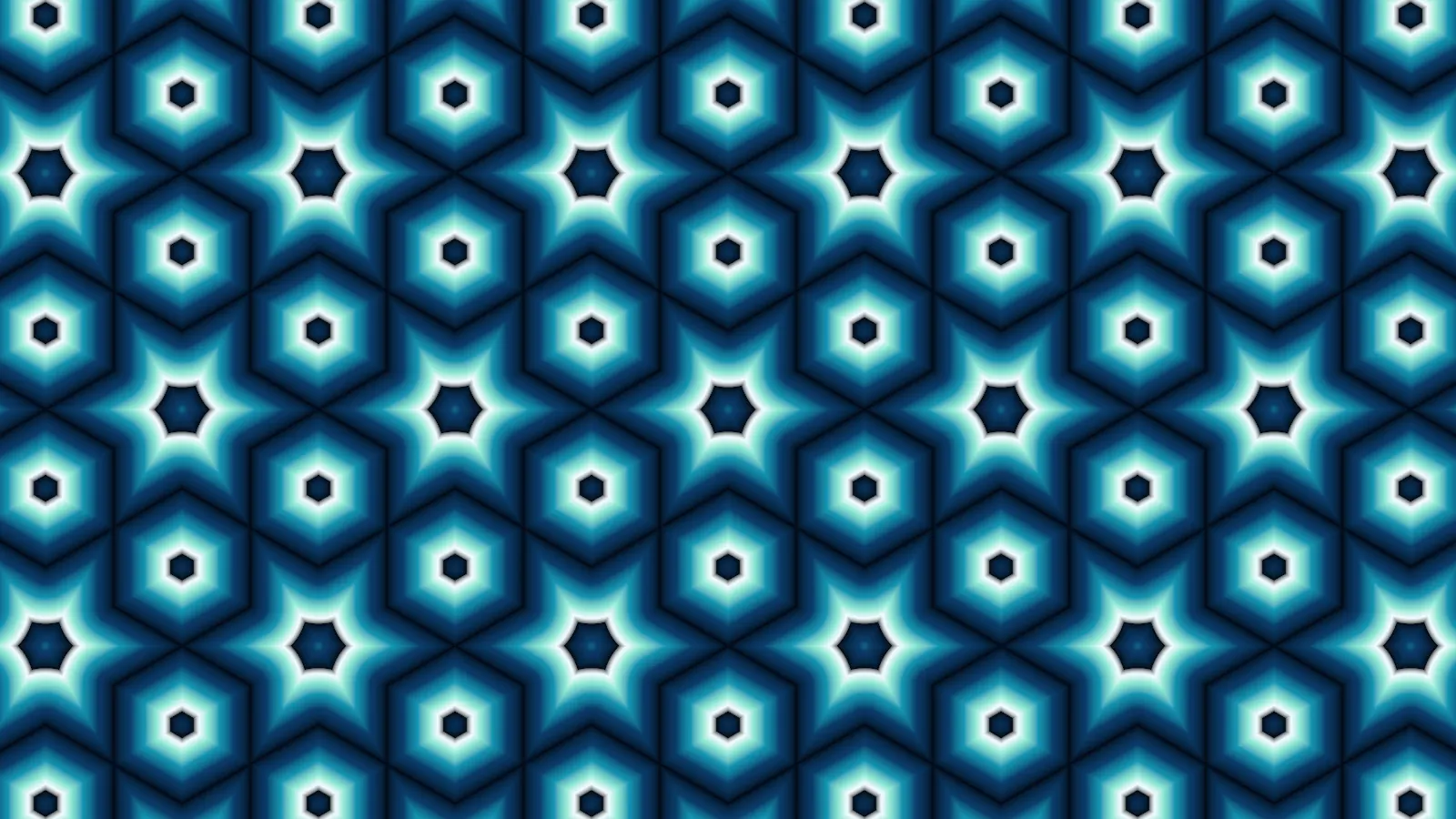
The hexagonal lattice produces six-pointed stars with p6m symmetry; the square lattice produces four-fold star-and-cross designs. Changing the Contact angle reshapes the stars from blunt to sharp while keeping the symmetry.
Related reading
Penrose tiling covers a non-repeating pattern with five-fold symmetry. The fractal kaleidoscope guide covers rosettes with any number of mirrors around one point. Fractal art shows more ways to combine sources and operators into finished pieces.
Frequently asked
What are the 17 wallpaper groups?
They are the 17 distinct ways a pattern can repeat across a flat plane in two independent directions. Each group is a combination of translations with some set of rotations, mirror reflections and glide reflections. Evgraf Fedorov proved in 1891 that there are exactly 17.
Why can't a repeating pattern have five-fold symmetry?
Rotations that preserve a lattice must have order 1, 2, 3, 4 or 6. This is the crystallographic restriction. Five-fold and seven-fold symmetry can appear in non-repeating patterns such as Penrose tilings, but never in a periodic one.
What is a glide reflection?
A glide reflection mirrors the pattern across a line and then slides it along that same line. Footprints in sand are the usual example: left and right prints are mirror images, offset by half a stride.
What do names like p4m and *442 mean?
p4m is the International (IUC) name: p for a primitive cell, 4 for the highest rotation order, m for mirrors. *442 is Conway's orbifold name: the star marks mirrors, and 4, 4, 2 are the orders of the rotation points where mirrors meet.
How do I make a seamless repeating pattern with a wallpaper group?
In the Studio, add Wallpaper Symmetry as the first operator and keep its rotation at a multiple of 90°. The Export section then saves one exact period as a Seamless tile PNG, or as a 16-bit tile heightmap for CNC and relief work.
Studio dispatches
New work, new writing — straight to you
Occasional letters from the studio. No spam, unsubscribe anytime.