 PARDESCO
Fractals & coloring
Fractal Kaleidoscope: Mandalas From Infinite Detail
Fold a slice of the Mandelbrot set between two mirrors and it becomes a mandala. See how the fold works, how the segment count changes the result, and how to turn it into a loop.
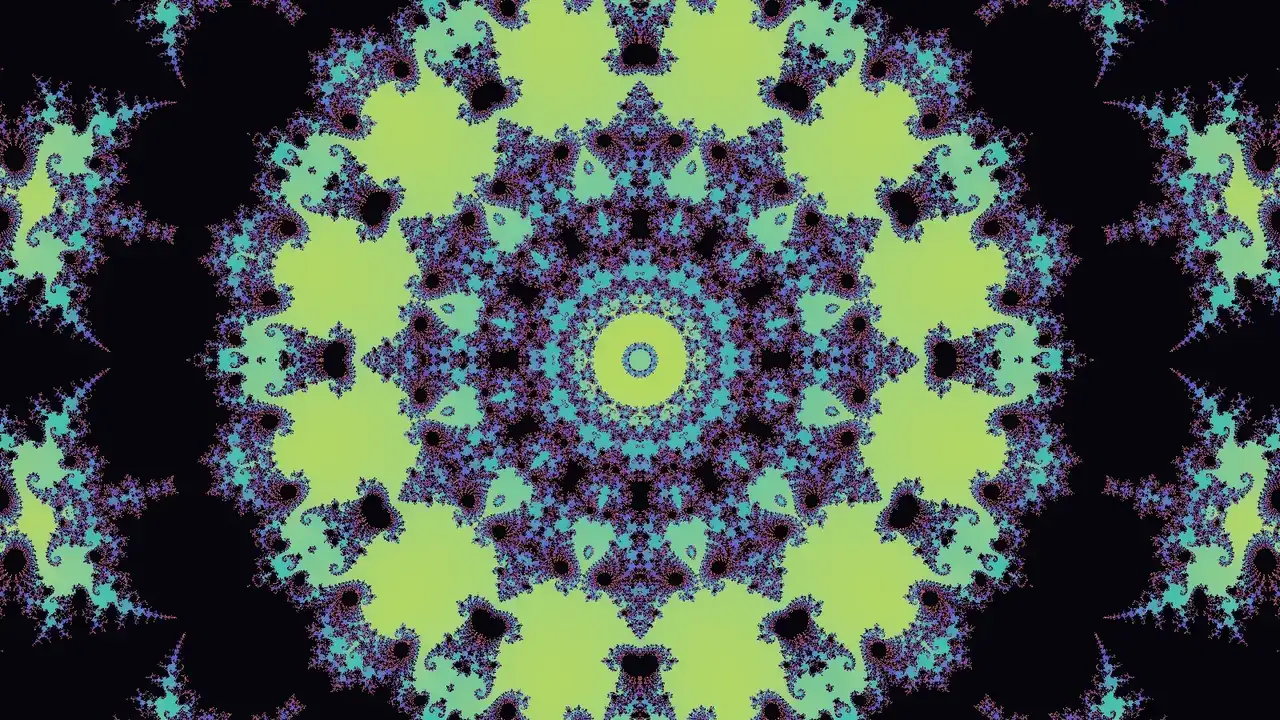
A kaleidoscope is two mirrors set at an angle. Whatever sits in the gap between them gets copied around the center, alternately flipped, until it fills a full circle. Put a fractal in that gap and you get a fractal kaleidoscope: the exact symmetry of a mandala with the endless edge detail of the Mandelbrot set packed into every petal.
The demo below is the Mandelbrot set near Seahorse Valley, folded into twelve segments. Nothing was drawn by hand. Every pixel is calculated from the same formula as the plain set, after a fold that moves it into one thin wedge.
◆ Open in StudioOpen the twelve-fold Mandelbrot kaleidoscopeChange Segments in the Kaleidoscope layer under Operators, or drag the view to fold a different part of the set.How the kaleidoscope fold works
For each pixel, the Kaleidoscope layer does three things before the fractal formula runs:
- Measure the pixel's angle around the layer's center.
- Wrap that angle into one segment. With 12 segments, each one is 30 degrees.
- If Mirror is on and the angle lands in the second half of the segment, reflect it back into the first half.
The formula then evaluates the folded point. So a twelve-fold mandala shows only a 15-degree slice of the Mandelbrot set, repeated 24 times: 12 copies plus 12 mirror images. Because the fold happens to coordinates rather than to a finished picture, nothing gets stretched or resampled. Zoom in and the calculation runs again at the new scale, with new detail inside each petal.
Two controls decide which slice you see:
- The layer's center. It starts at the middle of the view. Drag the view before adding the layer and you fold a different neighborhood of the set.
- Rotation. This moves the wedge around the center, which picks a different slice from the same neighborhood.
The demo sits close to a boundary point of the Mandelbrot set, so its wedge mixes dark interior bulbs with escaping spirals. That contrast is what makes the result read as a mandala. A wedge that is entirely inside the set folds into a flat dark disk, and one far outside folds into plain color bands.
Six-fold vs twelve-fold symmetry
The segment count changes the character of a mandala fractal more than any other setting. Here is the same view folded two ways:
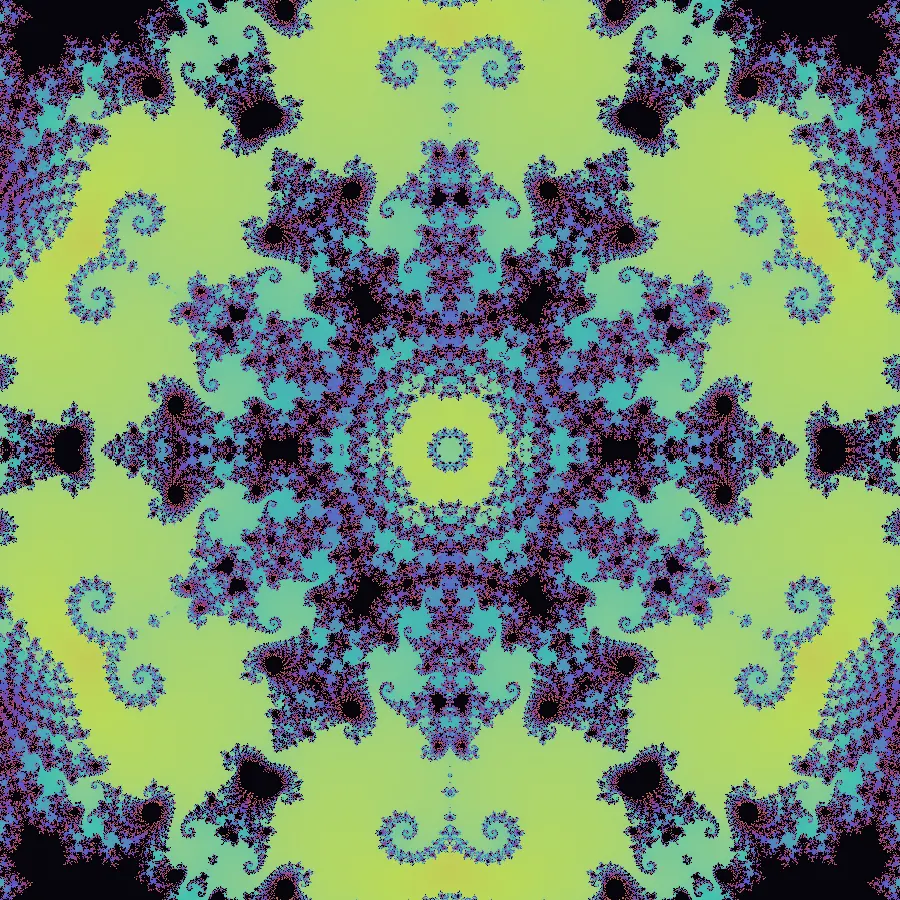
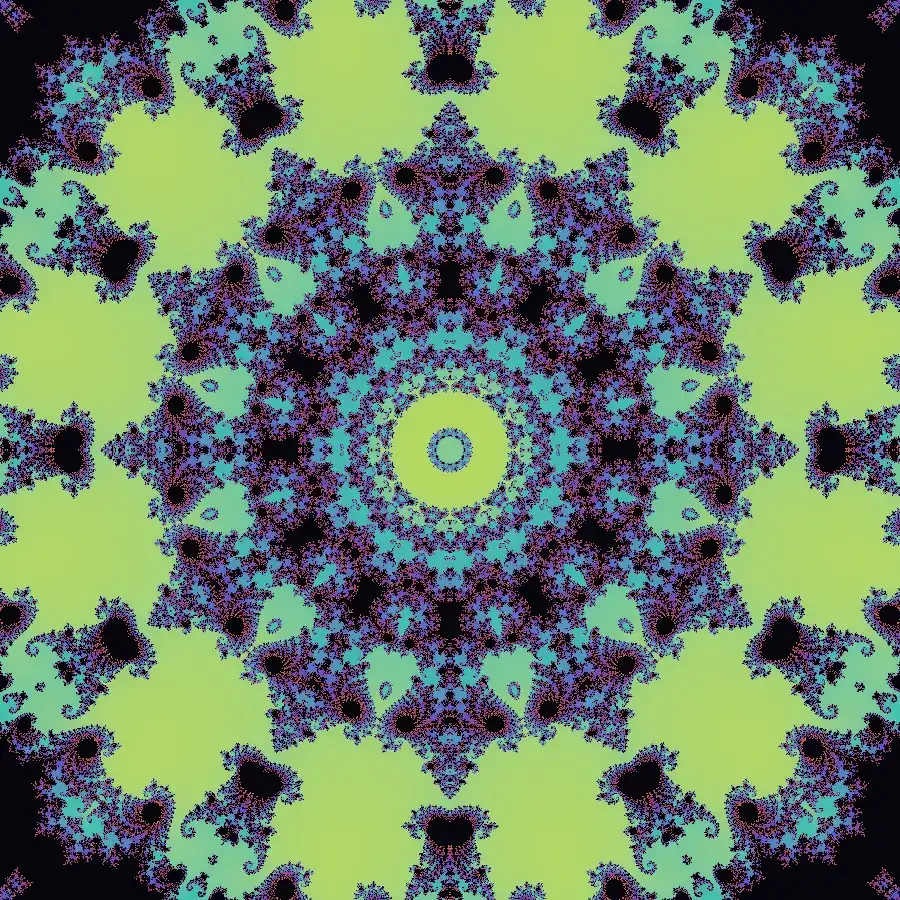
With six segments, each slice is wide enough to hold a whole spiral from Seahorse Valley, so you can still recognize the source. At twelve, the slice narrows and the spirals get cut into repeating lace. Past about 16 segments the wedges are thin enough that small features start to merge.
◆ Open in StudioOpen the six-fold versionSame view, same colors, half the segments.A practical order for designing one:
- Find an interesting boundary in the plain fractal first. Turn the Kaleidoscope layer off while you look.
- Turn it back on and try 5, 6, 8, and 12 segments.
- Sweep Rotation slowly. Small changes swap which features land on the mirror lines.
- Pick colors last. The gradient never changes the geometry, so it's safe to leave until the shape is right.
Turning the chamber: a seamless kaleidoscope loop
In a toy kaleidoscope you turn the tube and the beads tumble past the mirrors. Animating the Kaleidoscope layer's Rotation gets a similar result: the wedge sweeps around its center, so each frame folds a slightly different slice of the set and the petals keep re-forming.
The loop track advances Rotation by exactly one full turn per loop. After one turn the fold is back where it started, so the last frame matches the first with no crossfade. A one-cycle Gradient flow track runs alongside it and closes the same way.
◆ Open in StudioOpen the turning kaleidoscope loopThe Rotation track makes one full turn per loop, so the last frame matches the first. Export it as MP4 from the Motion section.To make your own, open Motion in the Effects panel, add a track for the Kaleidoscope rotation, and set the duration. Longer loops (20 seconds or more) give a calmer turn. Export writes an MP4 that repeats cleanly on social feeds or as a looping background.
Sacred geometry fractals and the hyperbolic kaleidoscope
Searches for sacred geometry fractals usually want six-fold rosettes, nested circles, and polygons that repeat inward. The Hyperbolic Tiling layer does exactly that, and it is a kaleidoscope in the strict sense. A hyperbolic tiling is generated by reflecting a triangle across three mirrors, one of them a circle. Every tile is a mirror image of its neighbor, and the copies shrink toward the rim of the disk without end.
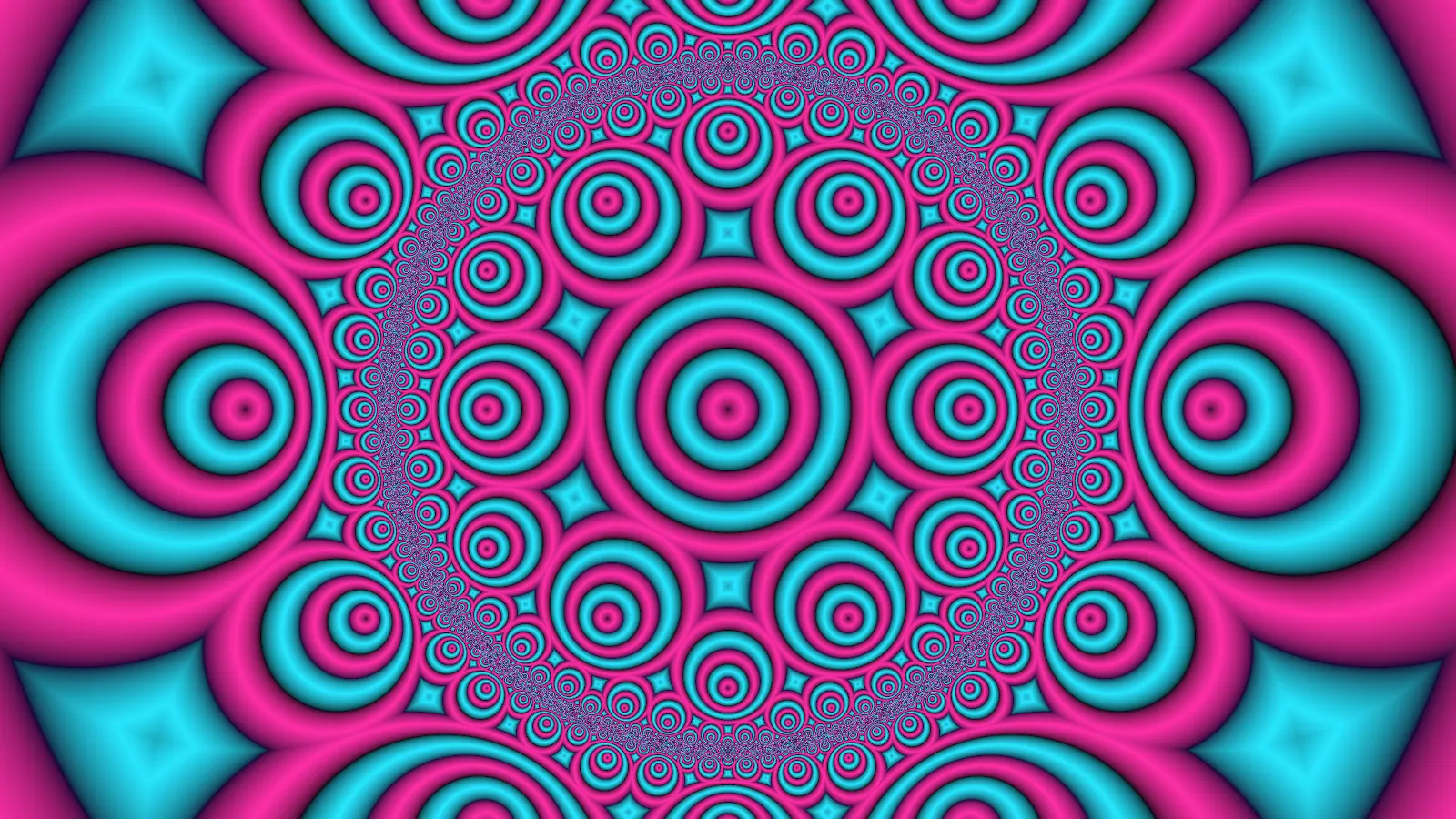
This demo uses a {6,4} tiling: hexagons, four meeting at every corner, which is impossible on a flat sheet but fits in the hyperbolic disk. The source is plain concentric rings. The fractal-looking repetition comes entirely from the reflections. Change Polygon p and Vertex q to change the symmetry of the whole disk. The combination works only when (p − 2)(q − 2) is greater than 4, so {6,4}, {7,3}, and {8,3} work while {4,4} and {6,3} stay flat.
For more on this geometry, the cool fractals gallery includes Hyperbolic Bloom, a seven-fold version of the same idea.
Kaleidoscope patterns from other sources
The Kaleidoscope layer works on every source in the Studio, and the choice of source decides whether the result is truly fractal:
- Mandelbrot and Julia sets keep their infinite boundary detail inside each wedge. A Julia set centered on the origin makes a clean snowflake, since it is already symmetric under a half turn. See the Julia set guide for seeds that work well.
- Field sources such as Rings, Angular Rays, and Quasicrystal give crisp geometric kaleidoscope patterns. They are not fractal unless a layer like the hyperbolic tiling or Log Spiral Tiling adds repetition at smaller scales.
- Stacking. Up to eight transform layers run in order. A Twist layer before the Kaleidoscope bends the whole mandala into a spiral. A Twist after it bends the source inside each wedge.
From screen to print, loop, or cut file
A finished fractal mandala can leave the browser in several forms. Still PNG export renders the view again at up to 8K or at 300 DPI print sizes, so filaments stay sharp on paper. Loops export as MP4. For makers, the heightmap export turns the pattern into a 16-bit grayscale relief or an STL for CNC carving, and SVG export traces the color bands as vector contours for laser scoring or pen plotting.
If you want a mandala as a coloring page or a one-piece cut file instead, Pardesco's Mandala Maker generates printable designs and SVG or DXF files for a laser or Cricut. For where the fractal side comes from, The Mandelbrot Set, Explained Visually covers the escape-time algorithm behind every demo on this page.
Frequently asked
What is a fractal kaleidoscope?
It is a fractal image folded through a set of mirrors. The kaleidoscope takes one wedge of the fractal and repeats it around a center, flipping every other copy, so the result has exact rotational and mirror symmetry while keeping the fractal's fine detail inside each wedge.
How many segments should a fractal mandala have?
Six and eight give bold, readable shapes. Twelve and above produce finer, lace-like patterns, and past about 16 the individual wedges get thin enough that small details start to blur together. Try the same view at several counts before changing anything else.
Is a mandala fractal a real fractal?
The folded image keeps the self-similar detail of its source, so zooming into a Mandelbrot or Julia kaleidoscope keeps revealing structure. The mirror fold itself is plain symmetry and adds no fractal detail. Folding a smooth field such as rings gives a symmetric pattern that is not fractal unless another step, like a hyperbolic tiling, adds repetition at shrinking scales.
What are sacred geometry fractals?
The phrase usually means fractal art built on the symmetries found in traditional sacred geometry: six-fold and twelve-fold rosettes, nested circles, and repeating polygons. In this tool those come from the Kaleidoscope layer and the Hyperbolic Tiling layer. The math is the same symmetry math; any spiritual meaning is up to the viewer.
Can I export a kaleidoscope animation as a seamless loop?
Yes. Put a loop track on the Kaleidoscope Rotation or on Gradient flow. Tracks advance a whole number of turns per loop, so the final frame lines up with the first, and the Motion section exports it as an MP4.
Can I print a fractal kaleidoscope?
Yes. Still PNG export goes up to 8K and includes 300 DPI print sizes. The view is recalculated at the export size, so fine filaments stay sharp instead of being scaled up from the screen.
Studio dispatches
New work, new writing — straight to you
Occasional letters from the studio. No spam, unsubscribe anytime.