 PARDESCO
Hyperbolic Geometry in Art: Seven Stars After Dürer
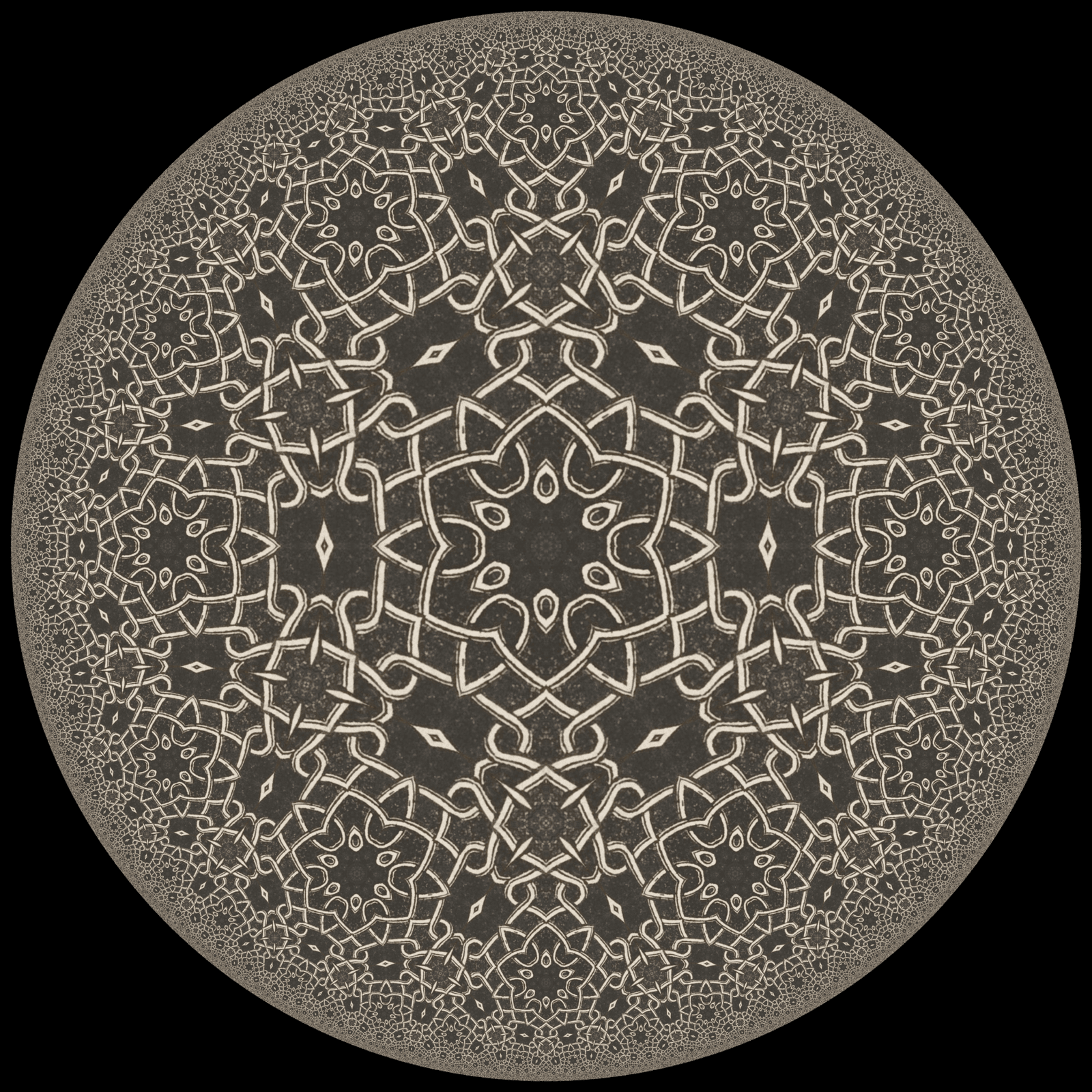
Hyperbolic geometry gives an artist a way to show an endlessly extending pattern inside a finite circle. Shapes that are equal in the geometry appear progressively smaller toward the boundary. In Seven Stars, I used that change of scale to transform a knotwork pattern after Albrecht Dürer.
The result became a physical work in laser-etched maple, selected for the 2026 Joint Mathematics Meetings art exhibition. This is a modern interpretation of the source pattern. The transformation tells us about the geometry I applied; it does not establish what Dürer knew about hyperbolic space.
How hyperbolic geometry changes a pattern
The hyperbolic plane has constant negative curvature. In its Poincaré disk model, the entire plane is represented inside a circular boundary. Angles are preserved, while distances and areas look increasingly compressed near the edge.
Its straightest paths, called geodesics, appear as circular arcs meeting the boundary at right angles, or as diameters through the center. The boundary itself lies infinitely far away in the hyperbolic metric. A print or carving can only show a finite portion at finite resolution.
This matters compositionally. The center can hold a recognizable motif while the surrounding repetitions become a dense fringe. I can work with that contrast without pretending a laser or a screen can draw infinitely small detail.
Seven Stars: knotwork translated into a disk
The source motif brings its own rhythm of interlaced strands and stars. My transformation changes the space those strands inhabit. The viewer can begin with the larger central forms and follow the knotwork outward until individual lines become difficult to separate.
Seven Stars (After Dürer, 1521), 2025. Laser-etched maple with acrylic paint removal, 40 × 40 × 0.6 cm. View the 2026 JMM exhibition entry.
The material adds another limit. A dense region that reads on a backlit screen can lose definition in wood. The finished work therefore needs to be assessed as an object with a surface and a practical detail limit, as well as a geometric image.
Reading tessellation notation
In standard Schläfli notation, {p,q} describes p-sided regular polygons with q meeting at each vertex. Thus {6,4} means four hexagons at a vertex, while {4,6} means six squares. Those are different tessellations. Douglas Dunham's Bridges paper gives the convention.
An earlier description of this work paired {6,4} with the incompatible phrase “six squares.” That wording was incorrect. I am leaving the specific tessellation assignment out of this account until it is reconciled with the original construction record; the image and exhibition history do not depend on that label.
Other transformation studies
I have also applied hyperbolic transformations to mandala imagery. These are contemporary image studies using historical source works. Their geometric structure does not validate a religious doctrine or prove that the source artists intended a hyperbolic construction.
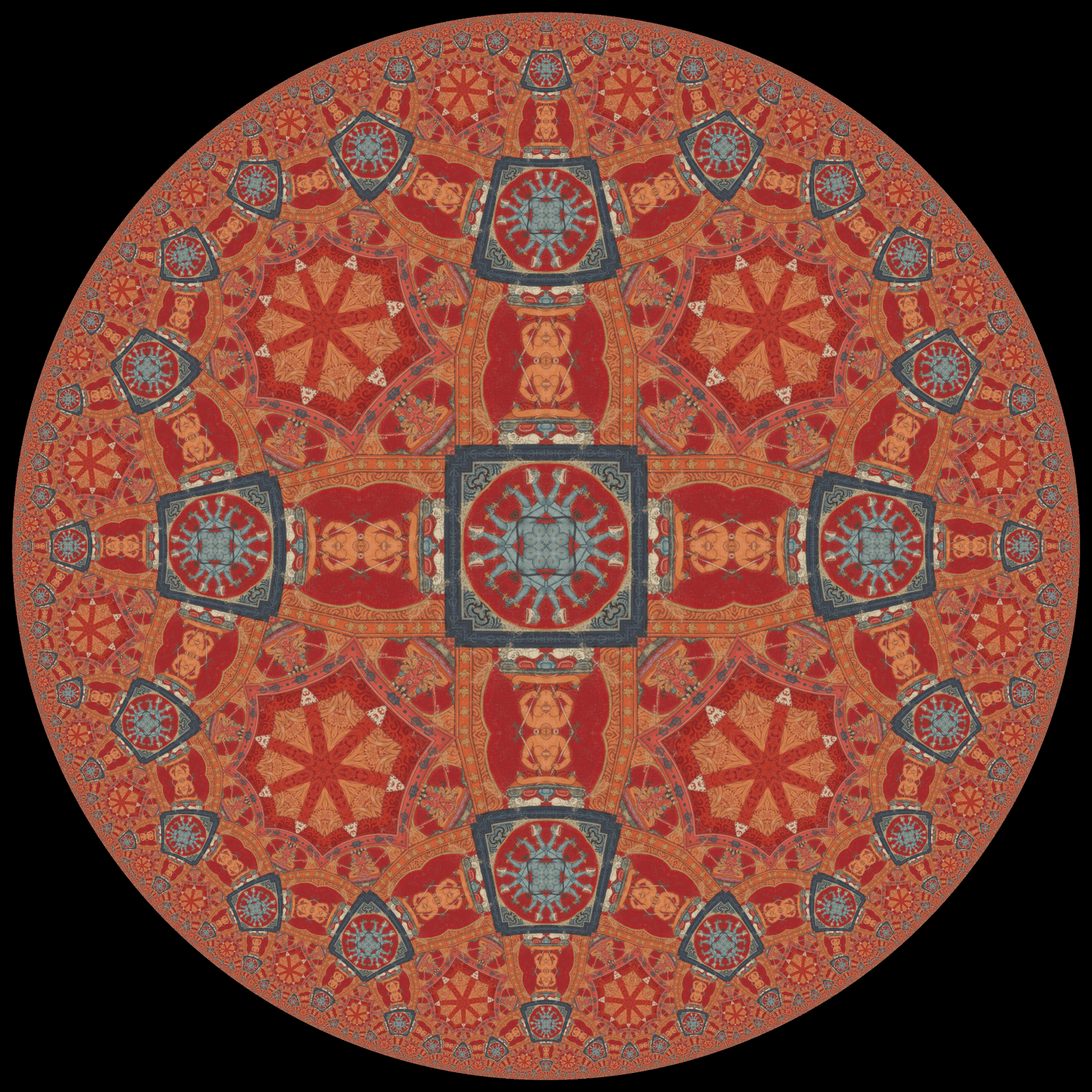
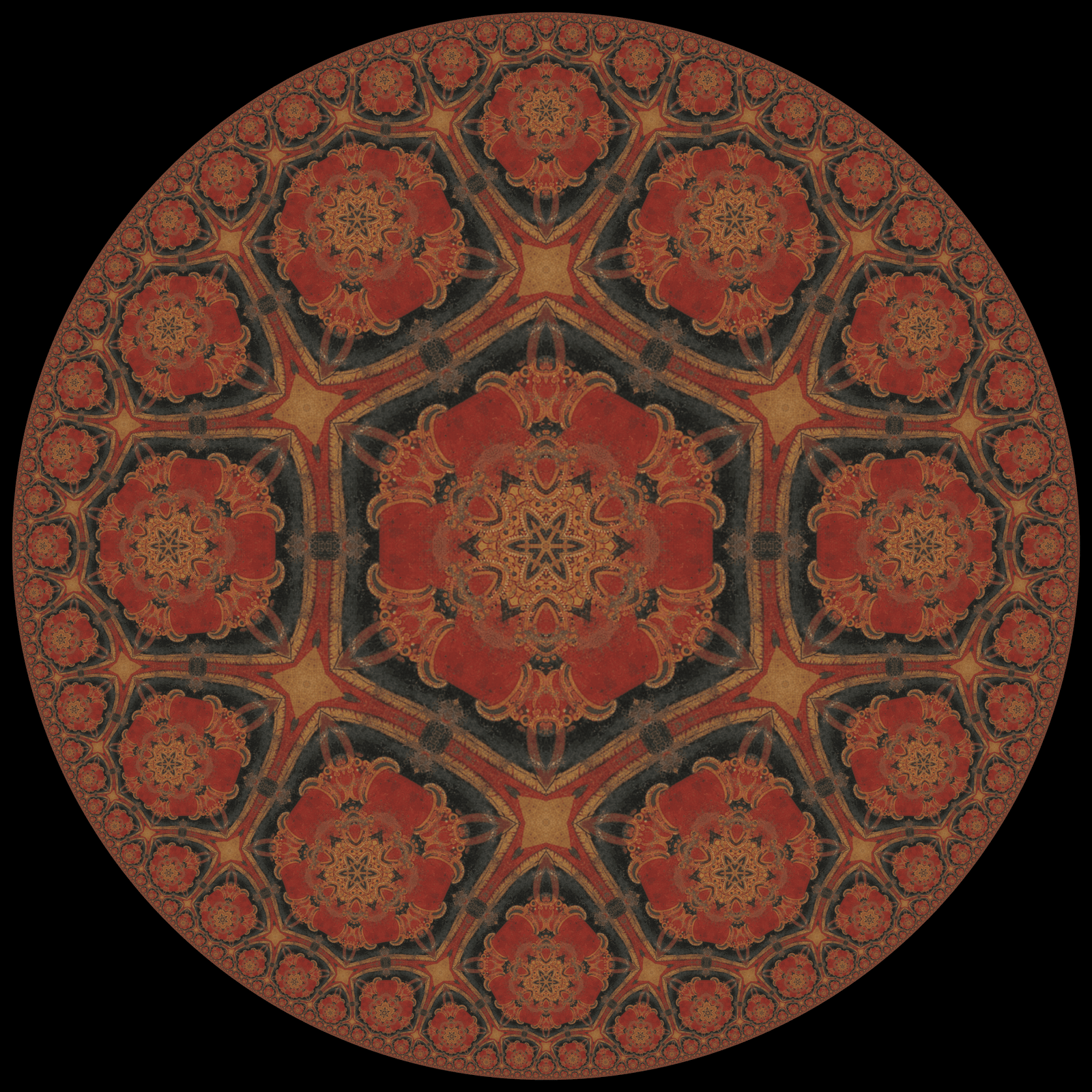
For these studies, the useful question is what the transformation does to the viewer's reading of the image. A central figure becomes one part of a larger field, and the boundary changes the sense of scale. Historical claims require their own sources and cannot be inferred from the transformed image.
Where this sits in my work
Hyperbolic art concerns a different geometry of space. My 4D art explores an additional spatial dimension through projection. Both use mathematics as a structure for images and objects, but they should not be confused.
The CNC wall art case study follows geometric relief into wood. For another kind of pattern research, the seven-fold girih study examines how my own motifs meet across a changing field.
Frequently asked questions
What is hyperbolic geometry in art?
It uses the geometry of a space with negative curvature to organize an image or object. In the Poincaré disk model, equal shapes can appear smaller toward a circular boundary, suggesting an unbounded pattern within a finite picture.
Does this show that Dürer knew hyperbolic geometry?
No. Seven Stars is a contemporary transformation of a pattern after Dürer. Applying a modern mathematical model does not establish the original artist’s knowledge or intent.
Is Seven Stars a physical artwork?
Yes. The 2025 work is laser-etched maple with acrylic paint removal, measuring 40 × 40 × 0.6 cm. It was included in the 2026 Joint Mathematics Meetings art exhibition.
What does {6,4} mean in a tessellation?
In standard Schläfli notation, {6,4} means regular hexagons with four meeting at a vertex. Six squares meeting at a vertex would be {4,6}.
Studio dispatches
New work, new writing — straight to you
Occasional letters from the studio. No spam, unsubscribe anytime.