 PARDESCO
What Is 4D Art? A Sculptor's Guide to the Fourth Dimension
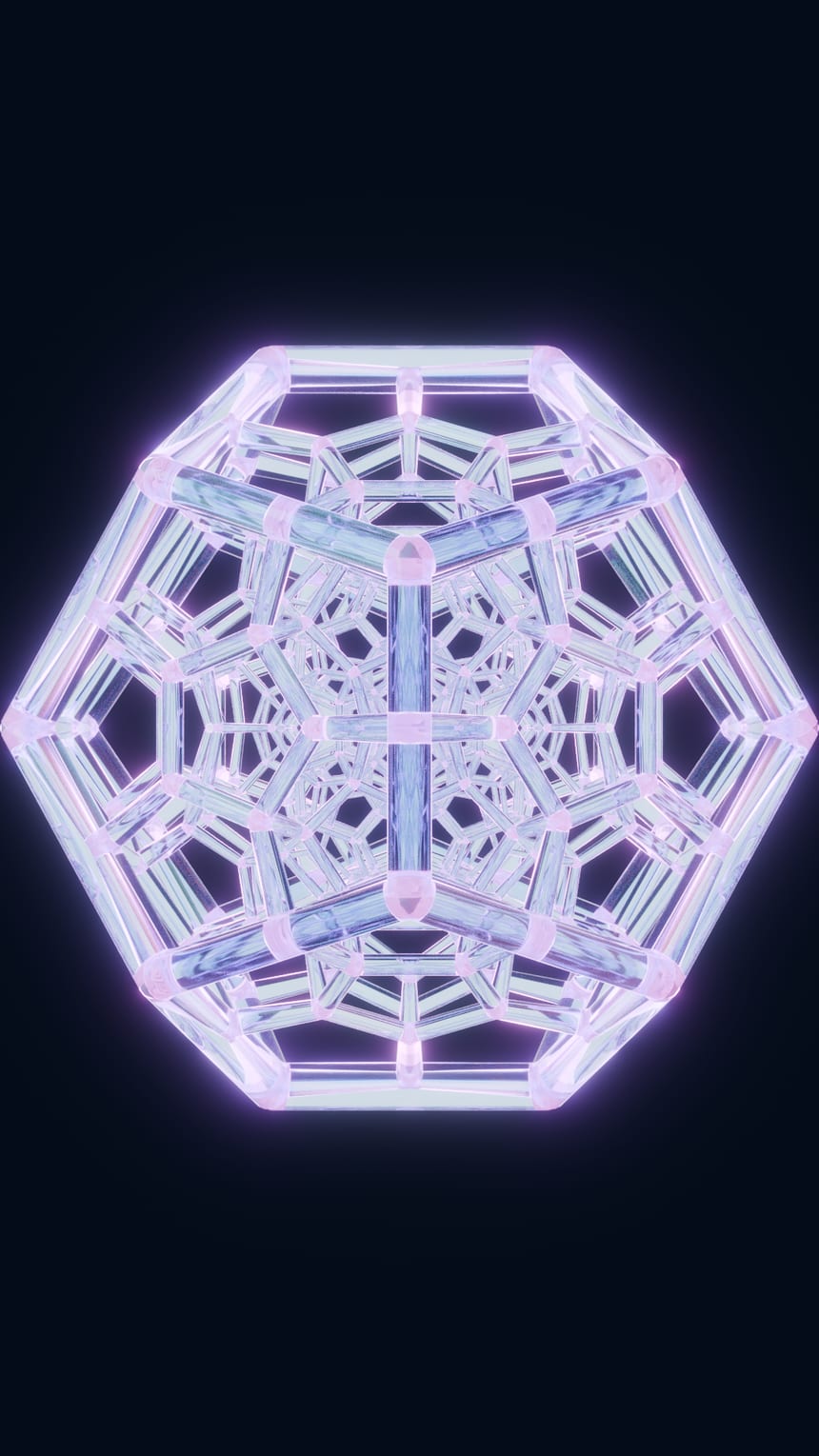
Projections from a higher space
There is a shape that cannot exist in our world. It has six hundred cells, or one hundred and twenty; sometimes it is twenty-four cubes folded into a single four-dimensional body. We cannot hold it. We cannot even see it directly — our eyes were built for three dimensions. But we can see its shadow. 4D art is the practice of casting those shadows deliberately, and I have spent years learning to cast them well.
I'm Randall Morgan, and I work as Pardesco. Everything on this page began as an actual mathematical object — a real four-dimensional polytope — projected down into our space and set slowly turning. Nothing is modeled by hand, and nothing is imagined. The geometry is the source of truth; my work is the translation.
What is 4D art?
4D art is artwork built from genuine four-dimensional geometry, projected into three dimensions so that we can see it. The term gets used loosely — sometimes for kinetic work where the fourth dimension is time, sometimes for anything with a lenticular shimmer. That isn't what I mean by it.
The medium, precisely
The "fourth dimension" in this work is not time. It is a fourth spatial dimension, perpendicular to length, width, and depth in a direction we have no way to point. Just as a cube is bounded by six flat squares, a tesseract is bounded by eight solid cubes. Those objects are fully described by mathematics and entirely real to it. They are simply not constructible here.
So a 4D artist is a translator. The work is not inventing the form — the form has been catalogued for over a century. The work is choosing how to bring it into view, and what is preserved or lost in the crossing.
That choice is where the art lives. A four-dimensional object can be flattened into our space in many ways, and each one tells a different truth about it. Most visualizations pick the method that keeps things tidy. I pick the one that keeps things honest.
Why straight edges arrive curved
To bring a polytope into view, I place its vertices on the surface of a four-dimensional sphere and project them stereographically into three-space — the same projection that flattens the globe into a map, lifted one dimension higher.
Something quiet and beautiful happens in that translation. Edges that are perfectly straight in four dimensions arrive in our world as curved arcs. The curvature is not stylization and it is not an effect applied afterward. It is the honest geometric consequence of looking at a higher thing from below — the same reason lines of longitude, dead straight on the globe, bow outward on a paper map.
Most renderings of 4D geometry use perspective projection instead, which straightens those lines back out and throws away the information. What you get is accurate as a diagram and dead as an image. Stereographic projection preserves the angles at which curves meet, so the lattice blooms and breathes as the form turns — and the rotation reads as a rotation rather than a jumble.
The turning matters as much as the shape. Each piece completes exactly one full rotation through a four-dimensional plane and returns precisely to where it began, so it loops forever without a seam. Watch the centre of the form above: as it rotates through the fourth dimension, the inner structure swells outward and becomes the outer shell. Nothing is growing. You are watching a rigid object turn through a direction you cannot point in.
A taxonomy of higher forms
These are not variations on a theme. Each is a distinct four-dimensional solid with an exact census — the four-dimensional analogues of the Platonic solids, and some considerably stranger relatives.
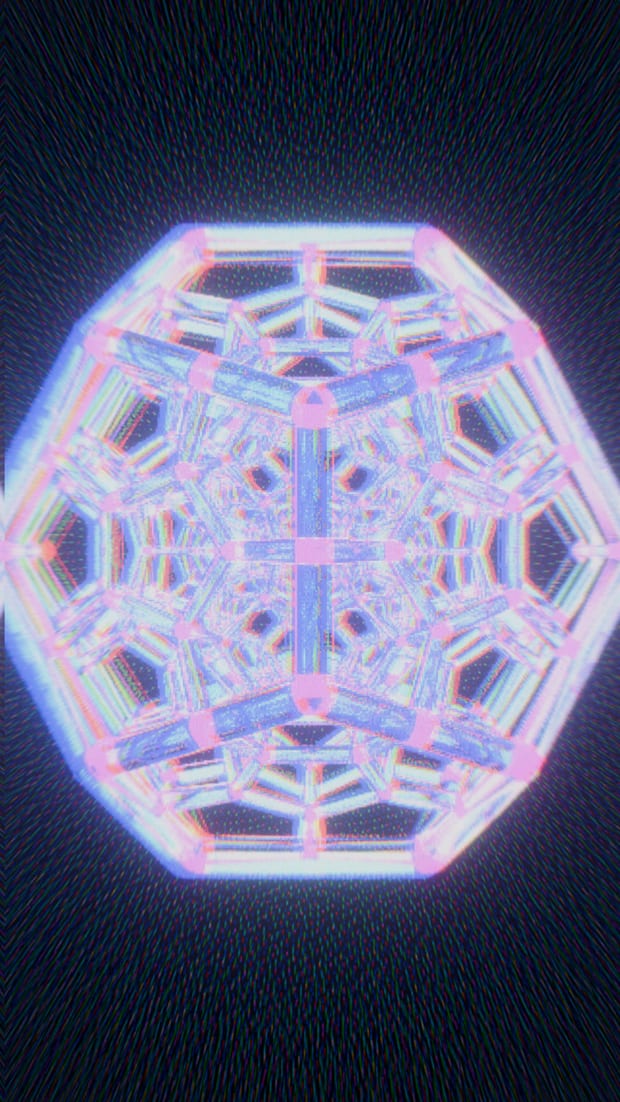
I render them in two finishes. Crystal treats the lattice as refractive glass and lets the form speak plainly. Prism Neon splits the light chromatically against a field of rays — it is the finish I release as editions. Each plate below records which.
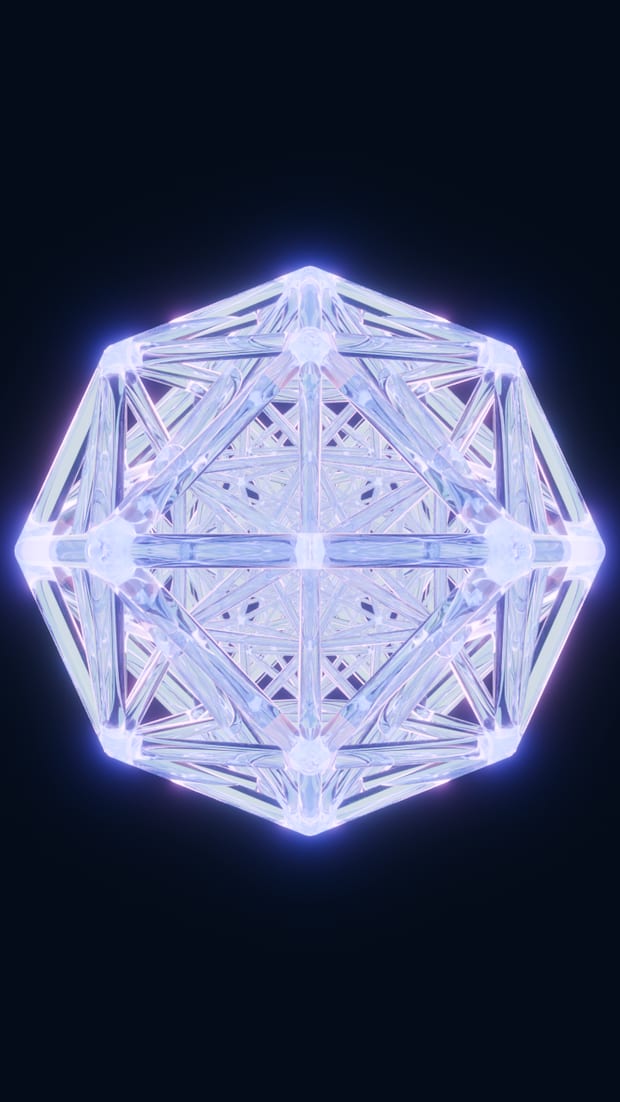
Six hundred tetrahedra packed onto a hypersphere — the densest of the six regular polychora.
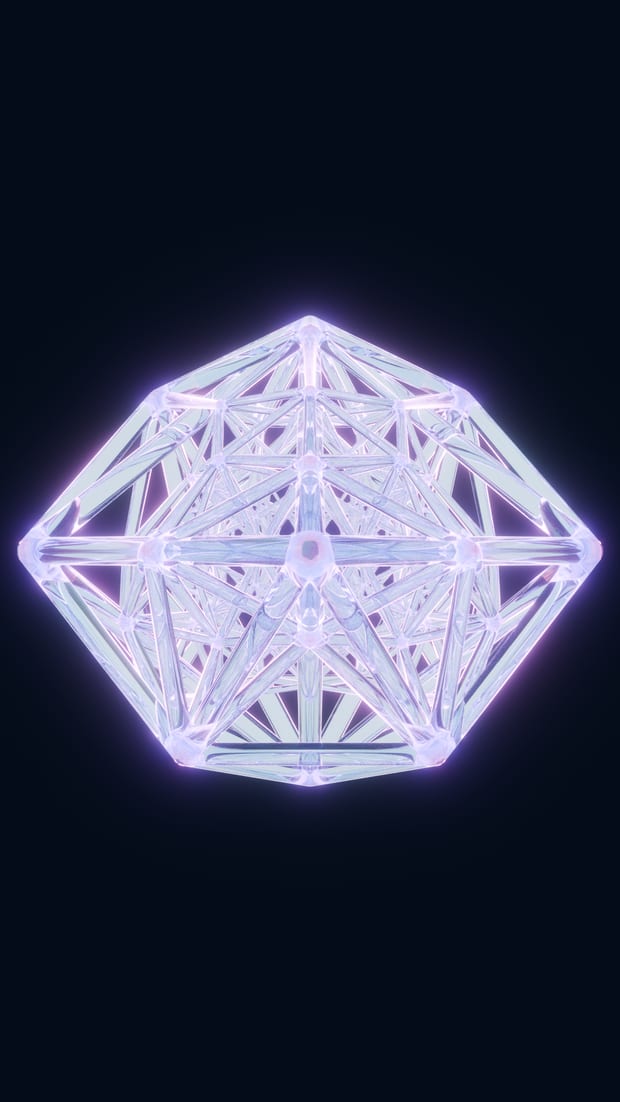
Two rings of pentagonal antiprisms locked at right angles, the gap between them filled by three hundred tetrahedra.
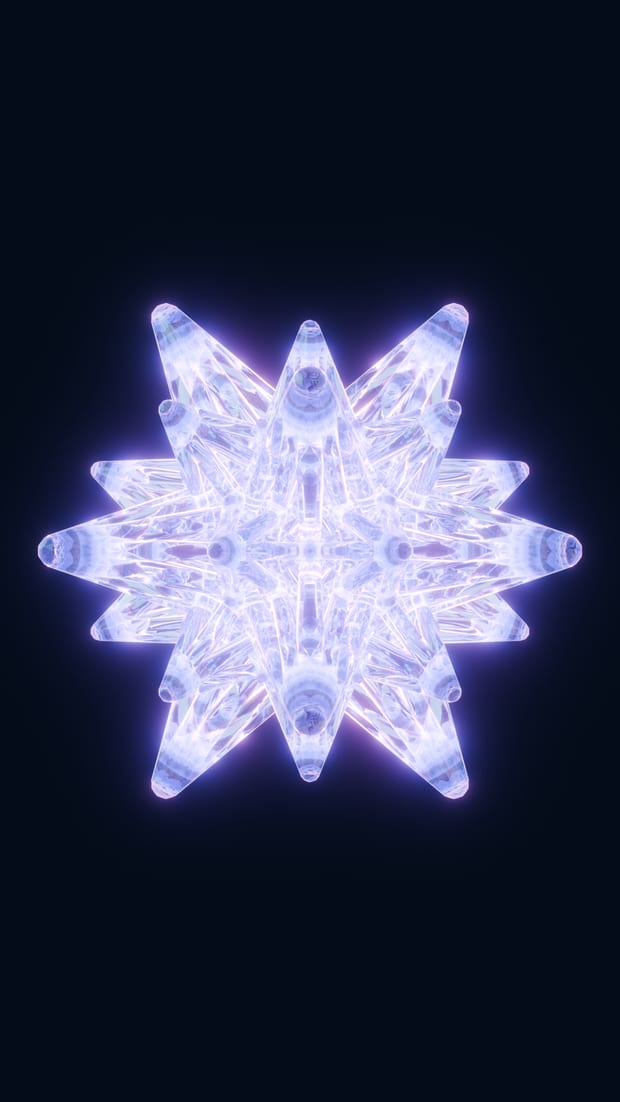
One of only ten star polychora. Its cells are great stellated dodecahedra, and they pass through one another.
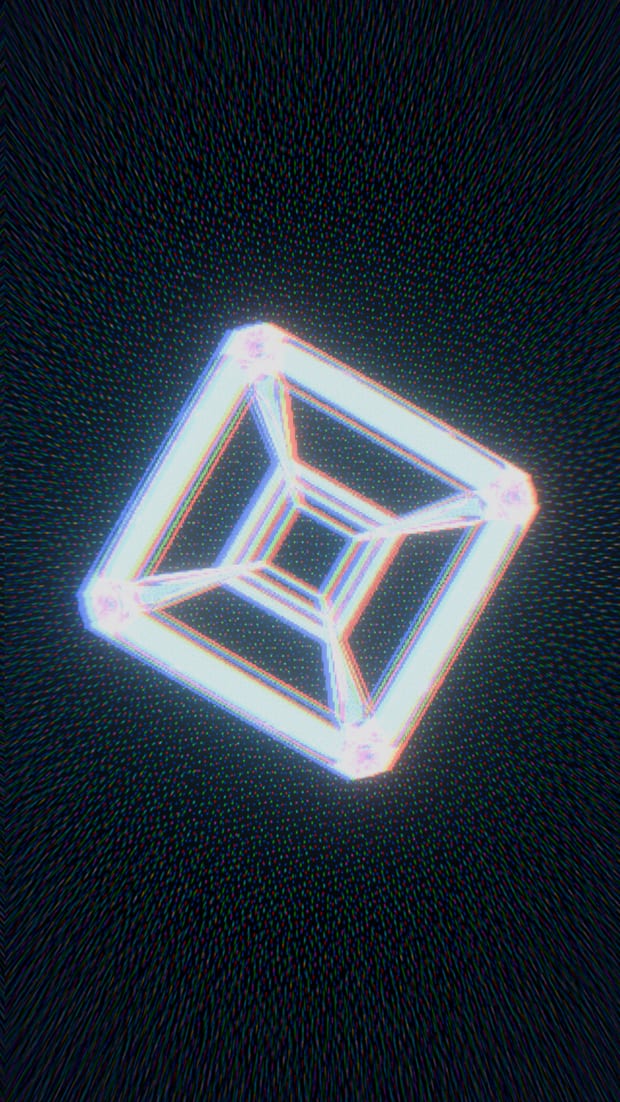
The one most people have met. Eight cubes, each joined to its neighbours along a whole square face.
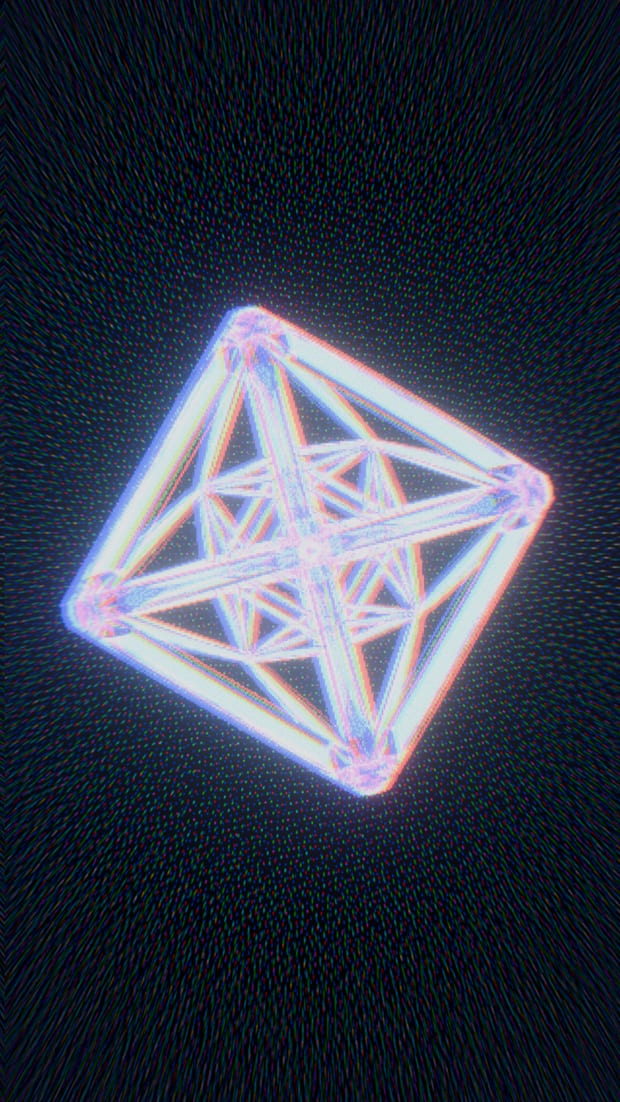
The anomaly. It is self-dual, and has no analogue in any other dimension — it exists only here.
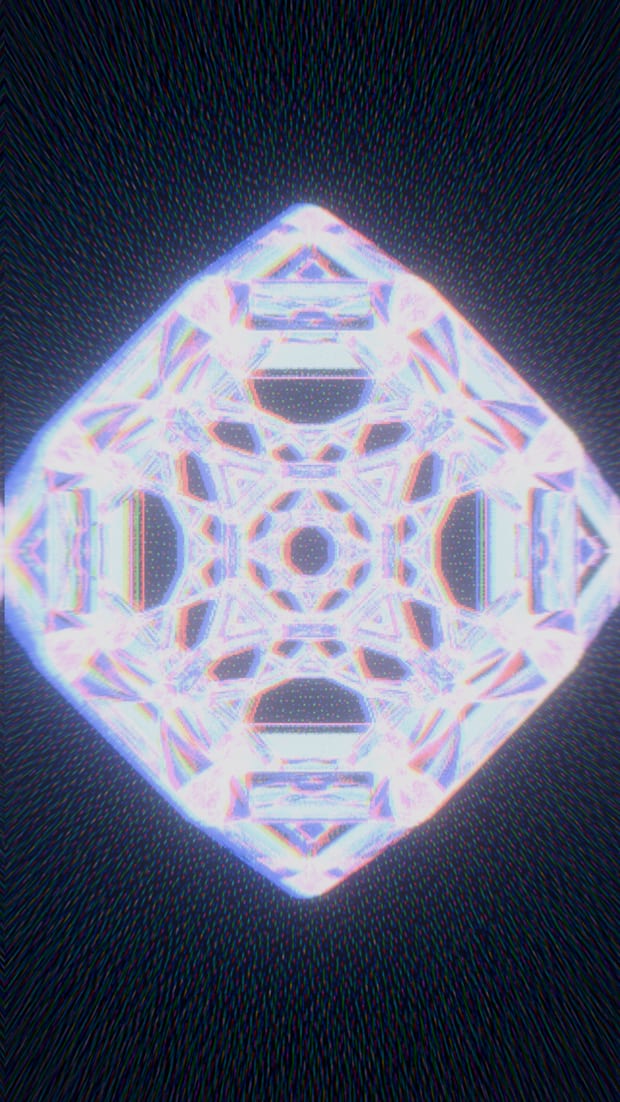
The bitruncated 24-cell: forty-eight truncated cubes, and like its parent it is self-dual.
The full catalogue runs to well over a thousand uniform polychora, most of which have never been rendered by anyone. That is the part I find hard to put down.
Nothing here is modeled
I built a pipeline that treats the mathematics as the source of truth. A generator I wrote bakes the four-dimensional rotation and projection frame by frame, and carries each point's depth in the fourth dimension forward as the thickness of the tube that renders it — so the parts of the form sitting further away in 4D arrive as heavier strokes of light. That data flows through USD into Blender, where geometry nodes grow tubes along the curves and render them as glowing glass.
On working with AI
I should be straightforward about this, because it matters to how the work is read. I used agentic AI as an engineering collaborator to build that pipeline — I directed, it implemented. What it did not do is generate the art. There is no diffusion model anywhere in this process, and no prompt produced any image on this page. The geometry comes from the mathematics, the projection from my choice of method, and the light from a renderer. AI let one artist build tooling that would otherwise have taken a team.
That collaboration has since moved further into the work itself. The renders on this page are lit and shaded through a Blender MCP connection, with materials driven directly rather than dialled in by hand — the same division of labour as before, applied to the look instead of the tooling.
Exhibited: Sitphi
Two of these projections were selected for the 2026 Joint Mathematics Meetings art exhibition, juried by The Bridges Organization. One is a hyperbolic piece after Dürer. The other is Sitphi.
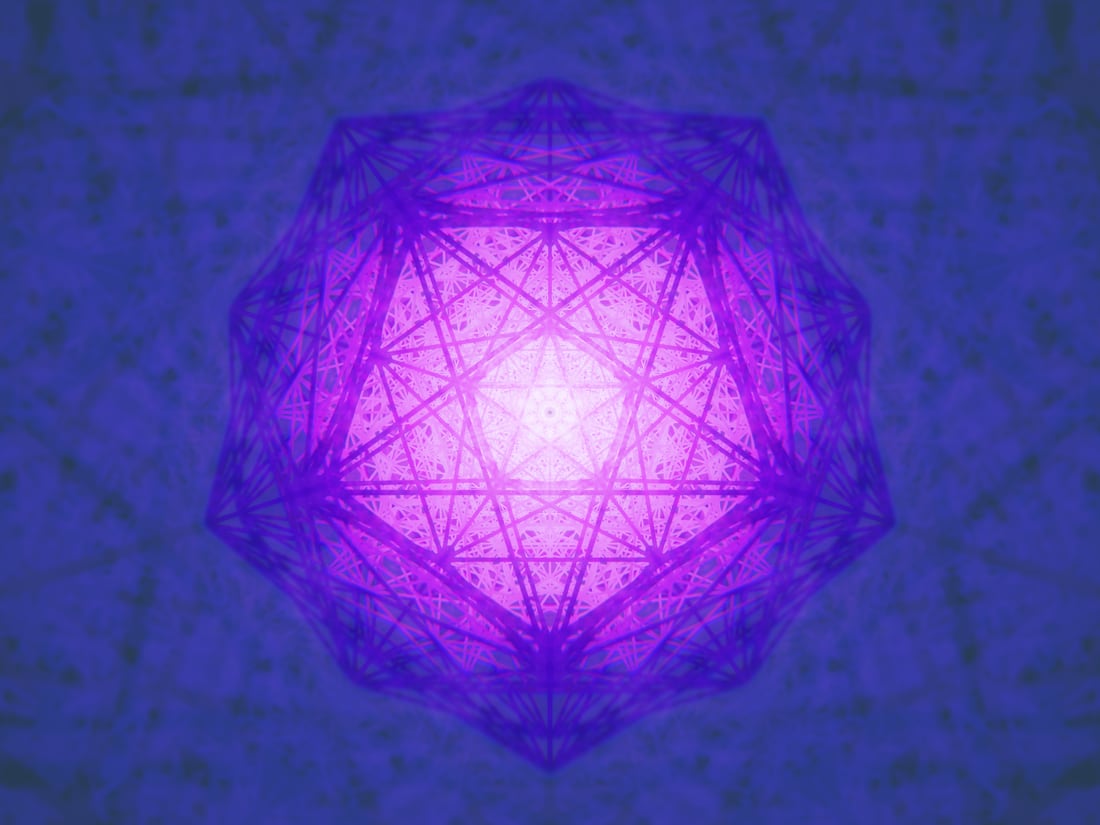
- Year
- 2025
- Subject
- Small tripesic hecatonicosachoron · Bowers: sitphi
- Medium
- Giclée print of digital render, 220 gsm matte fine art paper
- Size
- 30 × 40 cm
- Exhibited
- 2026 Joint Mathematics Meetings, The Bridges Organization
Sitphi projects the shadow of one of the more tangled objects in the catalogue. Where the 120-cell reads as an ordered lattice, this one arrives as interference — thousands of edges crossing at every depth, the density itself becoming the image.
A note on how this one was made
It is worth being precise, because the previous section describes a pipeline that Sitphi predates. The geometry was mathematical, as always — but the look was not. This render comes from 2025, before the current algorithmic process existed: the shaders and compositing were adjusted by hand in Blender, tuned by eye until the interference pattern read the way I wanted.
The newer work on this page is made differently, and I think it is better for it. But the older method is not something to quietly paper over — the practice changed, and a piece made under the previous one is still the piece that hung on the wall.
From projection to metal
Digital rendering is where the work is developed, but it isn't where it ends. Using the same data, I export printable meshes of these stereographic projections and use them as masters for lost-wax casting in bronze and silver.
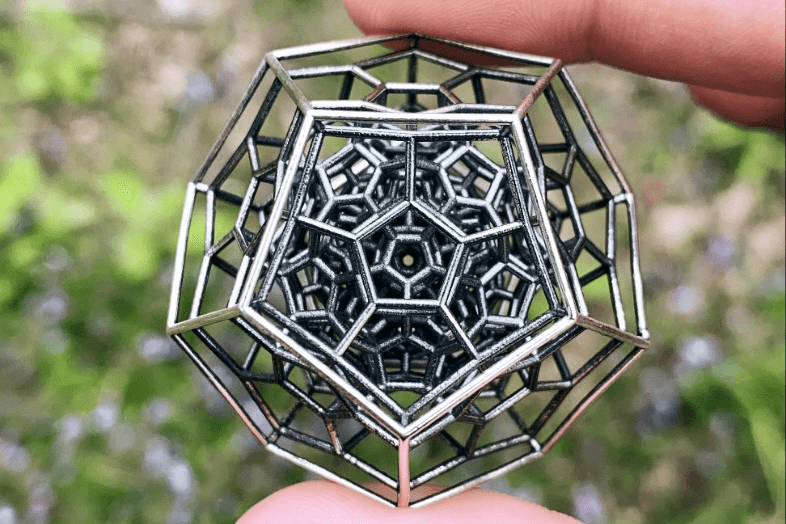
The result is a strange thing to hold: a solid object that is a faithful record of something that cannot be solid here. Not a sculpture of a higher dimension, and not an impression of one. A shadow it actually cast, caught in metal.
Collect the work
Eleven of these projections are released as single editions on pardesco.art — the Prism Neon series, each a seamless rotation of one polytope through a four-dimensional plane, minted one of one.
Morgan, R. (Pardesco). "What Is 4D Art? A Sculptor's Guide to the Fourth Dimension." Pardesco, 30 March 2025. https://pardesco.com/blogs/technology-art-design/exploring-fourth-dimension-4d-art
Studio dispatches
New work, new writing — straight to you
Occasional letters from the studio. No spam, unsubscribe anytime.