 PARDESCO
Sacred Geometry Art, Symbols & Meanings


Sacred geometry explores geometric forms and the meanings people give them. This guide covers how the patterns are built and what they symbolize in art and spiritual practice. Their construction can be measured; their meanings vary by tradition.
Compare the symbols and their meanings
| Symbol | Meaning or association | Geometric form |
|---|---|---|
| Vesica Piscis | Relationship and duality | Two equal circles with centers one radius apart |
| Seed of Life | Creation and beginnings | Seven overlapping circles |
| Egg of Life | Life and development | A circle or sphere arrangement; versions vary |
| Flower of Life | Interconnection | 19 circles on a hexagonal grid |
| Tree of Life | Divine emanations in Kabbalah | Ten sefirot; the diagram shown has 22 paths |
| Fruit of Life | Creation and potential | 13 circles selected from an extended circle grid |
| Metatron's Cube | Order and protection | Connections between 13 circle centers |
| Grid of Life | Structure and balance | A tetrahedral arrangement |
| Torus | Continuity and cycles | A ring-shaped surface |
| Merkaba | Balance in contemporary spiritual practice | Two interlocking tetrahedra |
Sacred Geometry Shapes
Vesica Piscis

The Vesica Piscis is the lens-shaped overlap of two equal circles whose centers lie on each other's circumference. Keep your compass at the same width for both circles and the construction follows directly.
The almond shape recalls the mandorla surrounding figures in religious art. Related curved forms include the Christian fish symbol and the triquetra. Those visual relationships do not establish a single origin or meaning for all three symbols.
A Reuleaux triangle uses three circular arcs and has constant width. It is a different construction, though it can be explored with the same compass techniques. Our Vesica Piscis guide looks more closely at the shape and its uses.
Seed of Life

The Seed of Life consists of seven equal circles: one in the center and six around it. The outer centers lie on the first circle. Keeping the compass radius fixed produces the sixfold symmetry.
Contemporary spiritual interpretations connect the pattern with creation and new beginnings. Comparisons with the seven days of Genesis are symbolic readings. The drawing is not a diagram of cell division, and the number of circles does not establish a biological connection.
For drawing practice, watch the intersection points. They give you the next compass positions and make it easier to extend the pattern without measuring each angle.
Egg of Life

The Egg of Life is a name used for related circle and sphere arrangements in contemporary sacred geometry. Some descriptions use eight spheres in a cubic arrangement; flat illustrations and counting conventions vary.
Its name invites a comparison with growth and the beginning of life. Treat that as symbolism. A geometric arrangement of spheres is not a verified template for an embryo, human organs, or all living organisms. Associations with musical octaves are analogies too.
Flower of Life
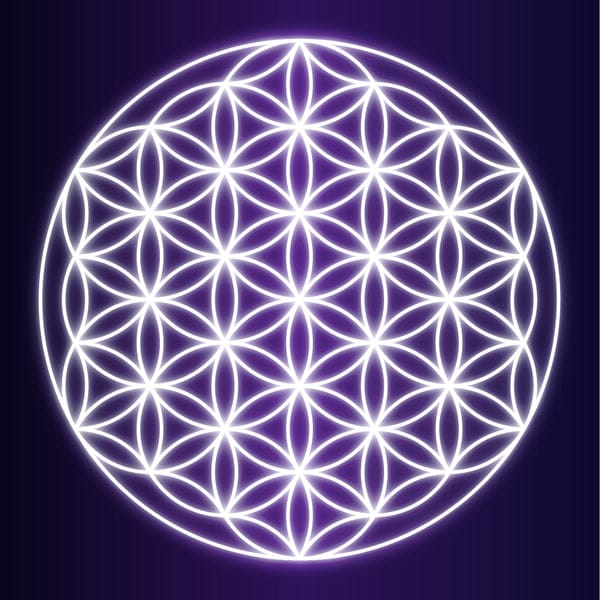
The Flower of Life expands the seven-circle pattern into a grid of 19 complete, overlapping circles, often surrounded by a larger boundary circle. Each small circle has the same radius.
Its repeating structure makes it a useful symbol of interconnection. The geometry can be extended beyond the familiar circular outline: the boundary selects one portion of a larger repeating design.
Overlapping circles occur in decorative art, but a similar pattern in two places does not prove that its makers shared the same name or beliefs. Claims about a particular ancient example need a dated source for that example. For architectural context, see our guide to geometry in architecture and the Met's account of geometric patterns in Islamic art.
Our Flower of Life guide covers the pattern in more detail.
Tree of Life

The Tree of Life shown here is a diagram of the ten sefirot in Kabbalah. Its connecting paths organize relationships between them. The version pictured has 22 paths.
The National Library of Israel's collection of Kabbalistic trees shows how these diagrams represent the divine through the sefirot. Later esoteric traditions also use the diagram for contemplation and spiritual development. These interpretations belong to their respective traditions.
Other cultures have sacred trees, including the Norse Yggdrasil. A shared tree metaphor does not make them versions of the same Kabbalistic diagram. See our Tree of Life guide for a fuller discussion.
Fruit of Life

The Fruit of Life is a selection of 13 circles from an extended Flower of Life grid. A central circle and two groups of six establish its radial arrangement.
It is usually drawn with separated or touching circles, making the centers easier to distinguish than in the overlapping Flower of Life. Connecting those centers gives the line network called Metatron's Cube.
Spiritual accounts associate the pattern with creation and potential. The 13 circles do not establish a physical gateway between dimensions.
Metatron's Cube

Metatron's Cube adds straight connections between the 13 centers of the Fruit of Life. Connecting every pair gives 13 × 12 ÷ 2 = 78 connections. Some lie along the same straight lines, so that count should not be confused with 78 visibly separate strokes.
The network suggests cubes and other projected solid forms. A flat resemblance does not by itself prove that a drawing represents a regular three-dimensional solid with the correct proportions. The Platonic solids have precise geometric definitions.
Contemporary spiritual interpretations associate the symbol with order, protection, and balance. Its name refers to Metatron, an angelic figure in Jewish mystical literature; the name alone does not establish an ancient origin for this particular drawing.
See our Metatron's Cube guide for a closer look at the construction.
Grid of Life (64 Tetrahedron)

The Grid of Life, also called the 64-tetrahedron grid, is a tetrahedral arrangement used in contemporary sacred geometry. Its illustration layers triangular forms into a larger symmetrical composition.
A tetrahedron has four triangular faces. Combining two in opposite orientations produces the star tetrahedron associated with the Merkaba. More elaborate arrangements depend on how the smaller forms are placed and counted.
Interpretations involving masculine and feminine balance are symbolic. The pattern's symmetry does not establish that it is a model of the vacuum or a verified theory of physics.
Torus

A torus is a ring-shaped surface. You can construct a ring torus by rotating a circle around an axis in the same plane that stays outside the circle.
Diagrams often add curved lines to suggest movement around the ring and through its central opening. Those lines can describe a chosen flow, but the surface itself does not generate energy or sustain motion.
In sacred geometry, the closed form lends itself to ideas of continuity and renewal. Our torus guide explores the geometry and its interpretations.
Merkaba

In contemporary sacred geometry, Merkaba commonly names a star tetrahedron: two interlocking tetrahedra pointing in opposite directions. Spiritual interpretations often associate their arrangement with balance.
The Hebrew word merkavah means chariot. In Jewish mystical tradition it refers to the heavenly chariot; this collection of texts and scholarly commentary on Sefaria traces that usage. That history should be distinguished from modern teachings about a rotating geometric light body. The familiar division into Egyptian “Mer, Ka, Ba” is not an established etymology of the Hebrew word.
The geometric construction is static unless it is physically moved or animated. Claims about activating a personal energy field are spiritual beliefs. Read our Merkaba guide for more context.
Use these symbols in your own designs
16 sacred geometry symbols in gold, mystic violet, celestial blue and black, as 3000 px transparent PNGs and scalable SVGs. Commercial license included.
Get the Vector Pack · $19How to use sacred geometry in art and daily practice
Choose an activity that interests you. You can study the construction, use a pattern as a focus for contemplation, or work it into a design.
Draw with a compass and straightedge. Begin with two equal circles, then build the Seed of Life. Keeping the radius fixed helps you see how the pattern fits together.
Use a diagram for quiet observation. Follow one circle or line through the design and notice where it intersects the others. Any spiritual meaning you give the exercise is personal.
Arrange a decorative grid. If you use crystals in a personal ritual, intersections provide convenient placement points. The drawing describes the arrangement; it does not demonstrate energy amplification.
Choose sacred geometry wall art for its pattern, material, and fit with the room. A Metatron's Cube model offers a different way to examine the form from a flat print.
How sacred geometry is created
We use these forms in Pardesco's artwork. Drawing a pattern is a useful place to start: you can see which circles share a radius, where the centers sit, and how a small construction becomes a larger design.
Start with a center and a radius
A compass gives you a repeatable distance. Draw a circle, choose a point on its circumference, and draw a second circle with the same radius. The shared lens is the Vesica Piscis. Continue placing centers at the intersections to build a sixfold pattern.
In symbolic accounts, a point or circle may stand for unity, sometimes called the Monad. This is a philosophical reading of the construction.

Follow the construction before interpreting it
Circles and straight lines let you examine symmetry, proportion, and repetition directly. A drawing can be checked by measuring its radii or comparing repeated parts. A spiritual interpretation asks a different kind of question: what does the form mean to the person using it?
Visual similarities between sacred geometry diagrams and images from physics do not establish a scientific connection. This guide uses geometry to explain the drawings and identifies spiritual meanings as interpretations.
The Platonic Solids

The five regular convex solids
The Platonic solids are the five convex polyhedra with congruent regular polygon faces and the same arrangement of faces at every vertex. Their symmetry makes them useful subjects for models and geometric art.
In Plato's Timaeus, the cube corresponds to earth, the tetrahedron to fire, the octahedron to air, and the icosahedron to water. The remaining solid, the dodecahedron, is associated with the cosmos. The dodecahedron is also labeled aether in contemporary sacred geometry charts.
Made of Simple Shapes
Their face, vertex, and edge counts are:
- Cube: 6 square faces, 8 vertices, 12 edges (Earth element)
- Tetrahedron: 4 equilateral triangular faces, 4 vertices, 6 edges (Fire element)
- Octahedron: 8 equilateral triangular faces, 6 vertices, 12 edges (Air element)
- Dodecahedron: 12 regular pentagonal faces, 20 vertices, 30 edges (associated with the cosmos)
- Icosahedron: 20 equilateral triangular faces, 12 vertices, 30 edges (Water element)
What makes them regular
Each solid repeats the same regular face and vertex arrangement. All its vertices lie on a sphere, although many other polyhedra can also be inscribed in spheres. The combination of convexity and regularity is what limits this group to five.
See our Platonic solids guide for the individual shapes.
4D Sacred Geometry

Four dimensions have six regular convex polytopes. They are the four-dimensional counterparts of regular solids. The image above shows a projection of the 120-cell.
A projection lets us view a higher-dimensional form in fewer dimensions, but it changes how lengths and angles appear. Overlapping lines in the image may belong to parts that are separate in the original geometry. Our 4D shapes guide explains these projections and the six forms.
See the 4D geometry examples to explore further.
The Golden Spiral & Fibonacci Sequence

The golden ratio, written φ (phi), is (1 + √5) / 2, or about 1.618. Dividing consecutive Fibonacci numbers gives ratios that approach this value as the numbers grow.
A golden spiral is a logarithmic spiral whose radius increases by a factor of φ every quarter-turn. The familiar drawing made from quarter-circle arcs in Fibonacci squares is an approximation, not the exact curve.
Fibonacci counts occur in some plant arrangements, but they are not a rule for every flower or spiral. A shell, galaxy, or human body should not be described as following the golden ratio without measurements supporting that claim.
The illustrated guide
The Essence of Sacred Geometry, second edition: 190 illustrated pages in 24 chapters, from the vesica piscis and the Platonic solids to Metatron's Cube, the Tree of Life and the torus.
Download the e-book · $6.99Frequently asked questions
What is sacred geometry?
Sacred geometry is the use and interpretation of geometric forms in art, architecture, and spiritual traditions. The forms have measurable properties; their symbolic meanings depend on cultural or personal context.
What are the most common sacred geometry symbols?
Common examples include the Flower of Life, Seed of Life, Tree of Life, Metatron's Cube, and Vesica Piscis. They do not all share the same history or religious meaning.
How can I use sacred geometry in daily life?
You can draw the patterns, study their symmetry, use an image for contemplation, or include them in artwork and decoration. These uses do not establish claims about healing or changing physical energy.
Are Platonic Solids part of sacred geometry?
Yes. The five regular convex polyhedra often appear in sacred geometry. Their mathematical properties are distinct from the elemental meanings assigned to them.
What is the Flower of Life symbol?
The familiar Flower of Life drawing has 19 equal, overlapping circles arranged on a hexagonal grid, often inside a larger circle. Contemporary spiritual interpretations commonly associate it with interconnection.
What does Metatron's Cube represent?
Metatron's Cube connects the centers of 13 circles. Joining every pair gives 78 connections, some of which overlap. Contemporary spiritual interpretations associate it with order and protection.
What is the difference between the Seed of Life and Flower of Life?
The Seed of Life has seven equal circles. The familiar Flower of Life extends the same construction to 19 circles. The seven-circle pattern sits within the larger one.
Is sacred geometry related to mathematics?
Yes. Its drawings use circles, symmetry, proportions, and geometric solids. Those constructions can be studied mathematically without adopting a spiritual interpretation.
What is the golden ratio in sacred geometry?
The golden ratio is (1 + √5) / 2, approximately 1.618. It occurs in geometric constructions and is associated with harmony in some artistic and spiritual interpretations. It is not a universal rule for natural forms or human proportions.
How is sacred geometry used in architecture?
Architects and craftspeople use geometry to organize plans, windows, ornament, and repeating patterns. Islamic geometric decoration is one documented example. Claims about a specific building's proportions or symbolism need evidence for that building.

 Wall art, set of 5
Studio dispatches
New work, new writing — straight to you
Occasional letters from the studio. No spam, unsubscribe anytime.