 PARDESCO
The Flower of Life: Ancient Symbol of Creation
Unlock the mysteries of the universe through this timeless geometric pattern
15 min read | Updated August 2026The Flower of Life is a repeating pattern of equal, overlapping circles arranged on a hexagonal grid. Its sixfold symmetry can be constructed with a compass by keeping one radius and moving the compass point from one circle intersection to the next. Spiritual traditions and modern practitioners give the pattern meanings such as unity, creation, and interconnection; those meanings are interpretations, distinct from the pattern's measurable geometry.
Unveiling the Mystical Flower of Life Meaning
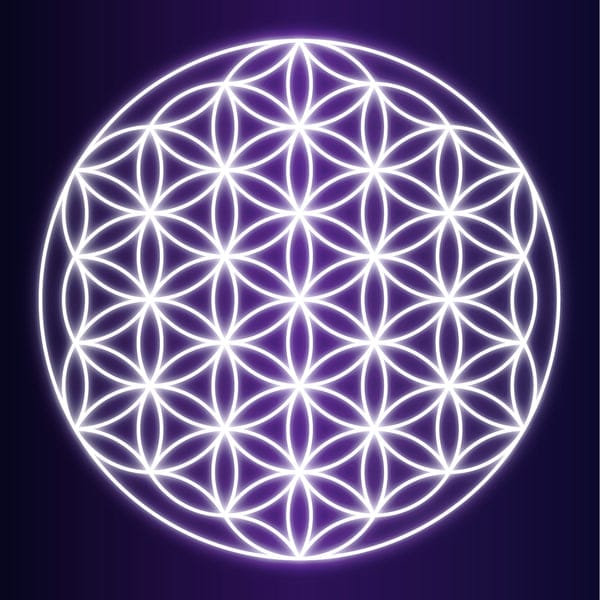
The mesmerizing Flower of Life pattern - a blueprint of creation
The Flower of Life is far more than a beautiful geometric design. This mesmerizing pattern of perfectly overlapping circles creates a flower-like formation with profound six-fold symmetry. For spiritual seekers worldwide, understanding the Flower of Life meaning has become a gateway to the fundamental principles of sacred geometry and universal consciousness.
Often described symbolically as a blueprint of creation, the Flower of Life symbol represents interconnection for many contemporary practitioners. Historically related overlapping-circle patterns also appear in architectural ornament and decorative arts across several cultures.
Historical Origins: The Ancient Flower of Life Pattern
The Flower of Life pattern traces its origins to some of humanity's earliest advanced civilizations. Archaeological evidence reveals its presence across multiple ancient cultures, suggesting a shared recognition of its significance:
Mesopotamia (7th Century BCE)
One of the oldest known examples appears on an Assyrian palace threshold during King Ashurbanipal's reign, carved into stone as a protective symbol.
Ancient Egypt (3000+ Years Ago)
Perhaps the most famous early instance is found at the Temple of Osiris at Abydos, where the pattern is carved into granite pillars. These Egyptian renderings consist of 19 circles drawn in red ochre—a sacred configuration that has fascinated researchers for generations.
Classical World (1st Century BCE)
By the 1st century BCE, the pattern had spread throughout the Mediterranean. A Roman mosaic floor from this period clearly displays the characteristic overlapping circles formation.
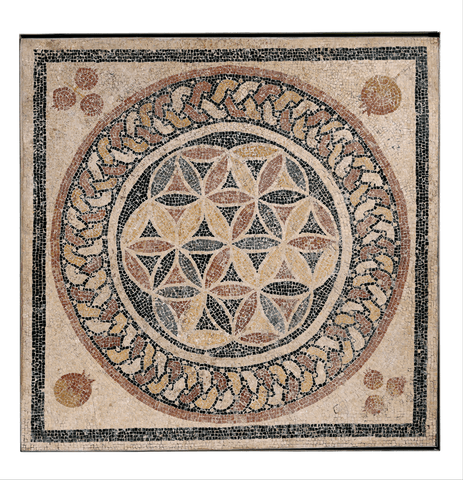
A Roman mosaic floor from the 1st century BCE featuring the Flower of Life pattern
As the pattern traveled across continents, it appeared in diverse contexts. Byzantine churches incorporated similar overlapping circle motifs as protective symbols. Islamic art embraced the geometric framework as a foundation for intricate patterns. Even in Asia, the design found expression in 14th-century Indian temples and within Beijing's 15th-century Forbidden City.
The Sacred Geometry of the Flower of Life
The Flower of Life sacred geometry represents mathematical perfection and profound symbolic meaning. At its core, this geometric marvel consists of evenly spaced circles arranged so that each circle's center lies on the circumference of six surrounding circles of equal diameter.
The Seed of Life: The Pattern's Core
The foundation of the design begins with what's known as the Seed of Life—a formation of seven interlocking circles that creates a perfect six-petaled flower rosette. This seed pattern emerges through elegant geometric construction:
- Begin with a single circle (representing unity or the source)
- Draw six additional circles centered on the circumference of the first at 60° intervals
- This first ring of circles yields the Seed of Life—the germinating pattern from which all else unfolds
Mathematical Marvels Within the Pattern
- Vesica Piscis: Each "petal" creates this almond-shaped lens, representing the threshold between realms
- Hexagonal symmetry: Six equal circles fit around a central circle when every center lies one radius away
- Rosette structure: Repeated circle intersections create the familiar six-petal forms
- Triangular grid: Connecting neighboring centers reveals equilateral triangles
Spiritual Significance of the Flower of Life Symbol
Beyond its mathematical elegance, the Flower of Life symbol holds profound spiritual significance across numerous traditions. This geometric formation is often described as the visual expression of life's interconnected nature and the divine blueprint of creation itself.
Universal Blueprint of Creation
Many spiritual traditions view the Flower of Life meaning as representing the very process of cosmic creation. The pattern illustrates how:
- All creation emerges from a unified source
- Complexity unfolds through perfect mathematical order
- Individual elements remain eternally connected to the whole
Energy, Healing, and Consciousness
- Meditation Focus: Attune to cosmic harmony and raise vibrational frequency
- Chakra Alignment: Balance the seven primary energy centers
- Environmental Harmonizer: Promote positive energy flow in living spaces
- Personal Protection: Worn as jewelry for energetic protection
Artistic and Architectural Expressions
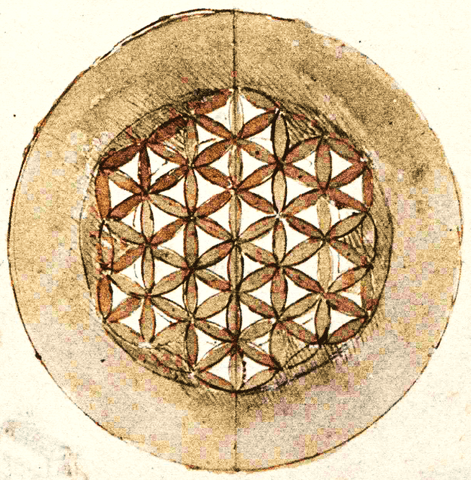
Leonardo da Vinci's sketch of the Flower of Life pattern (Codex Atlanticus, late 15th century)
Historical Artistic Applications
The Renaissance period saw renewed interest through figures like Leonardo da Vinci, who carefully studied the Flower of Life sacred geometry in his notebooks. Across architectural traditions, the pattern appears in various forms:
- Roman and Byzantine mosaics incorporated the pattern into floor designs
- Medieval European cathedrals featured similar rosette patterns in stained glass
- Islamic decorative arts used the overlapping-circle grid as a foundation
- Far Eastern decorative motifs included variations in latticework
Contemporary Creative Expressions
- Featured in New Age artwork and visionary paintings
- Album covers by Coldplay and Bring Me The Horizon
- Popular symbol in fashion and jewelry
- Meaningful body art and tattoo designs
- Incorporated in modern sacred spaces
The Flower of Life in Modern Practice
Today, the Flower of Life symbol continues to find new relevance in spiritual practices, design, and even scientific exploration.
Meditation and Mindfulness
Home and Environment
- Energy Balancing: Creating energetic balance in living spaces
- Sacred Space Creation: Marking meditation areas and healing rooms
- Aesthetic Harmony: Promoting a sense of order and peace
Personal Development
- Visual reminder of our connection to existence
- Perfect symmetry reflects balanced living
- Mirrors healthy psychological development
Deepen Your Sacred Geometry Journey
Ready to explore the profound wisdom of sacred symbols?
Get the Sacred Geometry E-Book ($4.99) Shop Sacred Geometry ArtFrequently Asked Questions
Studio dispatches
New work, new writing — straight to you
Occasional letters from the studio. No spam, unsubscribe anytime.