 PARDESCO
The Torus in Sacred Geometry
A torus is a closed surface shaped like a ring or doughnut, formed mathematically by revolving a circle around an axis in the same plane. In sacred geometry, people often interpret its continuous path as a symbol of circulation, return, balance, and wholeness. The geometry is measurable; the spiritual meaning is metaphorical and depends on the tradition or practitioner.
Key takeaways
- A ring torus has one central hole and no boundary.
- Its surface can be described by a major radius and a minor radius.
- Toroidal geometry appears in engineered magnetic-confinement devices and in mathematical models of some natural systems.
- A scientific use of toroidal topology does not prove claims about a universal human “torus energy field.”
- As a contemplative symbol, the torus offers a clear visual metaphor for cycles and return.
What Is a Torus?
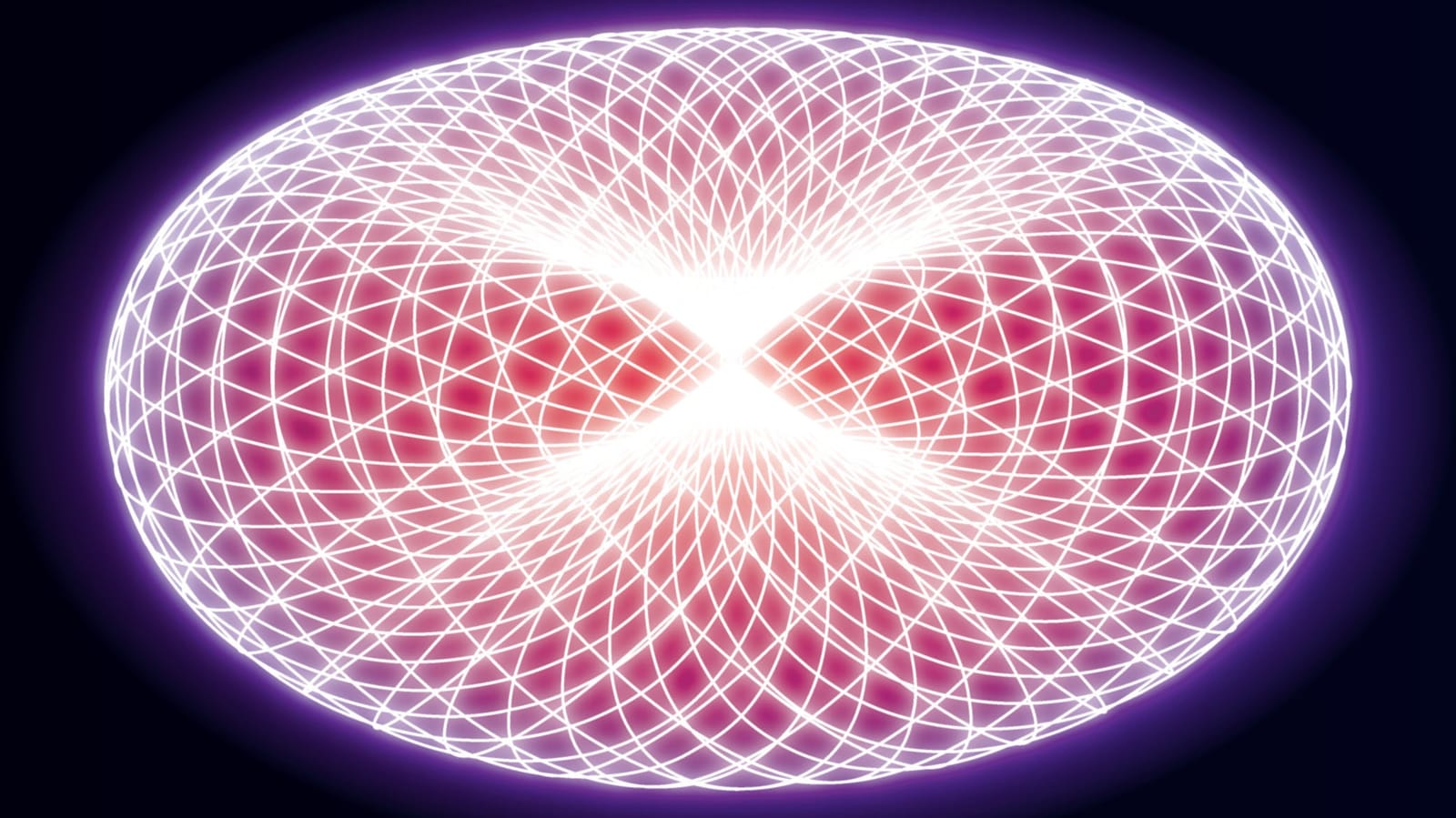
Imagine a circle of radius r. Move its center around a larger circle of radius R while keeping the smaller circle perpendicular to the path. The swept surface is a torus. For the familiar ring torus, R is greater than r.
A standard parametrization is:
x = (R + r cos v) cos u
y = (R + r cos v) sin u
z = r sin v
The angles u and v each run from 0 to 2π. One angle travels around the large central ring; the other travels around the circular tube. Topologically, the surface has genus 1—one hole—and Euler characteristic 0.
Topology cares about continuity more than exact shape. A coffee-mug handle and a ring torus are topologically equivalent because each surface has one hole and one can be continuously deformed into the other without cutting or gluing.
Ring Torus, Horn Torus, and Spindle Torus
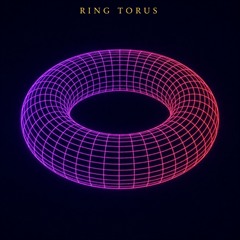
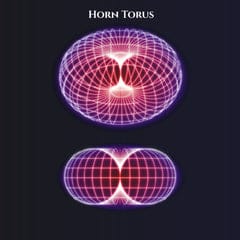
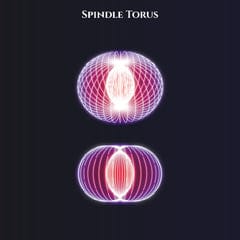
The word torus is also used more broadly. A “flat torus,” for example, is made by identifying opposite edges of a rectangle; it has toroidal topology even though it is not embedded as a doughnut-shaped surface in the plane of the diagram.
Where Toroidal Geometry Appears in Science and Engineering
Magnetic confinement in tokamaks
A tokamak confines hot plasma inside a toroidal vacuum vessel. At ITER, eighteen D-shaped toroidal-field magnets surround the vessel and produce a magnetic field whose primary role is to confine plasma particles. This is a literal engineered use of toroidal geometry, not a spiritual analogy.
Toroidal structure in grid-cell population activity
A 2022 Nature study analyzed simultaneous recordings from grid cells involved in spatial navigation. After dimensional reduction, the researchers found that the population activity occupied a low-dimensional manifold with toroidal topology. This means the network's repeating state space can be mapped like a torus; it does not mean the brain is physically doughnut-shaped or surrounded by a toroidal field.
Toroidal and poloidal magnetic components
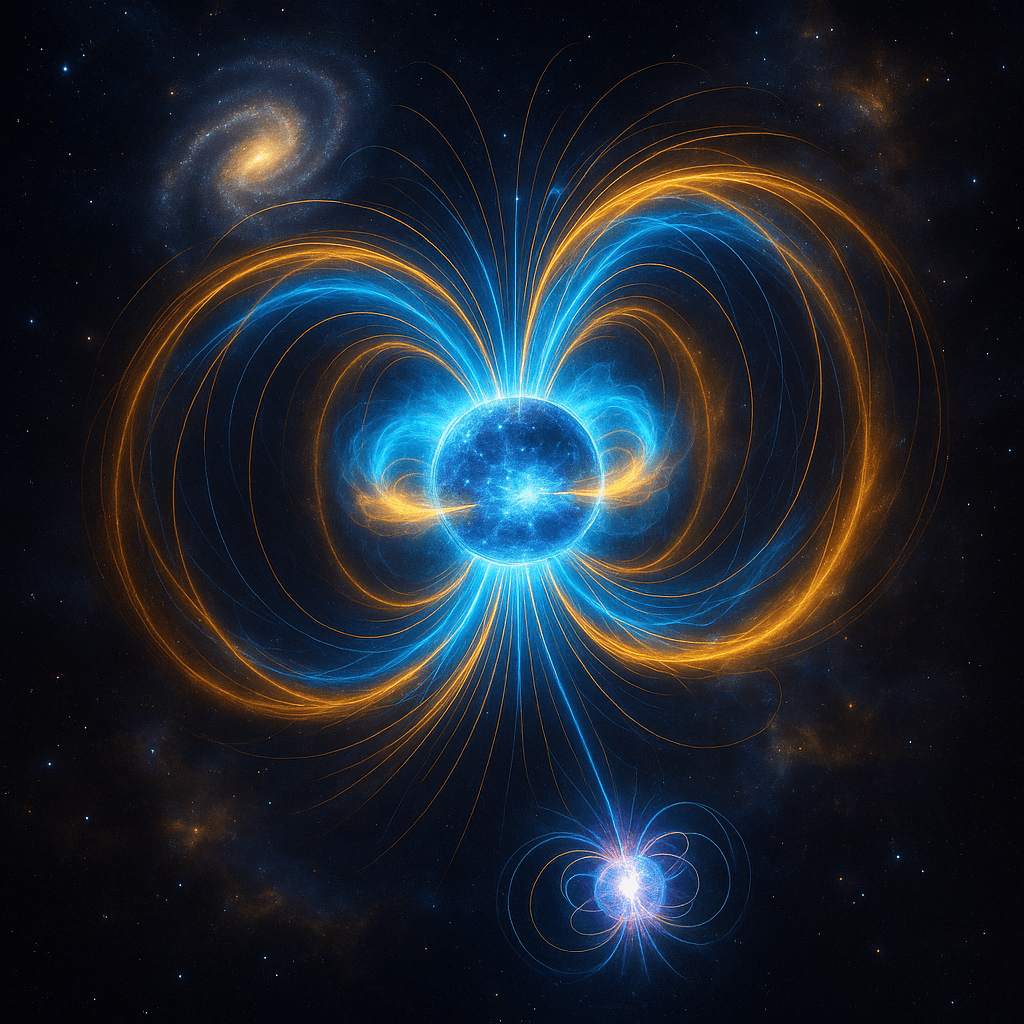
Plasma physics and solar physics distinguish magnetic-field components that run in toroidal and poloidal directions. NASA visualizations of the solar dynamo, for example, show toroidal magnetic bands developing through the Sun's differential rotation. “Toroidal” here describes direction and topology within a physical model.
What science does—and does not—establish
These examples show that toroidal topology is a powerful mathematical description. They do not establish that every organism or galaxy is a torus, that consciousness is generated by a toroidal field, or that visualizing a torus activates a measurable biofield. Those are separate claims and require separate evidence.
Torus Meaning in Sacred Geometry
Because a torus has no boundary edge and allows paths to circulate continuously in two directions, it readily becomes a symbol of:
- Return: a path can loop and come back to its starting region.
- Reciprocity: inward and outward movement can be imagined as parts of one circulation.
- Wholeness: the surface is continuous even though it encloses a central opening.
- Dynamic balance: rotation and flow can occur without changing the surface's underlying topology.
Those readings are useful as symbolism, but there is no single ancient or universal torus doctrine. Different artists and spiritual practitioners build different meanings around the form. A careful interpretation says “the torus can symbolize continuous circulation,” not “the torus proves that all energy flows this way.”
The torus and the Merkaba
The torus and star tetrahedron are distinct mathematical forms. Some contemporary meditation systems combine them in one visualization, imagining a rotating Merkaba inside a circulating torus. That pairing is a modern esoteric practice rather than a theorem of geometry or a shared teaching across all sacred traditions.
Toroidal Geometry in Art
Artists can represent a torus as a shaded surface, a wireframe, a field of circles, a knot winding around two periodic directions, or a projection that compresses three-dimensional form into a flat pattern. Each method emphasizes a different property: volume, topology, circulation, or repetition.
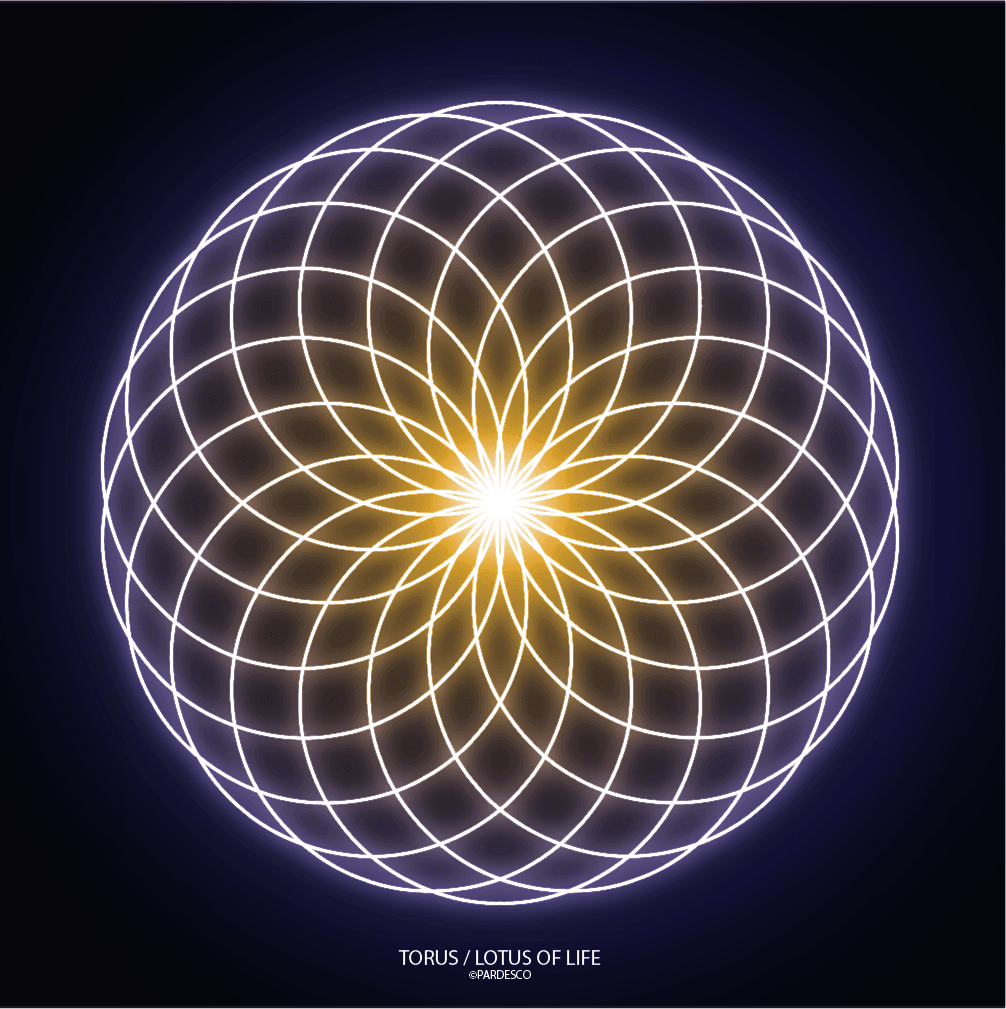
Pardesco's parametric process uses adjustable relationships—radius, repetition, depth, and transition—to turn mathematical structures into carved surfaces. Explore parametric wall art and geometric wood sculpture →
A Grounded Torus Visualization
This exercise is a visual-attention practice. It makes no claim to activate an invisible field or treat a health condition.
- Sit comfortably and breathe at an unforced pace.
- Picture a small ring torus centered in front of you.
- Trace one loop around the tube, then a second loop around the central opening.
- Notice that the two paths describe the torus's two periodic directions.
- If attention wanders, return to the imagined path or to the physical sensation of breathing.
Use the shape as you would a mandala: a structured focus for observation. Stop if the exercise feels uncomfortable, and do not substitute it for medical or mental-health care.
Frequently Asked Questions
What is a torus in simple terms?
A torus is a closed ring-shaped surface made by revolving a circle around an axis outside that circle. A doughnut and an inner tube are familiar approximations.
What does a torus mean spiritually?
Many practitioners use it as a symbol of circulation, return, reciprocity, and wholeness. These are symbolic interpretations, not scientific properties of the surface.
Is the human electromagnetic field proven to be an eight-foot torus?
No reliable evidence establishes that specific claim. Electrical activity from the heart can be measured at the body, and magnetic activity can be detected with sensitive instruments, but that does not validate the popular eight- or twelve-foot “torus field” description.
What did the grid-cell torus study prove?
It found that population activity in recorded grid cells could be represented on a low-dimensional manifold with toroidal topology. It did not show a physical doughnut in the brain or prove spiritual energy-field claims.
How are a torus and a Merkaba different?
A torus is a ring-shaped surface; a Merkaba is commonly represented by two interpenetrating tetrahedra. Some modern visualizations combine them, but they remain different geometric forms.
Studio dispatches
New work, new writing — straight to you
Occasional letters from the studio. No spam, unsubscribe anytime.