 PARDESCO
Mandala Guide: Buddhist, Tibetan and Sand Traditions
From Tibetan monasteries to art therapy rooms, these sacred circles are a centuries-old technology for holding attention — and a case study in how easily an honest tradition acquires dishonest statistics.
Mandalas are transforming how we heal, create, and understand consciousness. The Sanskrit word maṇḍala is usually rendered simply as "circle" or "disc" — the popular gloss "container of essence" comes from parsing it as maṇḍa ("essence") plus la ("container"), a traditional reading rather than a settled etymology. These intricate circular designs have served as spiritual maps, healing tools, and artistic expressions across cultures for millennia. Today, mandalas bridge ancient wisdom with contemporary therapy, appearing in cancer wards, classrooms, and smartphones riding a billion-dollar adult-colouring boom that raises complex questions about cultural respect and authentic practice.
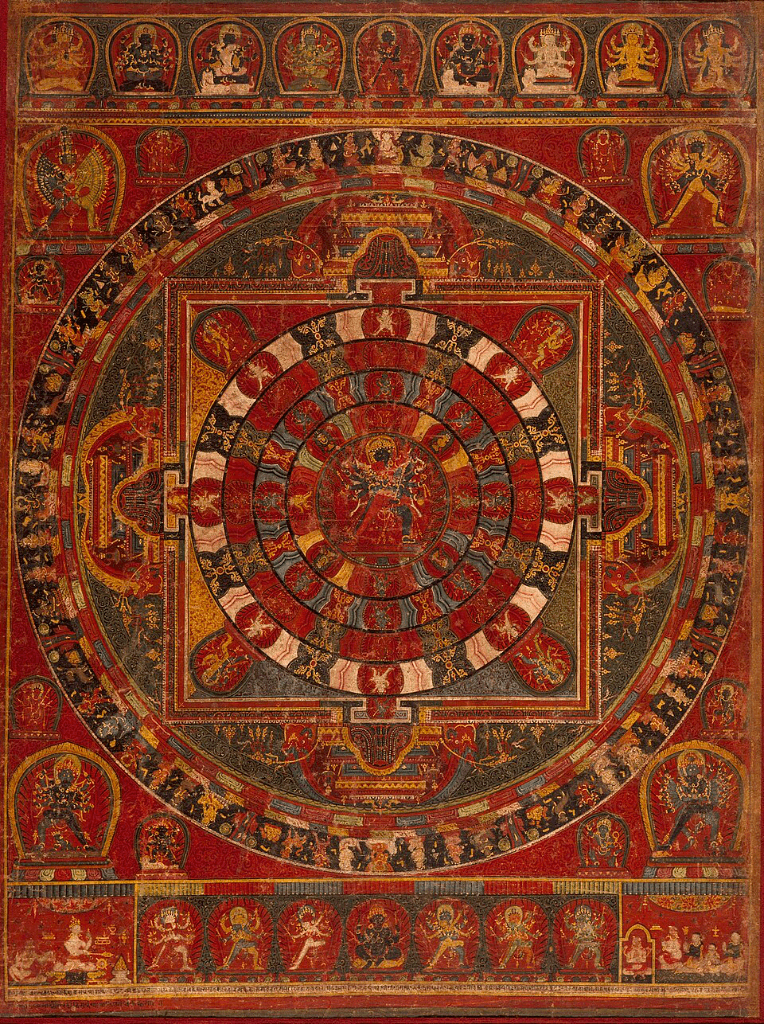
Chakrasaṃvara Mandala (Nepal, ca. 1100 CE) – One of the earliest surviving large mandala paintings, featuring the tantric deity Chakrasaṃvara with consort at the center of a red eight-petaled lotus. The eight cremation grounds filling the black background demonstrate how even death is incorporated into the mandala's cosmic order (Metropolitan Museum of Art, public domain).
Dating to approximately 1100 CE, this early Nepalese mandala provides crucial evidence of the consistency of mandala structure across centuries. Despite its age, it contains all the essential elements found in later mandalas: the central lotus with deity, the four-gated palace, and protective circles. The inclusion of eight cremation grounds – complete with yogis, animals, and trees – arranged symmetrically around the palace illustrates how even seemingly chaotic elements of death and transformation are ordered into mandalic harmony, guiding practitioners through layers of meaning toward enlightenment at the still center.
A Journey Through Sacred Geometry Across Civilizations
The story of mandalas begins not in one place but everywhere humans have sought to understand the cosmos. The earliest mandala-like representations appear in India's Rig Veda around 1500-500 BCE, where the term first described the ten circular books of sacred hymns. Claims that yantra representations date to 11,000 BCE circulate widely online but rest on no archaeological evidence we could verify.
Hindu traditions developed mandalas as vastu purusha mandalas - architectural blueprints for temples that map cosmic energy into physical space. The 8x8 grid of 64 squares, known as the Manduka template, became the foundation for sacred architecture from Konark Sun Temple to Meenakshi Temple. Each square represents an aspect of divine consciousness, with the central Brahmasthana housing the primary deity.
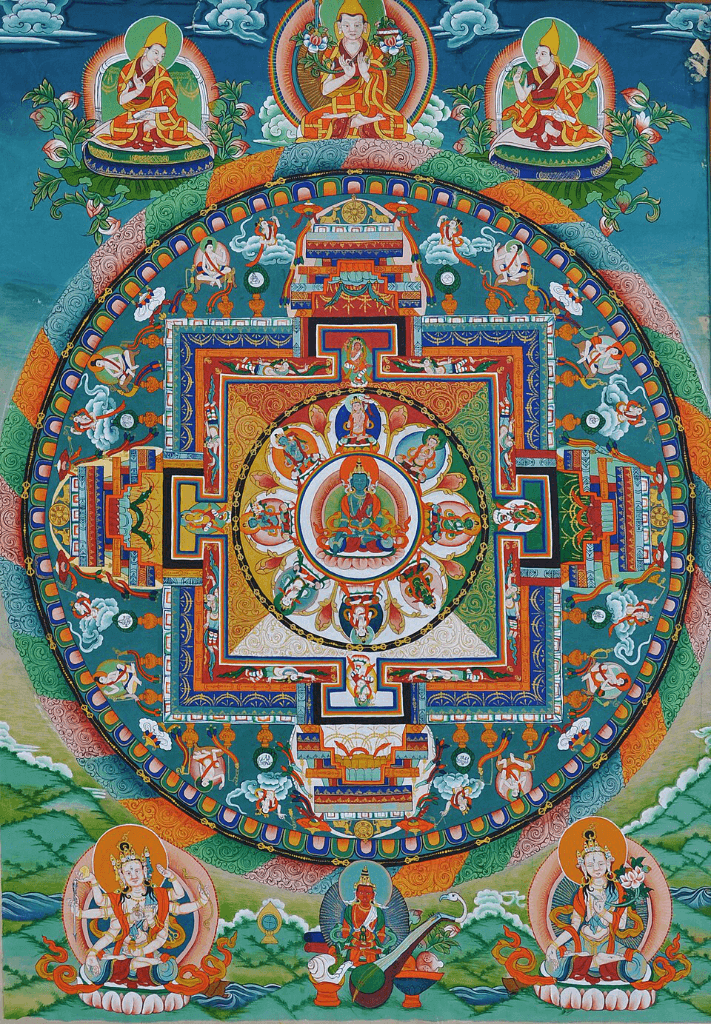
Mandala of the Buddhist deity Chakrasamvara (Nepal, 1490) – a sacred geometric painting with concentric layers of symbols guiding the practitioner toward the center.
Buddhist adaptation began around 450 CE, transforming Hindu concepts into distinct forms. As Buddhism spread via the Silk Road, mandalas evolved into the elaborate Tibetan sand paintings we recognize today. Monks spend weeks creating intricate designs from crushed precious stones, only to sweep them into water upon completion - a profound teaching on impermanence.
Independent Emergence Across Cultures
What makes this phenomenon remarkable is its independent emergence across cultures:
• Native American medicine wheels, some dating to 4000 BCE, share the same circular structure with radiating spokes
• Celtic knots from the 3rd century CE weave infinite patterns within circular boundaries
• Gothic cathedral rose windows transform stone and glass into mandala-like portals of divine light
• Islamic geometric patterns create infinite tessellations that mirror the boundless nature of Allah
• Aboriginal Australian traditions carry one of the longest continuous cultural histories on earth — but the familiar circular dot paintings are a modern movement, beginning at Papunya in 1971
A mandala mural on the ceiling of Shey Monastery's gateway (Ladakh, 17th century), with Buddhist deities arranged in symmetric geometric form to invoke divine blessings.
Understanding Sand Mandalas: The Art of Impermanence
Sand mandalas represent one of the most profound expressions of Buddhist philosophy through art. These intricate Tibetan mandalas are created using millions of grains of colored sand, traditionally made from crushed precious stones like turquoise, lapis lazuli, and coral. The practice, known as dul-tson-kyil-khor in Tibetan, meaning "mandala of colored powders," originated in the 7th century and was brought to Tibet from India in the 11th century.
The Sacred Process of Sand Mandala Creation
The creation of a Buddhist mandala in sand follows strict ritual protocols:
Day 1-2: Opening Ceremony
• Site consecration through elaborate prayers and chanting
• Drawing of the geometric blueprint using white ink on a red base
• Invocation of deities and protective spirits
Days 3-10: Construction Phase
• Teams of monks work in shifts, starting from the center
• Using metal funnels called chak-pur, they release sand grain by grain
• The rasping sound of the chak-pur creates a meditative atmosphere
• Each section is completed with specific mantras and visualizations
Final Day: Dissolution Ceremony
• The completed mandala is consecrated with final prayers
• Sand is swept from the edges toward the center
• Half is distributed to participants as blessings
• Remainder is released into flowing water to spread healing globally
The most complex sand mandalas, such as the Kalachakra mandala, contain 722 deities and can take a team of monks up to three weeks to complete. The deliberate destruction teaches non-attachment and the Buddhist concept of anitya (impermanence).
Decoding the Universal Language of Sacred Circles
The power of mandalas lies in their symbolic density - every element carries meaning refined over centuries of spiritual practice. The circle itself represents wholeness, the cosmos without beginning or end, creating a protected sacred space separate from chaotic external reality.
Understanding the Bhupura: The Sacred Gateway
One of the most misunderstood elements in traditional mandalas is the Bhupura - the square outer enclosure with four T-shaped gates. This architectural element is not merely decorative but represents:
The Bhupura's Sacred Significance:
• The Four Gates: Represent the four cardinal directions and the four immeasurables (loving-kindness, compassion, joy, and equanimity)
• The Square Form: Symbolizes the earth element and material world
• The T-Shape: Creates a threshold between sacred and profane space
• Protection: Acts as a spiritual fortress keeping negative energies out
• Entry Points: Each gate has specific guardian deities and symbolic colors
Understanding these elements is crucial for respectful engagement. When creating or using mandalas, recognizing that each component has centuries of spiritual significance helps avoid trivializing sacred traditions.
The Lotus Mandala: Symbol of Spiritual Awakening
The lotus mandala holds special significance across both Hindu and Buddhist traditions. The lotus flower's journey from muddy waters to pristine bloom perfectly encapsulates the spiritual journey from suffering to enlightenment. In mandala artwork, lotus petals appear in specific configurations:
Lotus Petal Configurations and Meanings:
• 8 Petals: The Noble Eightfold Path in Buddhism
• 12 Petals: The twelve links of dependent origination
• 16 Petals: The sixteen aspects of emptiness
• 64 Petals: The 64 qualities of enlightenment
• 1000 Petals: The crown chakra (Sahasrara) in Hindu tradition
Traditional lotus mandalas often feature multiple rings of petals, each ring representing different levels of spiritual realization. The outermost petals might be depicted as partially closed, symbolizing worldly consciousness, while inner petals open fully toward the divine center.
Core Symbolic Elements
At the mandala's heart lies the bindu - a single point representing pure consciousness, the source from which all creation emanates. Buddhist traditions elaborate this into complex systems where colors correspond to different Buddha families:
The lotus petals that often surround mandala centers carry profound metaphysical significance. Rooted in mud yet blooming pure above water, the lotus represents spiritual transformation - our capacity to rise from darkness into enlightenment.
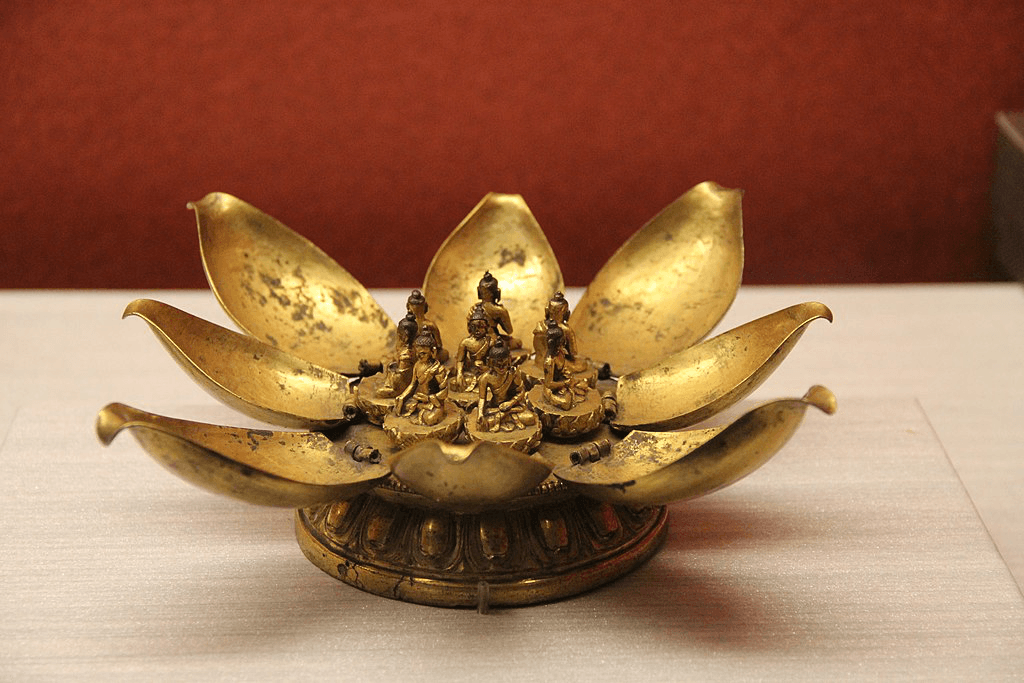
Gilded Tibetan lotus mandala sculpture (17th–18th century) featuring five seated Buddhas arranged on an open lotus flower platform. This three-dimensional mandala unites form and function – the lotus petals serve as thrones while embodying purity and enlightenment (Palace Museum, Taipei; photo by Gary Todd, CC0).
This remarkable gilded bronze piece demonstrates how lotus mandalas transcend two-dimensional representation. The five Buddha figures likely represent the Five Dhyani Buddhas, each associated with a cardinal direction and the center. The lotus's radial symmetry provides a natural mandala structure, with each petal equidistant and each Buddha equanimously placed, manifesting the concept of enlightenment literally blooming outward from a unified center.
Healing Mandalas: Ancient Medicine for Modern Minds
The concept of the healing mandala spans from ancient Ayurvedic medicine to contemporary psychotherapy. These therapeutic mandalas work on multiple levels - psychological, neurological, and energetic - to promote wellness and integration.
Traditional Healing Mandala Applications
In traditional contexts, healing mandalas serve specific therapeutic purposes:
Ayurvedic Healing Mandalas:
• Chakra Mandalas: Balance the seven energy centers of the body
• Dosha Mandalas: Harmonize Vata, Pitta, and Kapha constitutions
• Planetary Mandalas: Mitigate astrological influences
• Mantra Mandalas: Combine sacred sounds with geometric patterns for healing
Tibetan Medicine Mandalas:
• Medicine Buddha Mandala: Visualized for healing self and others
• Five Element Mandalas: Balance earth, water, fire, air, and space
• Protection Mandalas: Ward off illness and negative energies
• Longevity Mandalas: Promote health and extend life
Modern Therapeutic Applications
Mandala work has been studied directly by art therapy researchers — though the evidence base is smaller, and far more preliminary, than popular accounts suggest.
What the research actually supports
The best-known experiments ask people to colour a pre-drawn mandala after a mild anxiety induction, then compare their self-reported anxiety against people who coloured a plain or unstructured design. Several small studies of this kind have found a short-term reduction in reported anxiety. That is the honest extent of the finding: a modest, short-term, self-reported effect, in small non-clinical samples.
It does not establish that mandalas treat any medical condition. Figures circulating online for mandala-driven reductions in chemotherapy anxiety, PTSD symptoms, chronic pain, or insomnia trace to no published study we can find, and we won't repeat them here. Many hospital systems do run art therapy programmes within integrative medicine departments, and mandala work sometimes appears inside them — but the outcome data belongs to art therapy broadly, not to mandalas specifically.
What mandala practice reliably offers is closer to what its traditions always claimed: a structured, repetitive, absorbing focus for attention. That is worth something on its own, and it doesn't need invented statistics to be worth something.
Jung's Revolutionary Discovery Changes Western Psychology
Carl Jung's encounter with mandalas during his "confrontation with the unconscious" — the period beginning around 1916 that produced The Red Book — introduced these sacred forms to Western therapeutic practice. Drawing mandalas daily for a time, Jung described their stabilizing effect:
"I saw that everything, all the paths I had been following, all the steps I had taken, were leading back to a single point—namely the mid-point... It is the path to the center, to individuation."
Jung conceptualized the mandala as an archetype of the Self - not the ego but the totality of personality encompassing both conscious and unconscious aspects. He observed patients spontaneously creating mandala-like images during psychological distress without prior knowledge of the tradition.
What neuroscience can and can't tell us here
Mandala practice gets described online in confident neurological terms — specific percentage drops in default-mode-network rumination, specific increases in alpha-wave activity, brain-computer interfaces reading meditative states off colouring sessions. Those specific figures don't trace to published work.
What's reasonable to say: mandala colouring is a form of focused-attention activity. Sustained, structured attention tasks are genuinely well studied, and they do shift the brain's activity — most consistently by quieting self-referential mind-wandering and shifting people toward a calmer, more absorbed state. Mandala work plausibly sits in that family.
What isn't reasonable to say: that colouring a mandala produces a measured 34% reduction in rumination, or a 42% rise in alpha waves. Numbers that precise imply a study, and the study isn't there. Anyone quoting them — including, until this revision, this article — is passing along invented precision.
Mantra and Mandala: The Power of Combined Practice
Traditional practices often combine mandalas with mantras (sacred sounds) for amplified effect. This synergy works because:
Mantra-Mandala Integration:
• Visual-Auditory Synchronization: Engages multiple brain regions simultaneously
• Rhythmic Entrainment: Mantra repetition synchronizes with mandala's geometric rhythm
• Memory Enhancement: Visual patterns help memorize complex mantras
• Deeper Absorption: Dual focus prevents mind wandering
• Energy Activation: Specific mantras activate different mandala sections
Common mantra-mandala pairings include:
- Om Mani Padme Hum with Avalokiteshvara mandala for compassion
- Om Tare Tuttare Ture Soha with Green Tara mandala for protection
- Tayatha Om Bekanze with Medicine Buddha mandala for healing
- Om Ah Hum with any mandala for body-speech-mind purification
Mathematics Reveals Nature's Hidden Mandala Code
The effectiveness of mandalas may lie in their mathematical properties that mirror patterns throughout nature. Mandalas exhibit fractal geometry - self-similar structures repeating at different scales, like Russian dolls made of infinite complexity. This recursive patterning appears in blood vessel branching, lung structures, neural networks, flower petals, and galaxy spirals.
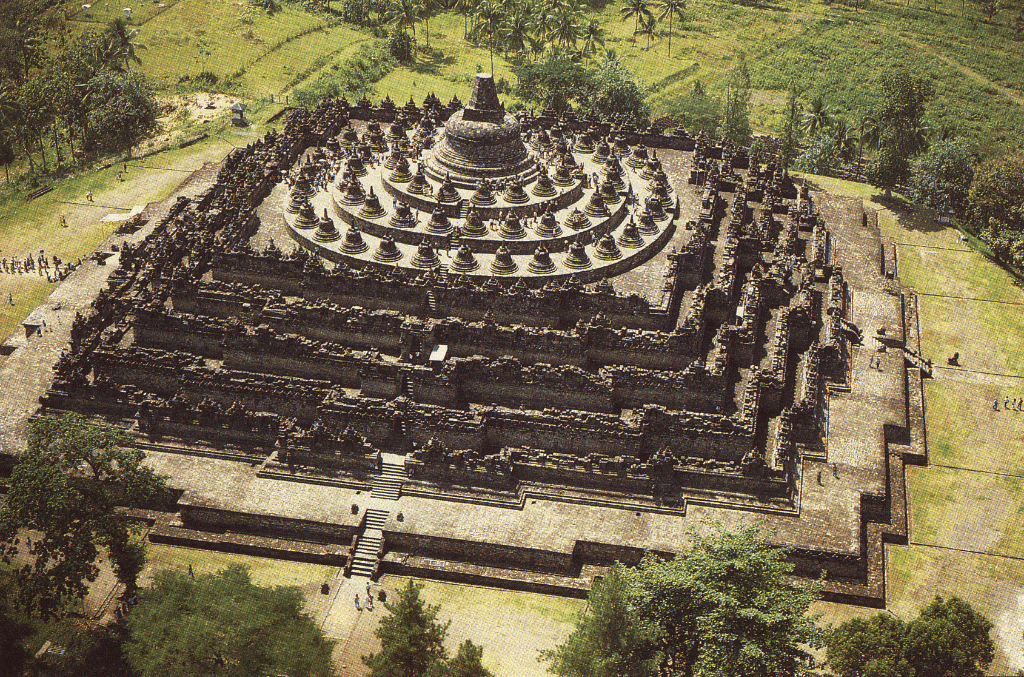
Aerial view of Borobudur Temple (Central Java, 8th–9th century), whose step-pyramid design doubles as a gigantic mandala plan representing the Buddhist cosmos.
Traditional mandalas incorporate the golden ratio (approximately 1.618:1) and Fibonacci sequences that govern natural growth patterns from nautilus shells to hurricane formations. Computer analysis reveals traditional mandala artists intuited these proportions without conscious calculation.
Sacred Geometry Principles
• Radial symmetry radiating from central points
• Rotational symmetry with elements repeating at regular angular intervals
• Translational patterns across space
• The integration of circle and square - "squaring the circle"
• Fractal patterns where simple rules generate infinite complexity
Mandala Painting and Artwork: Traditional Techniques to Modern Expressions
The art of mandala painting encompasses diverse techniques developed over millennia, from traditional thangka paintings to contemporary digital art. Understanding these methods enhances both appreciation and practice of mandala artwork.
Traditional Mandala Painting Techniques
Thangka Painting - The classical method of creating permanent Buddhist mandalas:
Traditional Thangka Process:
• Canvas Preparation: Cotton stretched on wooden frame, treated with chalk and glue mixture
• Grid Construction: Precise geometric guidelines using red ochre
• Pigment Application: Natural minerals ground with water and organic binders
• Gold Detailing: 24-karat gold leaf applied for divine radiance
• Consecration: Final blessing ceremony with mantras and incense
• Time Investment: 3-6 months for complex deity mandalas
Traditional pigments for mandala painting carry specific energetic properties:
Contemporary Mandala Artwork Techniques
Modern artists have expanded mandala artwork through innovative approaches:
Dot Mandala Painting:
• Uses acrylic paints applied with dotting tools
• Creates texture through layered dots of varying sizes
• Popular on rocks, canvas, and wood surfaces
• Time: 2-8 hours for medium complexity
Watercolor Mandalas:
• Employs wet-on-wet techniques for flowing effects
• Salt and alcohol create unique textures
• Masking fluid preserves white space
• Ideal for expressing emotional states
Mixed Media Mandalas:
• Combines paint, collage, and found objects
• Incorporates natural materials like pressed flowers
• Uses metallic leafing and texture paste
• Reflects personal journey and symbolism
Creating Mandalas: From Ancient Ritual to Modern Practice
Traditional Tibetan sand mandala creation remains one of the most elaborate spiritual practices on Earth. Monks begin with site consecration through dance and prayer chants before a qualified lama draws precise geometric designs. Using metal funnels called chak-pur that create meditative sounds when rubbed together, teams work from the center outward over several weeks.
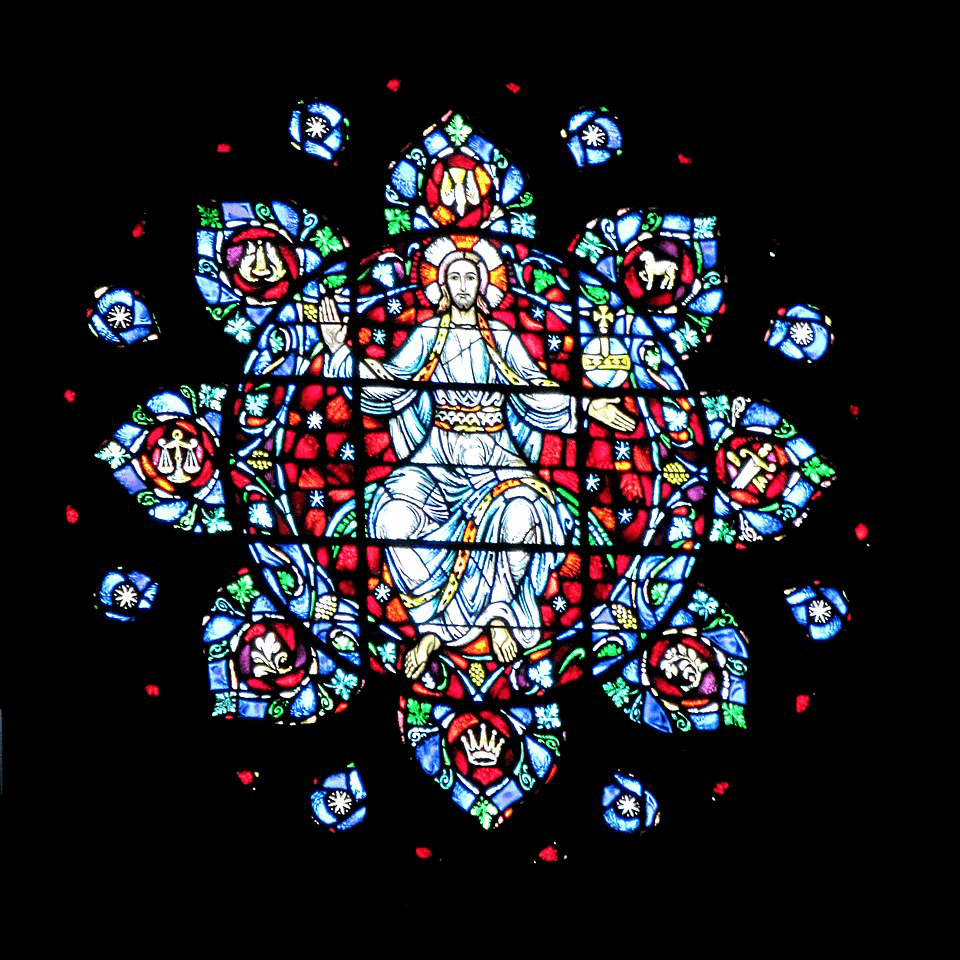
Rose window of Marsh Chapel (Boston University) – a Christian mandala of light, with geometric stained-glass petals spreading from a central Christ figure.
Creating Your First Mandala: A Step-by-Step Guide
Basic Materials Needed:
- Smooth paper (8"x8" for beginners)
- Pencils ranging from 2H to 2B
- Ruler, compass, and protractor
- Fine-tip pens (0.1-0.8mm)
Fundamental Process:
- Establish the center point with intersecting diagonal lines
- Create concentric circles at half-inch intervals using a compass
- Divide into equal sections (4, 6, 8, or 12) with a protractor
- Begin with a basic central motif like a simple flower
- Work outward ring by ring, repeating patterns in each section
- Build complexity gradually with each layer
- Add details with progressively finer pens
Or Generate and Print One
Drawing a mandala by hand is the traditional practice and worth doing at least once — the compass work is where the geometry stops being abstract. But if what you actually want is a page in front of you to colour, we built a tool that does the construction for you.
Pardesco Mandala Studio generates a mandala colouring page in your browser and prints it. Choose the rotational symmetry — 6, 8, 12 or 16, the same orders traditional designs use — and how much detail you want, from open shapes a child can fill in to fine work that will absorb an adult for an hour.
Every design is generated fresh, so the page you print is one nobody else has. Downloads are print-ready at 300 DPI on US Letter or A4, plus vector SVG if you want it poster-sized. It's free, there's no account, and nothing is watermarked — the geometry runs entirely in your browser, so there's nothing for us to meter.
The tool builds designs the same way this section describes: a centre point, concentric rings, equal division into sectors, and a motif repeated around each ring with the counts doubling as they move outward. What takes twenty minutes with a compass takes it a few milliseconds — but the underlying construction is identical, which is why the output looks like a mandala rather than a computer's idea of one.
Types of Buddhist and Tibetan Mandalas: A Comprehensive Guide
Understanding the different types of Buddhist mandalas and Tibetan mandalas helps appreciate their diverse spiritual functions and prevents misappropriation of sacred symbols.
The Five Principal Buddhist Mandala Categories
1. Teaching Mandalas (Dharma Mandalas)
• Used to transmit Buddhist teachings visually
• Include the Wheel of Life (Bhavachakra) depicting samsara
• The Refuge Tree showing lineage of teachers
• Often displayed in monastery entrance halls
2. Deity Mandalas (Ishtadevata Mandalas)
• Feature specific Buddhist deities at the center
• Avalokiteshvara (Compassion) - 1000 arms reaching out to help
• Manjushri (Wisdom) - Flaming sword cutting through ignorance
• Tara (Protection) - 21 forms for different types of aid
• Medicine Buddha - Deep blue figure holding healing herbs
3. Offering Mandalas
• Created as acts of generosity and merit-making
• Include the Universe Mandala offering the entire cosmos
• Use rice, precious stones, or visualized offerings
• Practiced daily by devoted practitioners
4. Initiation Mandalas (Abhisheka Mandalas)
• Used in tantric empowerment ceremonies
• Students enter physically or visualize entering the mandala
• Receive transmission of specific meditation practices
• Destroyed after ceremony to maintain secrecy
5. Body Mandalas
• Map the enlightened qualities onto the human form
• Chakra systems as energy mandalas
• Subtle body channels (nadis) forming geometric patterns
• Used in advanced yogic practices
The Kalachakra Mandala: The Wheel of Time
Among Tibetan mandalas, the Kalachakra holds special significance. This "Wheel of Time" mandala contains:
Kalachakra Mandala by the Numbers
The Dalai Lama has given Kalachakra initiations to over 2 million people worldwide, making it one of the most widely transmitted Tibetan mandala practices. Each initiation involves creating the complete sand mandala, with participants visualizing themselves entering its sacred architecture.
Color Selection and Meaning
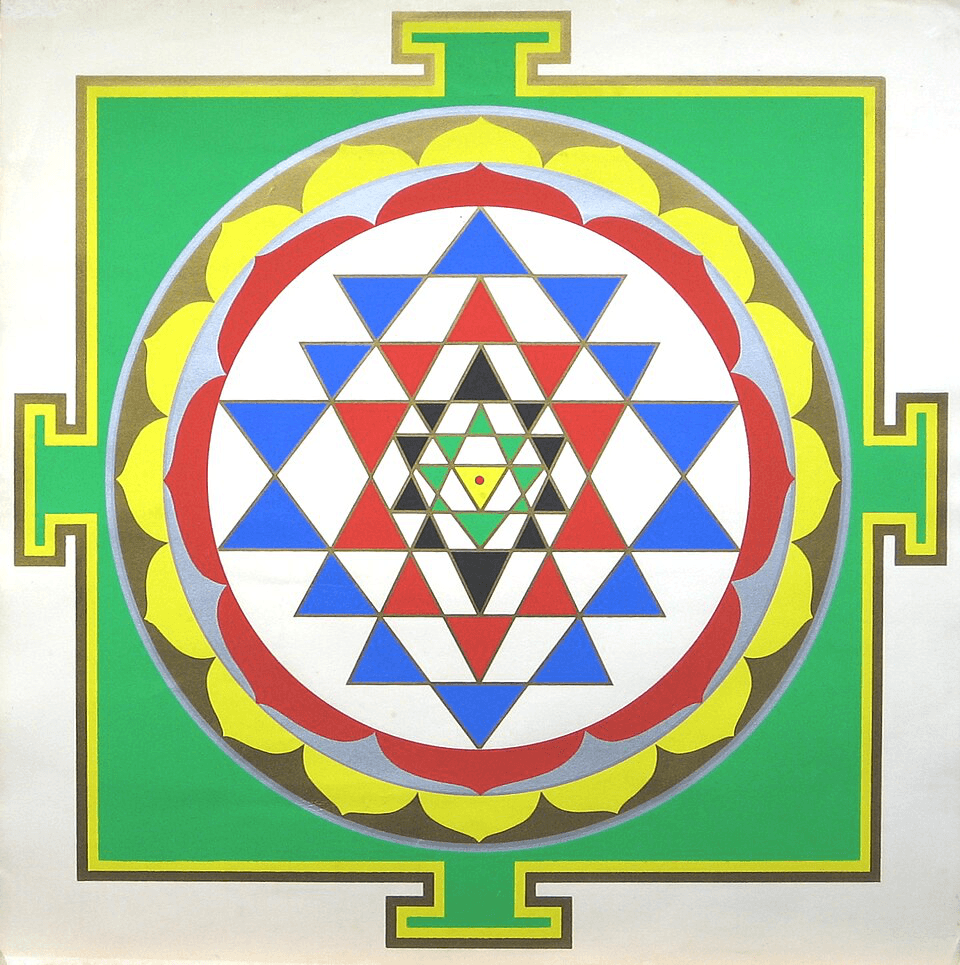
The Śrī Yantra, a sacred Hindu mandala of nine interlocked triangles, shown with traditional color coding (Harish Johari, 1974).
Cross-Cultural Mandala Traditions: A Global Phenomenon
While we often associate mandalas with Eastern traditions, circular sacred geometry appears independently across world cultures, suggesting a universal human impulse toward centered, symmetrical expression of the divine.
Native American Medicine Wheels
The Bighorn Medicine Wheel in Wyoming — the best-known example — is generally dated to roughly 1200–1700 CE, which makes it much younger than Buddhist mandalas rather than older. (The far earlier dates sometimes attached to Bighorn belong to a different site: the Majorville Cairn in Alberta, whose construction is estimated to have begun around 3000 BCE.) These sacred sites share remarkable similarities with Eastern mandalas:
Medicine Wheel Symbolism:
• Four Directions: East (yellow/spring/childhood), South (red/summer/youth), West (black/autumn/adulthood), North (white/winter/elder)
• 28 Spokes: Lunar cycle and ribs in buffalo thorax
• Center Cairn: Creator or individual consciousness
• Seven Stones: Stars of the Big Dipper
• Walking Meditation: Ceremonial circumambulation similar to Buddhist practice
Celtic Sacred Circles and Knots
Celtic mandalas manifest as intricate knotwork within circular boundaries, appearing in illuminated manuscripts like the Book of Kells (800 CE):
- Triquetra: Three interlocked loops representing trinity concepts
- Celtic Cross: Circle intersecting cross, uniting earthly and divine
- Spiral Patterns: Journey of life and spiritual growth
- Endless Knots: Eternal nature of spirit, no beginning or end
- Tree of Life: Connection between earth, heaven, and underworld
Christian Rose Windows as Architectural Mandalas
Gothic cathedrals feature rose windows that function as Western mandalas, transforming light into spiritual experience. The Notre-Dame rose windows (1250 CE) demonstrate mandala principles:
Rose Window Sacred Geometry:
• Central Christ Figure: Divine center point (bindu equivalent)
• 12 Petals: Apostles or months of the year
• Four Quarters: Evangelists or seasons
• Radiating Light: Divine emanation into material world
• Circular Frame: Eternal nature of God's love
Modern Culture Embraces and Challenges Sacred Traditions
The figures usually quoted here — a market worth billions, projected to keep growing — describe the adult colouring book market as a whole, not mandalas specifically. Mandalas are one popular motif within that boom, not the boom itself, and no reliable standalone figure for the mandala segment exists. The boom is real regardless: adult colouring titles went from a niche to a bestseller category over 2014–2015, and mandala designs were among the most reproduced images in it.
This popularization raises complex questions about cultural appropriation versus appreciation. Critics point to mandalas being used "purely for vanity, popularity and consumerism" without understanding sacred origins. Yet many Buddhist teachers welcome wider engagement, seeing it as an opportunity for spiritual awakening.
The Key to Respectful Engagement
Appreciation requires:
• Understanding cultural origins and historical context
• Crediting traditions and supporting authentic artisans
• Maintaining appropriate context and intention
• Educating oneself about sacred meanings
• Supporting traditional knowledge holders
Understanding Cultural Appropriation vs. Appreciation: A Detailed Guide
The line between cultural appropriation and appreciation of mandalas requires careful consideration. Here are specific guidelines for respectful engagement:
❌ Cultural Appropriation Warning Signs:
• Commercial Exploitation: Selling "authentic" mandalas without cultural knowledge or giving back to origin communities
• Sacred Symbol Misuse: Using deity mandalas as decoration, tattoos in inappropriate locations, or party themes
• Misrepresentation: Claiming to teach "traditional" practices without proper training or lineage
• Selective Adoption: Taking aesthetic elements while dismissing spiritual significance
• Cultural Costume: Using mandalas to appear "spiritual" or "exotic" for social media
✓ Respectful Appreciation Practices:
• Education First: Study the history and significance before creating or using mandalas
• Acknowledge Sources: Always credit the tradition (Buddhist, Hindu, Native American, etc.)
• Support Authenticity: Purchase from traditional artists and fair-trade sources
• Maintain Integrity: Don't mix sacred symbols from different traditions carelessly
• Practice Humility: Recognize you're a student of ancient wisdom, not an expert
• Give Back: Support monasteries, indigenous artists, and cultural preservation efforts
Specific Guidelines for Different Mandala Elements
Understanding what elements are particularly sacred helps avoid unintentional disrespect:
Highly Sacred - Approach with Maximum Respect:
• Deity Mandalas: Specific Buddha or Hindu deity images require initiation to use properly
• Tantric Symbols: Sexual or esoteric imagery has specific ritual contexts
• Mantras in Sanskrit/Tibetan: Sacred sounds should be learned from qualified teachers
• Ritual Implements: Vajras, bells, ritual daggers have ceremonial purposes only
Generally Acceptable for Respectful Personal Use:
• Geometric Patterns: Basic circular designs without specific deities
• Nature Mandalas: Using flowers, stones, and natural materials
• Abstract Mandalas: Personal creative expressions inspired by mandala principles
• Coloring Book Mandalas: Designed specifically for stress relief and creativity
How to Learn Authentically
For those genuinely interested in traditional mandala practices:
- Seek Qualified Teachers: Learn from monasteries, cultural centers, or certified instructors
- Start with Basics: Begin with simple geometric mandalas before approaching sacred forms
- Understand Context: Study the philosophy and culture, not just the art form
- Join Communities: Participate in cultural centers and support their programs
- Practice Patience: Traditional knowledge unfolds slowly with dedicated study
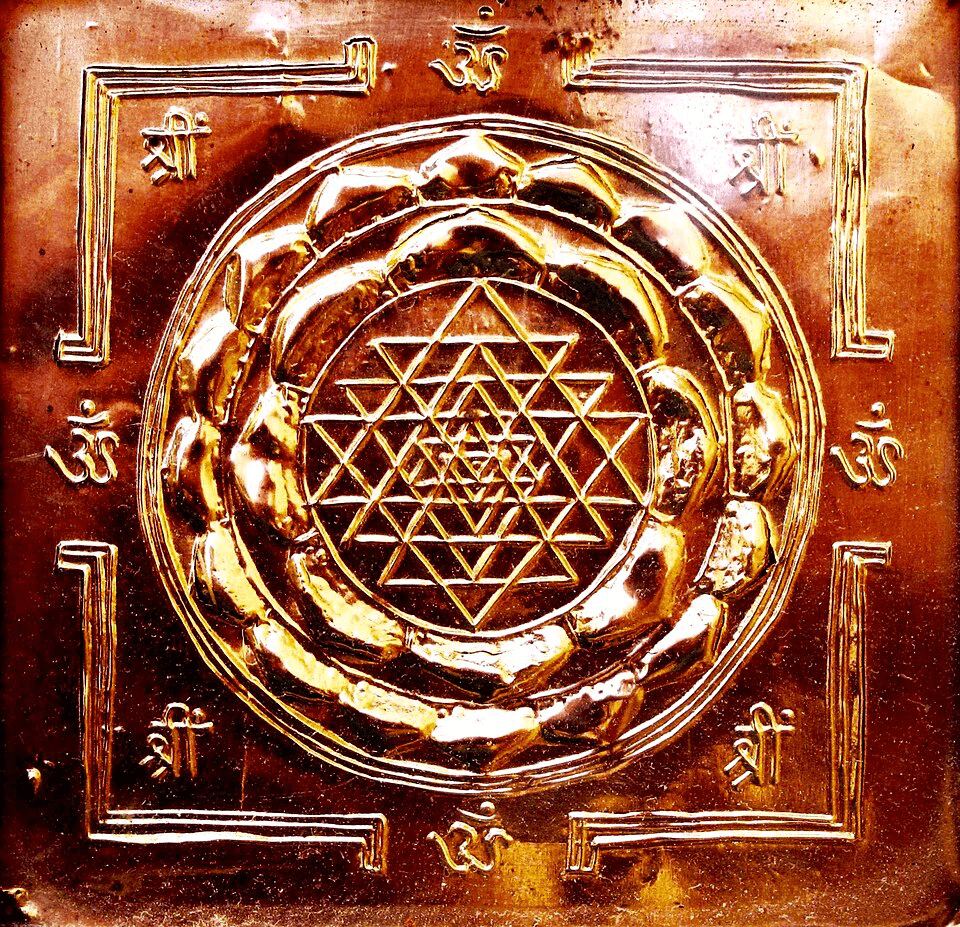
A copper relief of the Śrī Yantra (modern), showing the mandala's nine interlocking triangles and lotus petal frame in three-dimensional form.
Educational and Therapeutic Applications
Educational applications show particular promise across all age groups — though here too, the specific percentages that circulate (improvements in focus, test scores, participation rates) don't trace to identifiable studies, so we've dropped them rather than repeat them.
Why mandalas work in a classroom
The case for mandala work in education doesn't rest on effect sizes. It rests on what the activity is: a task with a clear structure, no wrong answer, an obvious stopping point, and a visible result. That combination is unusually forgiving for students who struggle with open-ended creative work or with sustained sitting.
It also happens to be real geometry. Constructing a mandala means dividing a circle into equal parts, working with radial symmetry, and repeating a motif around an axis — the same operations a geometry lesson covers abstractly. That connection is worth making explicitly, and it needs no statistics to justify.
Medical schools use mandala creation for student well-being, self-awareness development, and burnout prevention. Special education programs use mandalas for ADHD support, autism spectrum expression, and fine motor development.
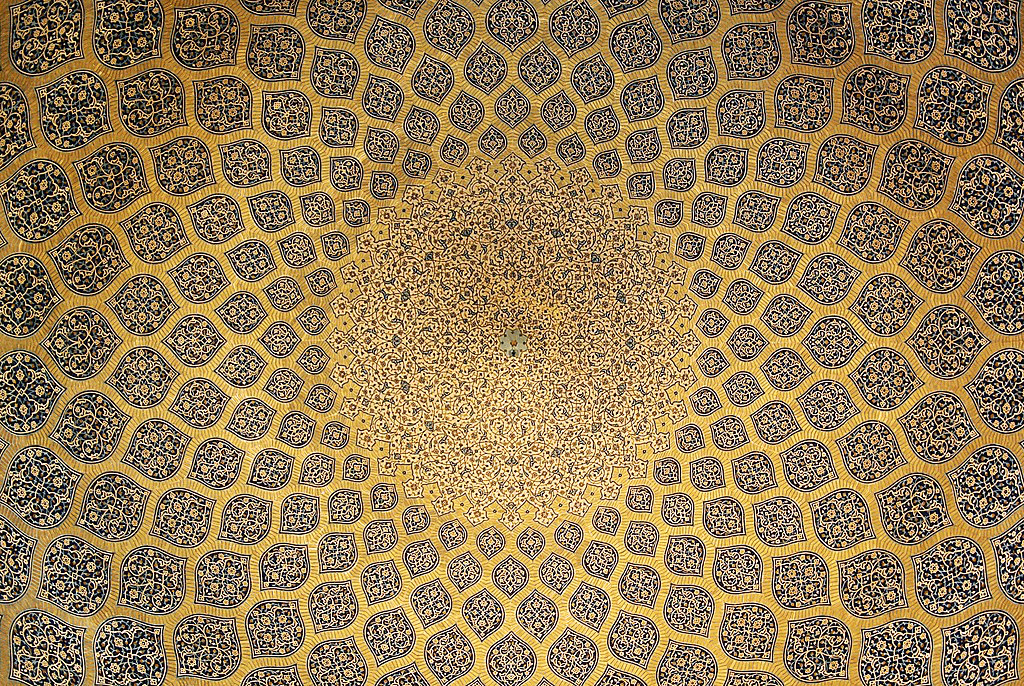
Interior of the Sheikh Lotfollah Mosque dome (Isfahan, Iran, 17th century) – an Islamic geometric pattern radiating from the center, often likened to an architectural mandala.
Architectural Mandalas: Sacred Geometry in Stone and Space
Some of the world's most magnificent sacred structures are three-dimensional mandalas, designed to guide spiritual journeys through physical space. These architectural mandalas demonstrate how sacred geometry transcends two dimensions.
Borobudur: The World's Largest Mandala
Borobudur in Java, Indonesia (built 750-850 CE) is essentially a massive three-dimensional Buddhist mandala in stone:
Borobudur's Mandala Structure:
• Base: Kamadhatu (world of desire) - hidden reliefs of earthly temptations
• Middle: Rupadhatu (world of forms) - 5 square terraces with 2,672 relief panels
• Top: Arupadhatu (formless world) - 3 circular platforms with 72 stupas
• Center: Main stupa representing Nirvana
• Walking Path: 3-mile circumambulation route ascending through Buddhist cosmology
• Buddha Statues: 504 statues in specific mudras for each direction
Hindu Temple Mandalas: The Vastu Purusha
Hindu temples are built according to the Vastu Purusha Mandala, a sacred architectural blueprint:
Temple Mandala Mathematics
Labyrinth Mandalas: Walking Meditation Paths
Labyrinths represent a unique form of mandala designed for walking meditation, found in cultures worldwide:
Types of Labyrinth Mandalas:
• Classical Seven-Circuit: Found in ancient Crete, represents seven chakras
• Chartres Cathedral: 11-circuit design from 1201 CE, pilgrimage substitute
• Baltic Wheel: Scandinavian stone labyrinths for fishing magic
• Man in the Maze: Tohono O'odham nation's journey of life symbol
• Contemporary: Hospital and park labyrinths for healing walks
Walking a labyrinth mandala activates similar neurological responses to seated mandala meditation, with the added benefits of bilateral stimulation through movement, grounding through physical activity, and metaphorical journey work.
The Future of Mandalas: Ancient Wisdom Meets Emerging Technology
Virtual reality mandalas offer immersive three-dimensional sacred spaces where users walk through geometric structures experiencing mathematics as architecture. Brain-computer interfaces provide real-time neurological feedback during creation, personalizing practices to individual neural patterns.
Research priorities include:
• Larger clinical trials with diverse populations
• Longer follow-up periods assessing sustained benefits
• Mechanism studies understanding exactly how mandalas affect consciousness
• Cultural collaboration with traditional knowledge holders
• Educational integration with teacher training programs
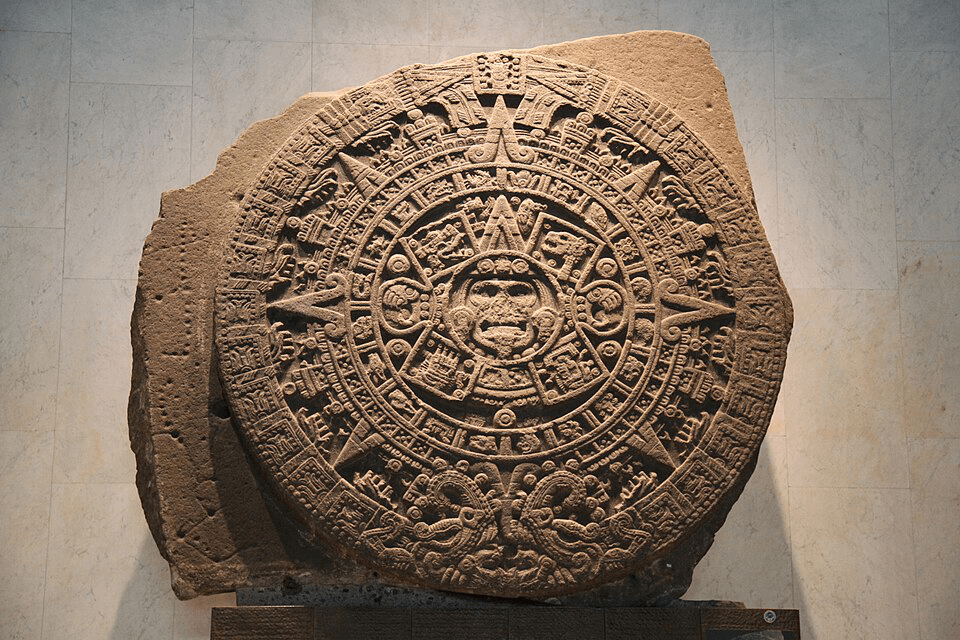
The Aztec Sun Stone (circa 15th century) – a circular cosmological mandala of the Mexica, detailing the epochs of creation and the ritual calendar in symmetric concentric design.
Sacred Circles for Contemporary Consciousness
Mandalas demonstrate that some human innovations transcend their origins to become universal languages of consciousness. From Tibetan monks creating sand paintings grain by grain to neuroscientists mapping brain waves during coloring sessions, from Jung's personal crisis drawings to AI-generated fractal patterns, mandalas reveal themselves as technologies of integration - tools for harmonizing the disparate aspects of modern life into coherent wholes.
The research clearly demonstrates measurable benefits: reduced anxiety and PTSD symptoms, improved focus in ADHD, enhanced geometric reasoning, decreased cortisol levels, and activated mindfulness networks in the brain. Yet quantifying these effects only partially captures what practitioners have known for millennia - that the simple act of creating centered, symmetrical beauty from basic geometric principles somehow reorganizes consciousness itself.
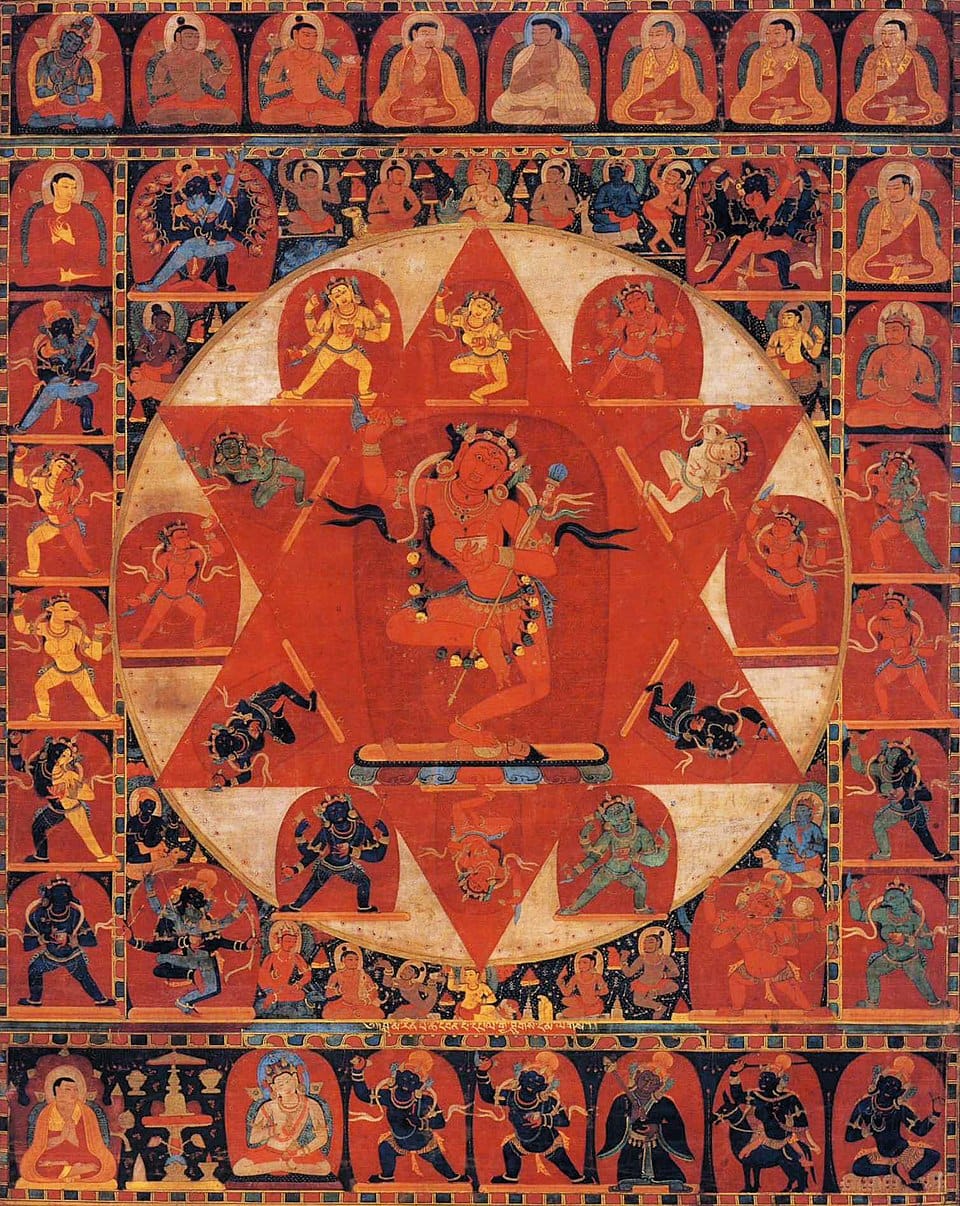
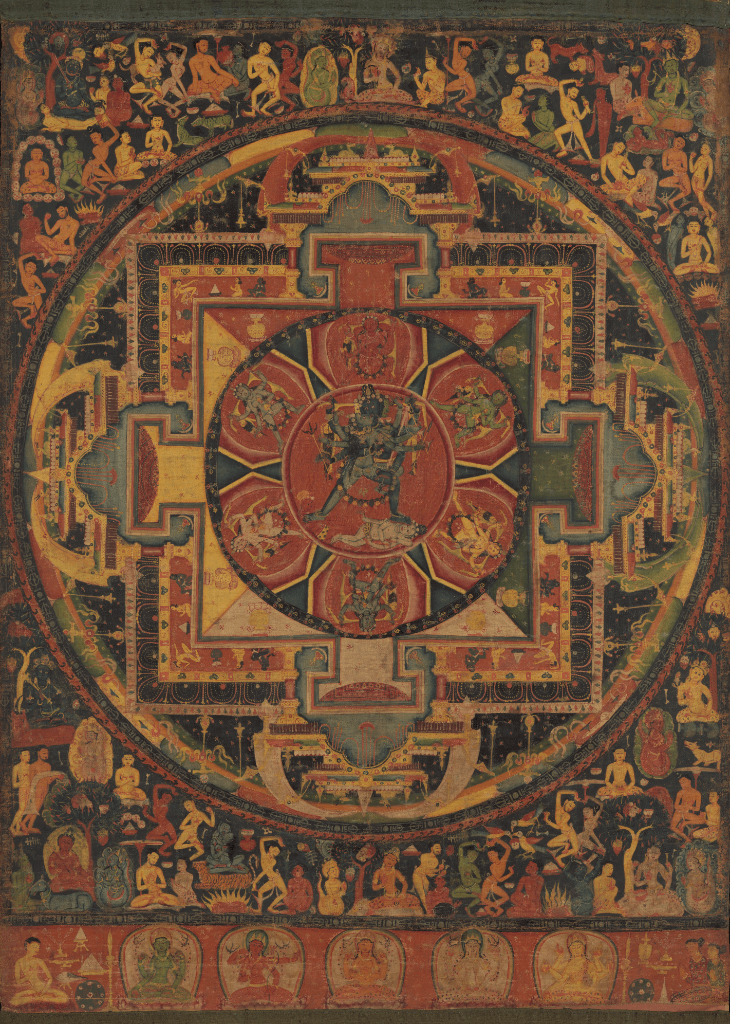
Mandala of Vajravārāhī (Tibet, 14th century) – A Sakya school thangka painting featuring the fierce red tantric goddess dancing within an eight-petaled lotus, surrounded by deity figures and a geometric palace with T-shaped gateways. The vibrant reds and fiery motifs reflect the goddess's transformative power (Metropolitan Museum of Art, public domain).
This 14th-century example demonstrates the sophisticated iconography of deity mandalas. The eight-petaled lotus surrounding Vajravārāhī signifies spiritual unfolding, with each petal containing a deity representing an aspect of enlightened energy. The perfect geometric alignment – with circles nested within squares and the deity at the exact center – exemplifies the mandala's role as a map of both the cosmos and consciousness.
Moving forward requires balancing accessibility with authenticity, innovation with tradition, and commercial interests with cultural respect. Whether you approach mandalas as spiritual practice, therapeutic tool, artistic expression, or meditative hobby, the invitation remains the same: pick up a compass, find your center, and begin drawing circles within circles.
In that ancient gesture lies a pathway both timeless and urgently contemporary - a practice that honors where we've come from while pointing toward where we might go as conscious beings seeking wholeness in a fragmented world.
Your Next Steps: Beginning Your Mandala Journey
Ready to explore the transformative power of mandalas? Here are concrete ways to begin:
For Beginners:
- Start Simple: Download free printable mandala templates to color
- Try Nature: Create a small mandala with leaves or stones in your yard
- Join a Class: Search for "mandala workshop" in your area
- Use Apps: Try MandalaGaba or Zen Mandala for digital creation
- Read Further: "Creating Mandalas" by Susanne Fincher for therapeutic approaches
For Deeper Study:
- Buddhist Centers: Many offer sand mandala demonstrations and teachings
- Art Therapy Programs: Professional training in therapeutic mandala use
- Sacred Geometry Courses: Understanding mathematical principles
- Cultural Immersion: Visit temples, museums with mandala collections
- Retreats: Dedicated mandala meditation retreats worldwide
Resources for Continued Learning
Books:
• "The Mandala Book" by Lori Bailey Cunningham
• "Jung and the Making of Modern Psychology" by Sonu Shamdasani
• "Mandala: Journey to the Center" by Bailey Cunningham
• "The Art of the Mandala" by Losang Samten
Online Resources:
• Asia Society's Mandala Exhibition (asiasociety.org/exploring-mandala)
• Rubin Museum's Mandala Lab (rubinmuseum.org)
• Cornell University's Mandala Project
• The Mandala Project healing initiatives
Support Traditional Artists:
• Tibet House US - Preserving Tibetan culture
• Drepung Loseling Monastery - Sand mandala tours
• Indigenous art cooperatives worldwide
• Fair trade mandala art from Nepal and India
Remember: The power of mandalas lies not in perfect execution but in mindful engagement. Whether you're coloring a simple design, creating elaborate sand paintings, or simply observing the mandala patterns in nature around you, you're participating in an ancient human tradition of seeking center, balance, and wholeness. Begin where you are, with what you have, and let the circle guide you home.
Frequently Asked Questions
What does the word 'mandala' actually mean?
In Sanskrit, maṇḍala is usually rendered simply as 'circle' or 'disc'. The popular translation 'container of essence' comes from reading it as maṇḍa, meaning essence, plus la, meaning container — a traditional gloss rather than a settled etymology.
Do mandalas have proven health benefits?
The honest answer is smaller than the popular one. Small studies have found that colouring a pre-drawn mandala produces a short-term reduction in self-reported anxiety compared with unstructured colouring. That is a modest effect in non-clinical samples. Specific figures circulating online for effects on chemotherapy anxiety, PTSD, chronic pain or sleep do not trace to published research.
What is the difference between a mandala and a yantra?
A mandala is generally a representational and cosmological diagram — a symbolic map of a realm, palace or deity's domain, often rich in imagery. A yantra is more abstract and instrumental: a geometric figure used as a focus for a specific practice or mantra. The Sri Yantra is the best known example, and the categories overlap in practice.
Why are Tibetan sand mandalas destroyed after they are made?
The dismantling is part of the practice, not a postscript to it. Sweeping the sand together and returning it to running water enacts the teaching on impermanence that the mandala was constructed to express. A permanent sand mandala would contradict its own subject.
Is it disrespectful to make my own mandala?
Drawing or colouring a mandala for your own practice is widely regarded as fine. The care is needed around consecrated forms with specific ritual function, around selling work that borrows directly from a living tradition without acknowledgement, and around mixing sacred elements from unrelated traditions into a single decorative design.
Studio dispatches
New work, new writing — straight to you
Occasional letters from the studio. No spam, unsubscribe anytime.