 PARDESCO
Sri Yantra Meaning – A Sacred Symbol of Divine Energy
Introduction: The Power of Sacred Geometry
In the realm of sacred geometry, the Sri Yantra stands as humanity's most powerful symbol of divine energy and cosmic harmony. Also known as the Shri Yantra, Sri Chakra, or Shree Yantra, this ancient geometric masterpiece has captivated spiritual seekers for millennia with its profound ability to channel cosmic energy and represent the universe's creation.
The term Sri Yantra derives from Sanskrit: Sri meaning "auspicious" or "revered," and Yantra meaning "instrument" or "geometrical device" – essentially translating to "sacred instrument". True to its name, this mystical diagram serves as a powerful tool that channels cosmic energy through its precise geometric design, representing both the origin of the universe and the union of masculine and feminine divine forces.
Key Insight: The Sri Yantra meaning transcends its visual beauty. For spiritual practitioners, it functions as a cosmic map guiding the journey toward enlightenment. Within Hinduism's tantric practices, it's revered as the visual embodiment of the divine – earning its title as the "queen of yantras."
What is the Sri Yantra? Understanding the Divine Blueprint
The Sri Yantra is a complex sacred geometry figure that has served as a mystical diagram (yantra) for thousands of years, invoking spiritual power and profound insight. While it may appear as merely a symmetrical web of interlocking triangles at first glance, this intricate design carries layers of cosmic meaning.
The Sacred Construction
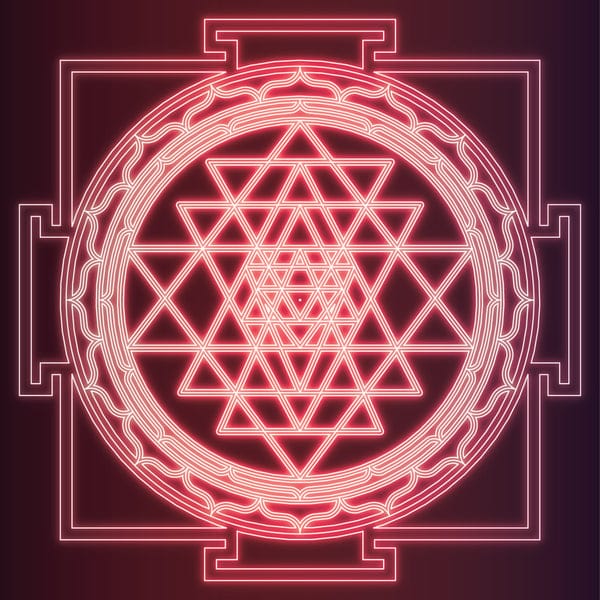
Composed of nine interlocking triangles radiating from a central point, the Sri Yantra creates a geometrically precise pattern used as a powerful meditation focus. The configuration includes:
- 4 upward-pointing triangles – Representing Shiva (masculine/transcendent principle)
- 5 downward-pointing triangles – Embodying Shakti (feminine/creative force)
- 43 smaller triangles – Formed by their intersection, depicting the entire cosmos
This interpenetration symbolizes the union of masculine and feminine divine energies – a cosmic harmony creating balance throughout the universe. Sometimes called the Navayoni Chakra ("nine sources"), it references the womb-like creative symbolism of the divine feminine.
Living Energy Field: The Sri Yantra isn't merely artistic – it's revered as a living energy field in spiritual practice. In the Shri Vidya school of Hindu Tantra, it's the central object of devotion and meditation, considered the sacred geometric form of goddess Tripura Sundari.
Geometric Elements and Symbolism: Decoding the Sacred Pattern
The Sri Yantra's transformative power lies in its sacred geometry – every line and shape deliberately combines to create a symbolic blueprint of creation itself.
🔺 Nine Interlocking Triangles
The foundation of the Sri Yantra consists of nine primary triangles overlapping in perfect harmony:
- 4 Upright triangles: Masculine principle (Shiva/consciousness)
- 5 Inverted triangles: Feminine principle (Shakti/energy)
- 43 Total triangles: Created by intersection, representing manifold existence
This arrangement illustrates that reality arises from the interplay of fundamental polarities – the divine union at the core of existence.
⚫ Bindu (Central Point)
At the Sri Yantra's heart lies the Bindu – a dot of supreme significance representing:
- The single point of cosmic origin and unity
- The creative womb of the universe
- The junction where physical and spiritual merge
- The still center from which all energies emanate
Focusing on the bindu during meditation helps practitioners merge consciousness with universal oneness, embodying Advaita (non-duality).
🌸 Concentric Lotus Petals
Two rings of lotus petals surround the triangles:
- Inner ring (8 petals): Creation and divine energy flow
- Outer ring (16 petals): Material realm extension and vital life force (prana)
The lotus symbolizes purity, spiritual unfolding, and consciousness blossoming – representing growth and dynamic vitality emerging from the bindu's stillness.
⬜ Outer Square (Bhupura)
The entire diagram is encased in a square frame with four T-shaped gates:
- Known as the Bhupura – the "temple" or sacred enclosure
- Four gates facing cardinal directions (N, S, E, W)
- Represents the earthly realm and physical world
- Serves as a protective boundary for inner sacred space
Stepping through these gates symbolically enters a sanctified temple – a gateway to the divine realm.
Microcosm of the Macrocosm: Each element works in harmony, making the Sri Yantra a perfect representation of creation (emanation from the One), preservation (cosmic order maintenance), and dissolution (return to unity). Some teachings regard it as a visual representation of the primordial sound "Om."
Historical Context and Cultural Significance
The Sri Yantra's origins are shrouded in ancient mystery, deeply embedded in the Indian subcontinent's rich spiritual tapestry. This sacred symbol has been integral to Vedic and Tantric traditions for millennia.
Ancient Roots
While its exact origin date remains unknown, scholars trace the Sri Yantra back to antiquity:
- A connection is sometimes drawn to the Śrī Sūkta, a late appendix hymn to the Rigveda — but that reading is one scholar’s interpretation, not consensus, and the hymn contains no yantra diagram
- The earliest texts that actually describe how to construct the figure are considerably later; nothing survives that shows the full diagram in Vedic times
- Rose to prominence within Tantra and Shaktism (goddess worship)
Sri Vidya Tradition
By the early medieval period — the earliest known construction text dates to the late 9th century CE — the Sri Yantra had become central to:
- Sri Vidya: A tantric cult focused on Divine Mother worship
- Lalita Tripura Sundari: The "Beautiful Goddess of the Three Worlds"
- Nava Chakra: Nine enclosures, each with specific deities and significance
- Saundarya Lahari: Famous tantric poem describing Sri Yantra worship
Temple Installation
Tradition credits the philosopher Adi Shankaracharya (8th century CE) with installing Sri Chakras in several temples. This is devotional history rather than documented record — the Sri Chakra now in the Kanchipuram shrine carries an inscription dating its installation to the 16th century, by Nrusimhadvari. What the tradition does tell us is how the object is treated:
- Treated with same reverence as deity idols
- Daily puja (ritual worship) performed with flowers, sandalwood, incense
- Best-known example: Kamakshi Temple in Kanchipuram
- Symbolizes that the geometric form equals the anthropomorphic deity
Cultural Bridge: The Sri Yantra historically bridged worldly life (artha and kama) with spiritual life (dharma and moksha), suggesting the Goddess's energy pervades all realms. Kings kept it for luck and success, while yogis used it for meditation and spiritual empowerment.
Spiritual and Meditative Applications
The Sri Yantra endures as a prominent symbol due to its practical spiritual applications. Beyond elaborate geometry and mythology, it serves as a powerful tool for inner transformation.
🧘 Meditation and Concentration
Tratak meditation (steady gazing) on the Sri Yantra deepens concentration:
- Focus softly on the center bindu
- Allow gaze to encompass the whole pattern
- Naturally draws mind into single-pointed focus
- Unlocks profound insights and heightened awareness
- Aligns individual mind with cosmic order
🏠 Energizing Spaces
In Vastu Shastra and modern holistic living:
- Attracts positive energy and prosperity
- Balances energy fields in spaces
- Removes negative influences
- Associated in household practice with prosperity — though the Sri Yantra’s own deity is Lalita Tripura Sundari, not Lakshmi, as this article notes elsewhere
- Promotes harmony in relationships
🙏 Ritual Worship (Sri Yantra Puja)
Ceremonial worship of the diagram as Divine Mother embodiment:
- Adorned with flowers, rice, sandalwood, vermilion
- Specific mantras chanted (Panchadasi mantra)
- Nine levels worshipped in sequence
- Symbolic journey toward divine center
- Confers spiritual merit and worldly fulfillment
🏛️ Sacred Architecture
Influence extends into temple design:
- Inspires temple floor plans and designs
- Concept of moving through sacred spaces
- Sri Meru: 3D pyramidal form
- Represents Mount Meru (cosmic mountain)
- Template of divine order in sacred spaces
💫 Personal Transformation
Modern practitioners use for healing and growth:
- Clears energy blockages
- Aligns chakras (energy centers)
- Normalizes human biofield (aura)
- Breaks through life obstacles
- Holistic wellness tool for mind, spirit, environment
Sri Yantra in Modern Times: Ancient Wisdom for Today
Despite ancient origins, the Sri Yantra experiences a remarkable resurgence in modern times, crossing cultural and religious boundaries to appeal to diverse spiritual seekers worldwide.
🧘♀️ Spiritual and New Age Communities
- Universal symbol of balance and manifestation
- Featured in yoga studios and meditation centers globally
- Exemplar of sacred geometry in teachings
- Included in mindful coloring books for stress relief
- Used in guided meditations worldwide
💆 Holistic Healing and Wellness
- Energy healing sessions incorporate Sri Yantra graphics
- Crystal grid work combined with ancient symbolism
- Life coaches use for manifesting abundance
- Entrepreneurs keep as desk talismans
- Fusion of spirituality with professional life
🎨 Art, Design, and Culture
- Contemporary paintings and digital art
- String art and laser-cut designs
- Popular tattoo symbolizing spiritual growth
- Fashion jewelry and wearable art
- Blends mathematics with spirituality
🔬 Scientific Interest
- Mathematicians study perfect geometric construction
- Psychology researchers examine meditation effects
- EEG studies show coherent brainwave patterns
- Bridge between ancient wisdom and modern science
- Consciousness research applications
🌐 Digital Age Proliferation
- Social media spreads awareness globally
- Sacred geometry forums discuss meanings
- Ambassador of Hindu sacred geometry
- Accessible to anyone visually
- Sparks interest in Hindu philosophy
Conclusion: Embracing the Sacred Journey
The Sri Yantra, with its mesmerizing interlocking triangles and lotus petals, transcends its role as an ancient drawing – it's a symphony of spirituality, geometry, and mythology encoding humanity's deepest wisdom about the universe's nature.
The Sri Yantra's meaning encompasses the union of divine energies, the cosmic map, and the pathway to spiritual realization. It bridges material and spiritual, outer and inner, many and one – reminding us that within life's complexity lies a center of stillness and unity we can always return to for peace and guidance.
In our modern world of rediscovered ancient practices, the Sri Yantra continues to inspire and transform. Whether drawn by its artistic beauty, metaphysical benefits, or rich cultural background, engaging with the Sri Yantra offers profound rewards. You might meditate with its image, decorate your space with its design, or simply reflect on its philosophy – aligning yourself with generations of truth-seekers who've used this sacred symbol as a doorway to the infinite.
Deepen Your Sacred Geometry Journey
Ready to explore the profound world of sacred symbols like the Sri Yantra? Discover comprehensive insights into ancient wisdom and geometric patterns that have guided humanity for millennia.
Explore "The Essence of Sacred Geometry" E-BookExpand your understanding of ancient wisdom and support the sharing of these transformative teachings. Let geometric wisdom guide you toward prosperity, balance, and inner peace.
Frequently Asked Questions
How many triangles does the Sri Yantra contain?
Nine primary triangles: four pointing upward, associated with Shiva, and five pointing downward, associated with Shakti. Their interpenetration generates 43 smaller triangles, which are then enclosed by rings of 8 and 16 lotus petals and a square bhupura with four gates.
Which deity is the Sri Yantra associated with?
Lalita Tripura Sundari, the central goddess of the Sri Vidya tradition. She is frequently confused with Lakshmi in popular accounts, but they are distinct figures and the Sri Yantra belongs to Lalita.
Is the Sri Yantra the same thing as the Sri Chakra?
The terms are used almost interchangeably. In careful usage, Sri Yantra refers to the two-dimensional diagram and Sri Chakra to the same design as a consecrated ritual object, including the three-dimensional pyramidal Meru form.
How old is the Sri Yantra?
Older in tradition than in documented evidence. The earliest known texts describing its construction date to around the late ninth century CE. Temple traditions attributing much earlier installations to Adi Shankaracharya are devotional history rather than verified record — the Sri Chakra at the Kamakshi temple in Kanchipuram, for example, carries an inscription dating its installation to the sixteenth century.
How is a Sri Yantra used in practice?
In Sri Vidya practice it is a meditation support rather than an object of worship in itself. The practitioner's attention moves inward through the enclosures toward the bindu at the centre, or outward from it, treating each layer as a stage. It is a structured focus for attention, and traditions describe it in spiritual rather than medical terms.
Studio dispatches
New work, new writing — straight to you
Occasional letters from the studio. No spam, unsubscribe anytime.