 PARDESCO
Lotus Mandala Coloring Pages
The lotus — padma — ring is the most characteristic element of a mandala, and the one most often drawn wrongly. Traditional lotus rings do not sit in separate bands. Each row of petals rises through the row beneath it, and that overlap is what holds the design together as a single fabric rather than a stack of separate hoops.
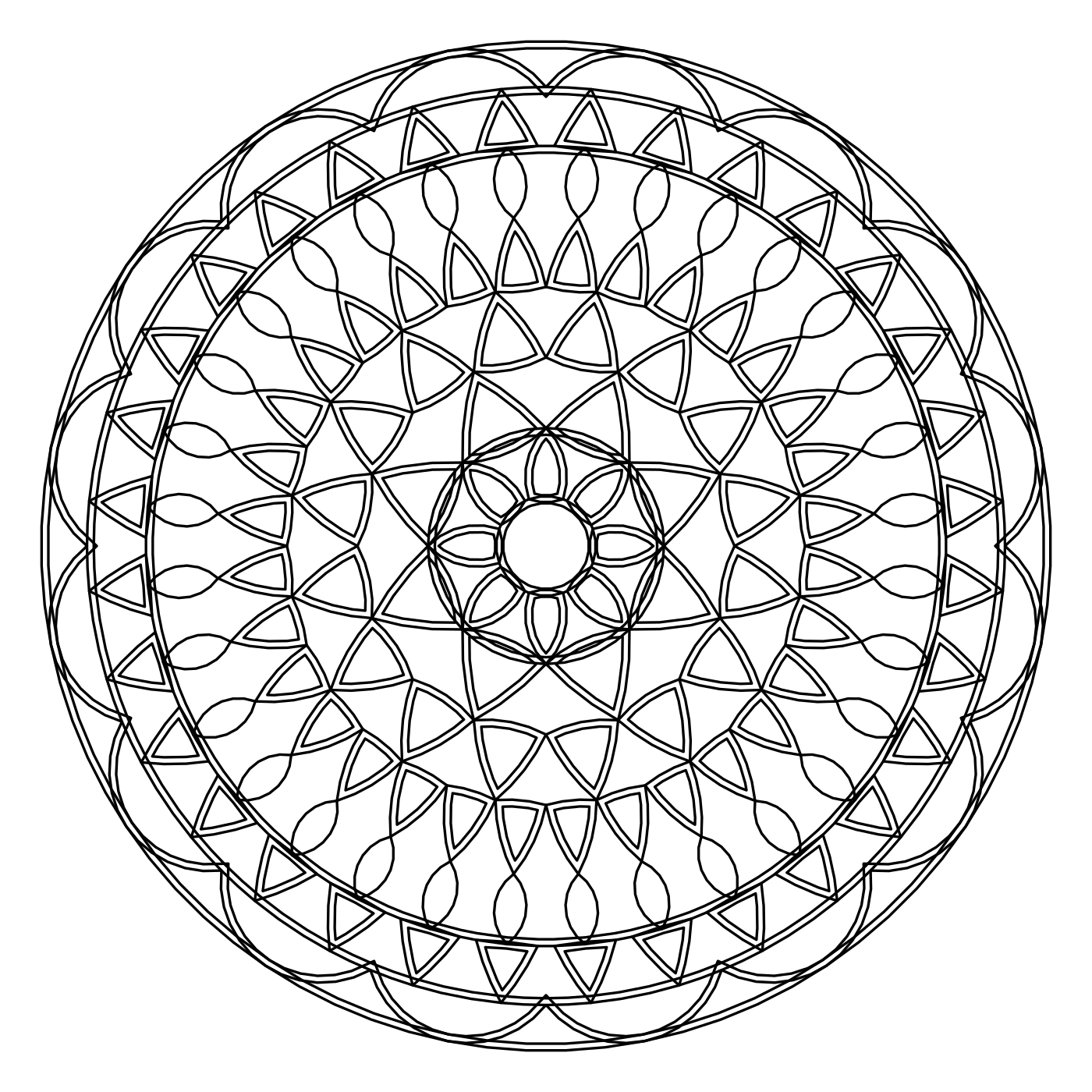
How a lotus ring is built
- Divide the circle into equal sectors. Petal counts run 4, 8, 16, 24, 32, 64, 108 — always the traditional doubling, never an arbitrary number.
- Each petal spans from an inner radius to an outer one, with its base occupying part of its sector and its tip on the centreline.
- Two circular arcs run from the base corners to the tip. Their curvature decides whether the petal reads as a sharply pointed Tibetan padma or a blunt, fleshy lotus.
- The next row out is rotated by half a sector, and its two base corners land ON the tips of the two petals beneath it — so the rows are joined at every apex rather than merely overlapping.
What is documented, and what isn’t
This studio sells sacred-geometry work, so it matters that the difference is stated rather than blurred. Padma is inspired by the tradition below — it is not a reconstruction of it.
Documented
- Petal counts and their doubling. Interior mandala lotus rings specifically use 4, 8, 10 and 16 petals.
- That successive rows overlap and are offset by half a sector.
- That the grid is laid down first, in proportional units, before any ornament is drawn.
Not documented — our construction, not history
- How much the rows overlap. No tradition we could find records an overlap fraction — manuals record counts, placement and proportional units, not ratios. Our generator does not use one: each row’s base corners are placed exactly on the tips of the row beneath, so the rows are welded at those points and no overlap figure is needed. That construction is described from a photograph of someone drawing a mandala by hand — evidence of a practice, not a cited source.
- Petal tip angles. No source states them numerically. The ranges we use are a house calibration.
Sources
Other styles
- Bloom — Big round petals with petals drawn inside them. Few regions, easy to colour.
- Lancet — Tall pointed arches split by mullions, ring after ring, with a dentil rim.
- Mandorla — Compass work only: a seed of life, lens rings, and flower-of-life lattices.
- Oculus — Rings of tangent circles with trefoils inside, between sectioned bands, under a cusped rim.
- Filigree — A star polygon core, chevron rings and fish-scale fills. Dense, for fine pens.