 PARDESCO
Rose Window Mandala Coloring Pages
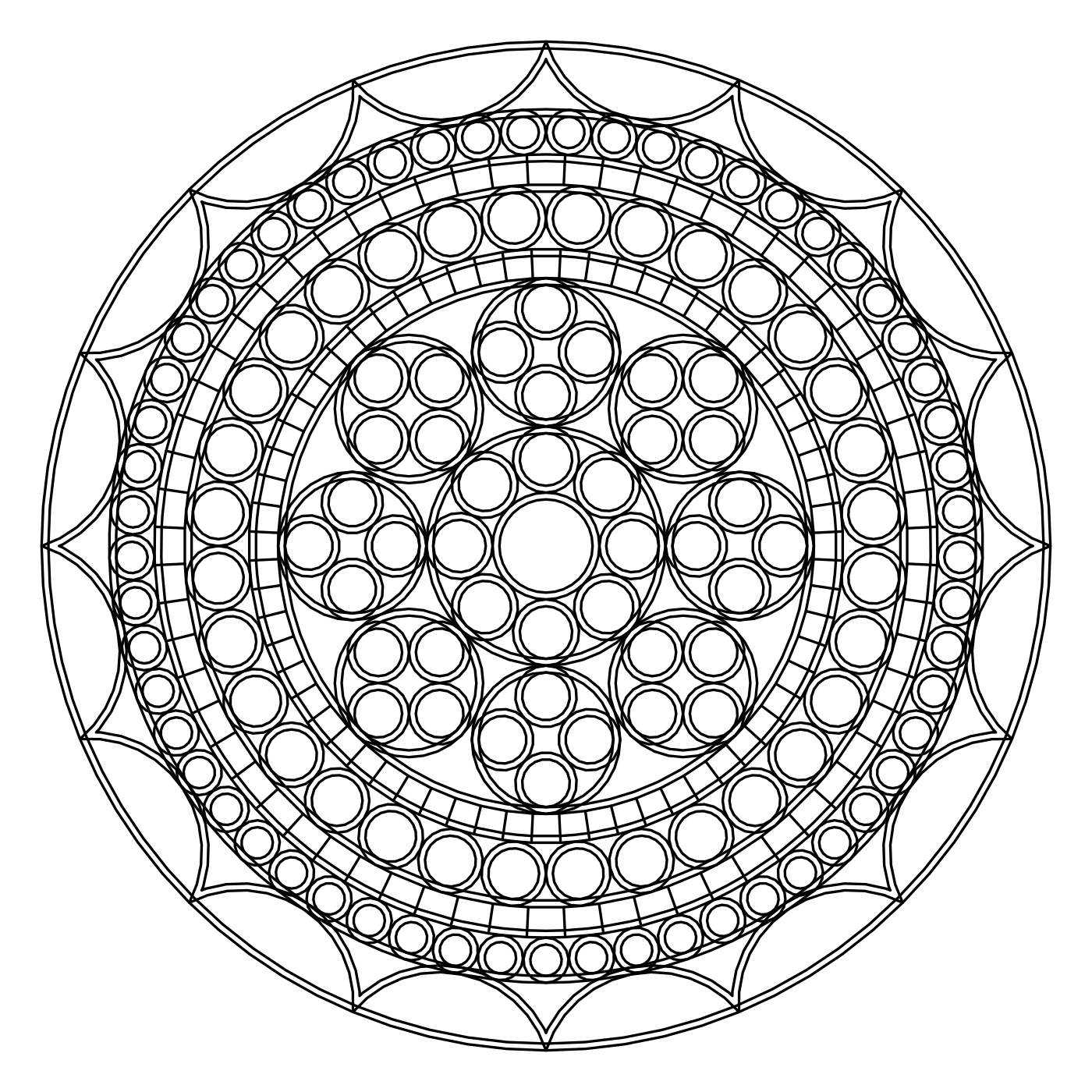
A Gothic rose window is a mandala by another name: a circle divided by radiating stone ribs into equal sectors, filled with bands of smaller circles. It is the one radial tradition where the underlying geometry is still standing in daylight and can simply be measured.
How rose tracery is set out
- Draw the oculus — the main circle.
- Divide it into equal sectors with radiating mullions. Rayonnant windows, from the 1240s, make these thin spokes running from a central boss.
- Inscribe a ring of equal sub-circles, each tangent to its neighbours and to the oculus.
- Fill each sub-circle with foils — the trefoils and quatrefoils that give tracery its lobed look. Our generator sizes each band of sub-circles so every circle is tangent to its two neighbours and to the rings on either side, then fits three or four smaller tangent circles inside each one at the finer detail settings.
What is documented, and what isn’t
This studio sells sacred-geometry work, so it matters that the difference is stated rather than blurred. Oculus is inspired by the tradition below — it is not a reconstruction of it.
Documented
- The distinction between plate tracery, where openings are pierced through a stone plate, and the bar tracery of slender ribs that replaced it in the 13th century.
- The Rayonnant scheme of spoke-like mullions radiating from a central oculus.
Not documented — our construction, not history
- Any numeric rule for sizing the sub-circles. We found none. The relation we use — for n circles tangent to each other and to the oculus, r/R = sin(π/n) / (1 + sin(π/n)) — is simply what tangency forces, so any correctly built window obeys it. But we have no source saying masons expressed it that way, so treat it as geometry, not as history.
Sources
Other styles
- Padma — Pointed lotus petals in interlocking rows, out to a scalloped rim.
- Bloom — Big round petals with petals drawn inside them. Few regions, easy to colour.
- Lancet — Tall pointed arches split by mullions, ring after ring, with a dentil rim.
- Mandorla — Compass work only: a seed of life, lens rings, and flower-of-life lattices.
- Filigree — A star polygon core, chevron rings and fish-scale fills. Dense, for fine pens.