 PARDESCO
Mathematical Art Made with AI Agents: The Fourth Dimension Plates
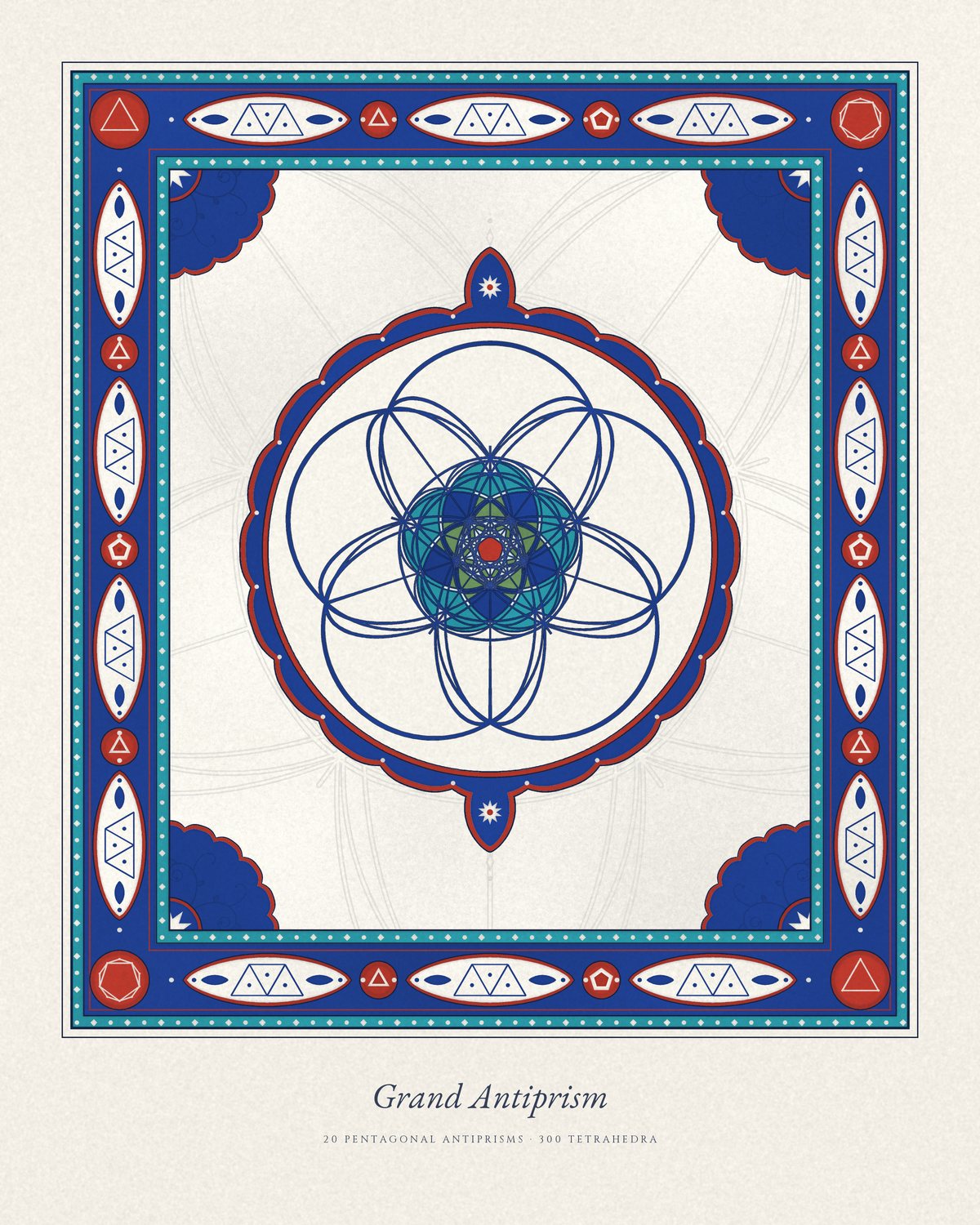
These plates are mathematical art made with AI agents, and the code that made them is public. Anyone can download it, run it and get back the same image, byte for byte. That is the point of this post: to show what the agents did, what I did, and how you can check both.
Each plate takes a four-dimensional polytope, projects every one of its edges down to a drawing, and sets that drawing as the medallion of an illuminated page. AI coding agents wrote the software to my specifications. No generative image model was used anywhere. Below is how the plates work, the full record of the decisions behind them, and the repository that reproduces them.
What the plates are
A four-dimensional polytope is the 4D relative of a polyhedron: a closed shape bounded by 3D cells, the way a cube is bounded by squares. You cannot see one directly, so every picture of one is a projection, and the choice of projection is most of the art.
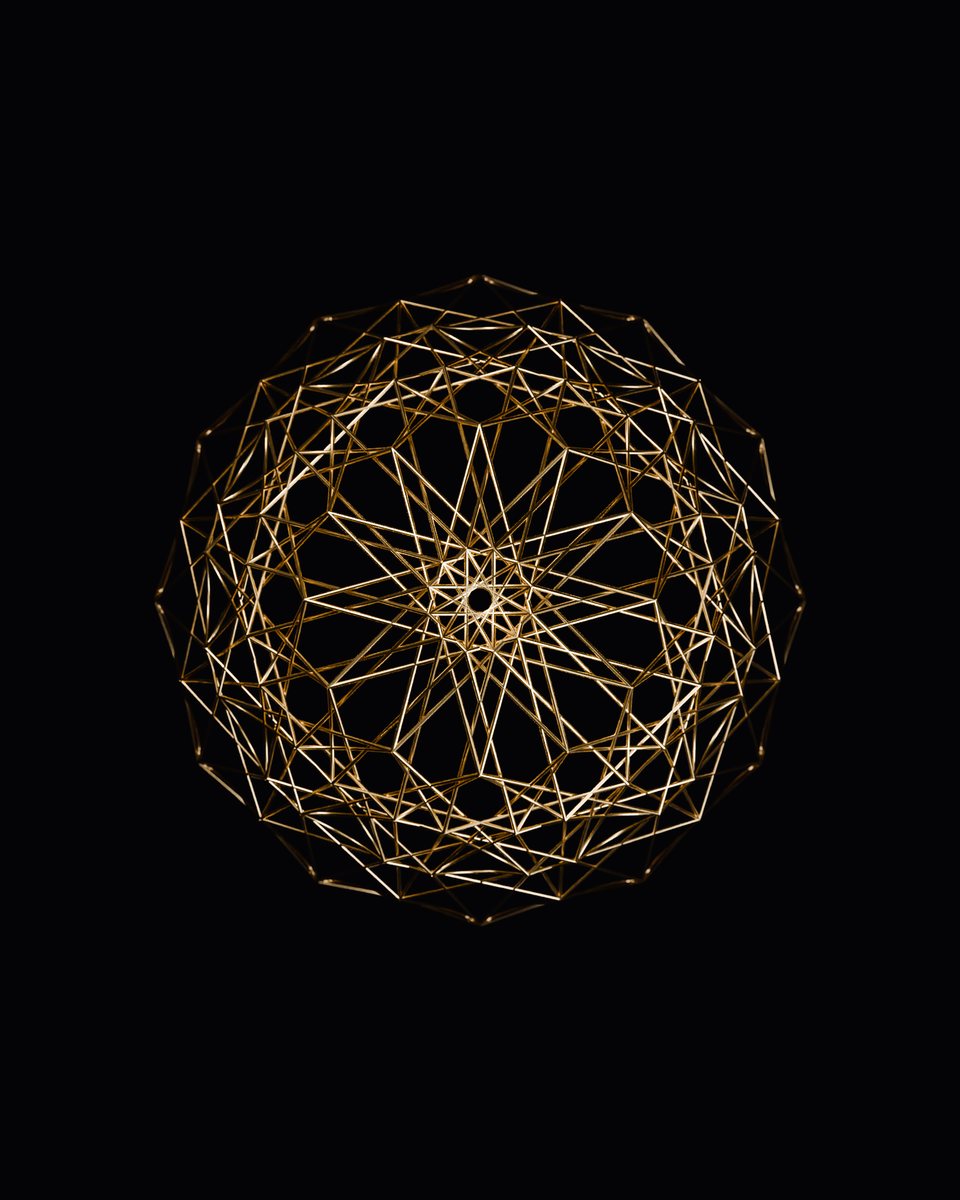
The plates use one projection throughout. Every edge of the polytope is pushed out onto a sphere in four dimensions, then projected stereographically into three, and the result is viewed straight down an axis of symmetry measured from the geometry. Straight edges become arcs, and from a symmetric place to stand the arcs close into a rosette: three-, four-, five-, six-, eight- or ten-fold, depending on the polytope and the axis.
Turning the polytope in the four-dimensional plane that contains the view axis changes the drawing continuously, and it stays a rosette the whole way round. I call this the axis walk. The clip below is one plate's medallion walking its axis and coming to rest on the view used for that plate.
Ornament from the polytope itself
The plates borrow the grammar of Islamic geometric design and illuminated manuscripts, because those traditions are already about symmetry. A rosette is what a symmetric object looks like from a symmetric place to stand. The border follows a rule: wherever the ornament is mathematical, it comes from the polytope on the page.
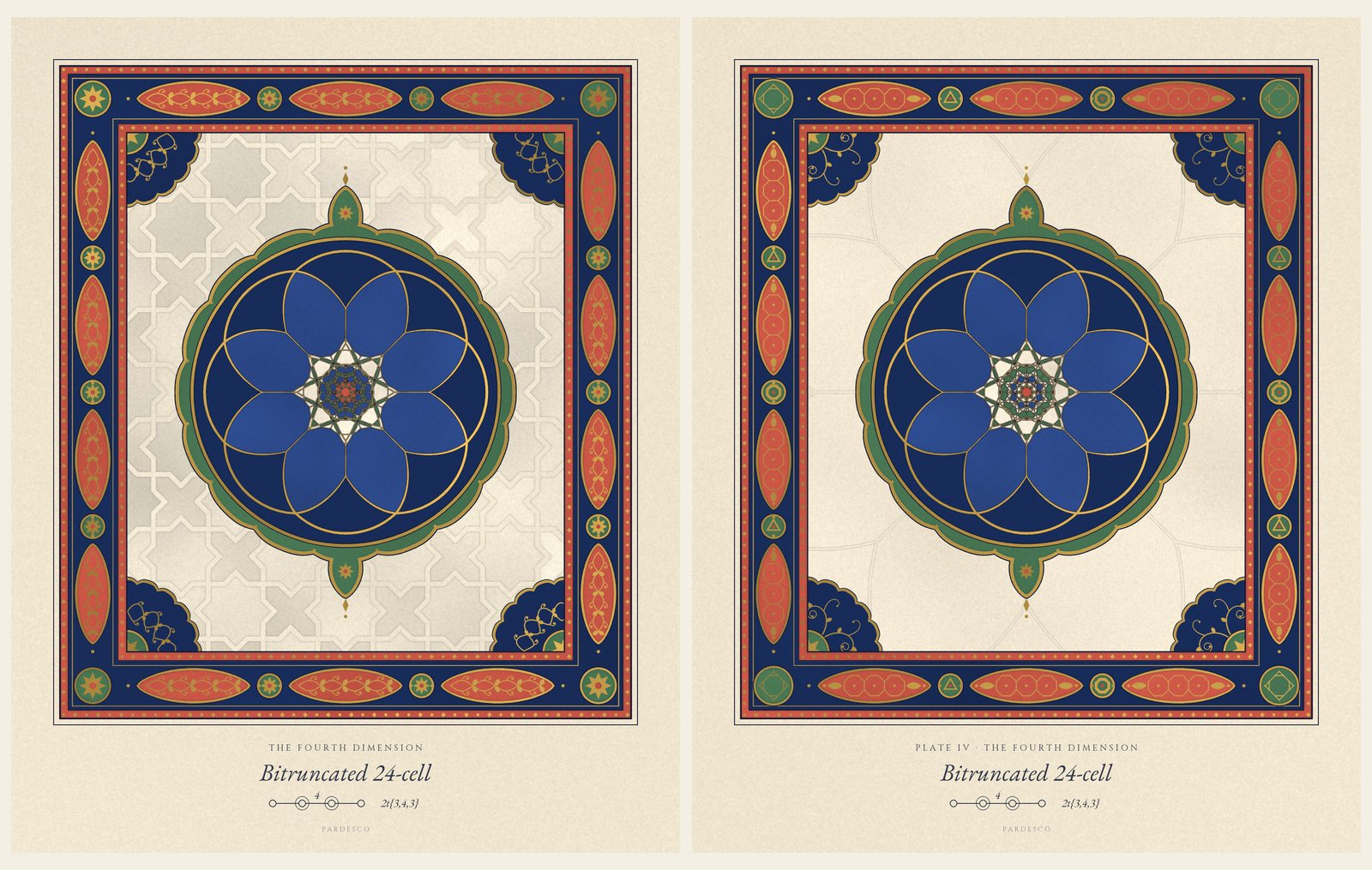
| Part of the plate | Where it comes from |
|---|---|
| Medallion | Every edge of the polytope, projected as above |
| Border cartouches | A belt of the polytope's own faces, unfolded flat: true shapes, true adjacency |
| Corner seals | Its cells, each seen down its own highest-order axis |
| Roundels | Its face polygons |
| Field behind the medallion | The outer part of its own projection, enlarged |
| Frame, cusps and corner scrolls | Conventional manuscript ornament, not derived from the polytope |
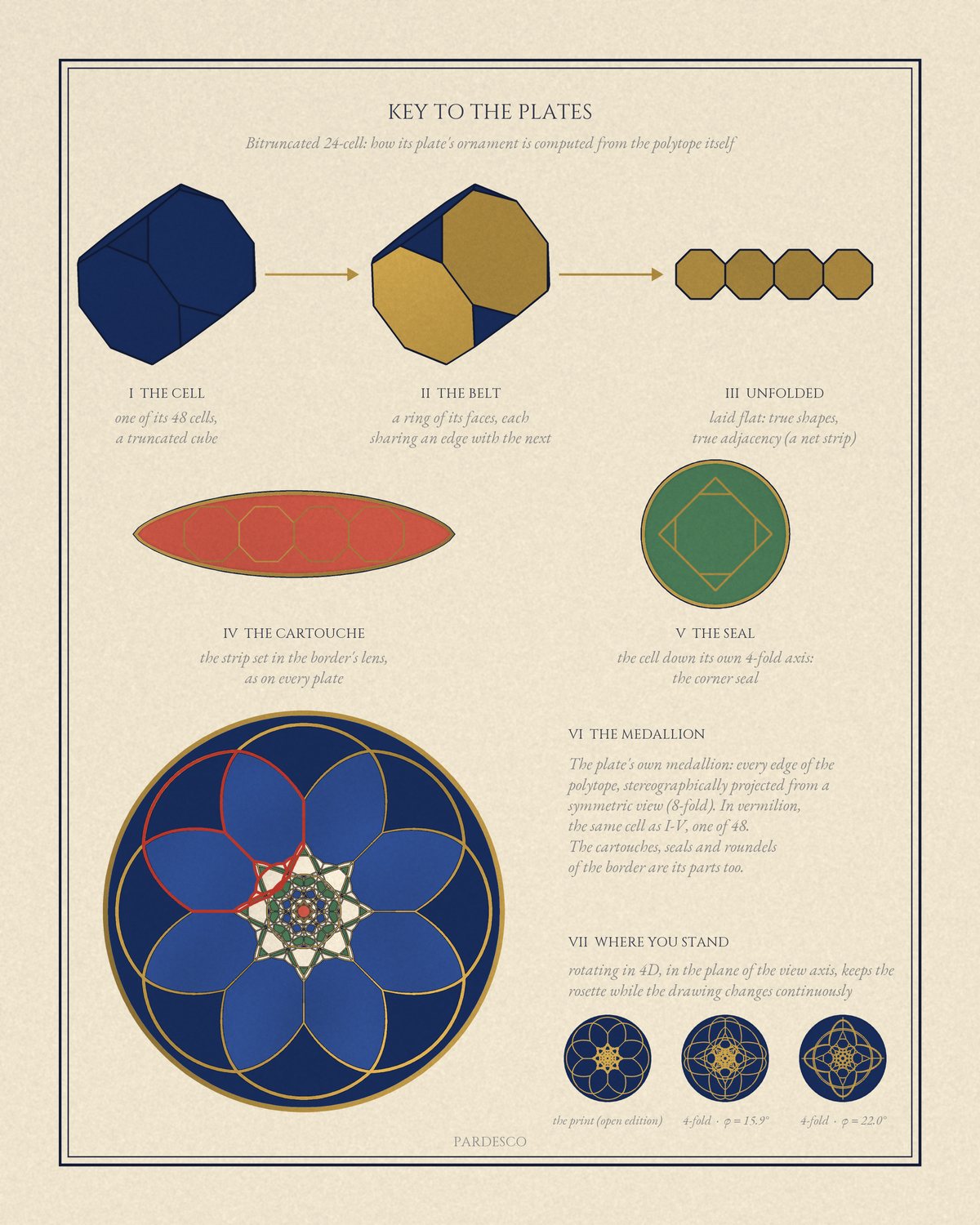
The key plate shows the chain for one shape, the bitruncated 24-cell: one of its 48 cells, a belt of that cell's faces, the belt unfolded into a strip, the strip set into a cartouche, and the cell itself as a corner seal.
What the agents did and what I did
The software was written by AI coding agents. Claude, from Anthropic, wrote and ran the code: the projection, the symmetry finder, the plate composer, the automatic gates and the reproducibility bundle. OpenAI's Codex reviewed the plates as a second opinion, first as an art director and later on the mathematics. I did not write the code by hand.
What I did was set the direction and the rules, judge every result, reject what was wrong and choose what to keep. Some of the most important calls were catching mistakes the agents had made confidently. The full log is below; this is the split in short.
| Who | What they did |
|---|---|
| Me | The direction (classical plates, polytope as medallion), the rules (100 to 800 edges, camera only on a symmetry axis), every approval and rejection, the motion, the series name, and two corrections the system had got wrong |
| Claude (coding agent) | All of the code, every render, the measurements behind each claim, and build decisions I delegated in writing, each logged for my review |
| Codex (reviewing model) | Ranked palettes and border designs; caught a mathematical error in how the corner seals were keyed; confirmed and extended my correction of the standpoint overclaim |
| Image models | Nothing. None was used. |
I think of the plates as mine in the way a printmaker's edition is theirs. The press does the printing; the printmaker decides what is on the plate and which pulls are signed. My CV lists the juried exhibitions this practice comes from, including Bridges and the Joint Mathematics Meetings.
Plates I–V and the Genesis plates
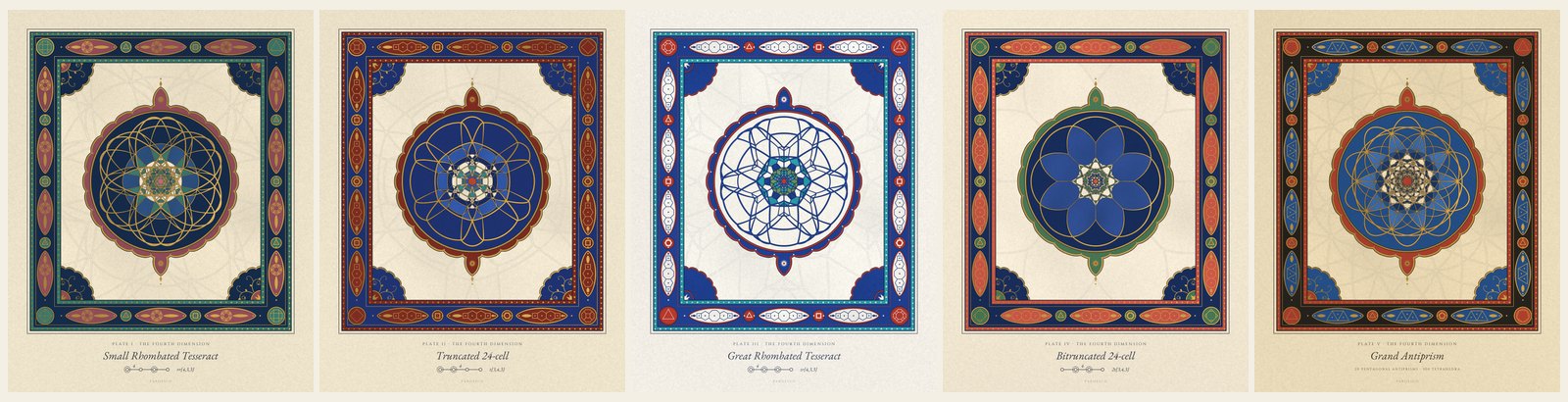
There are two groups. Plates I–V are open editions: five polytopes, each from its most symmetric view, each available in five historical palettes (Timurid, Safavid, Mamluk, Ottoman and Iznik).
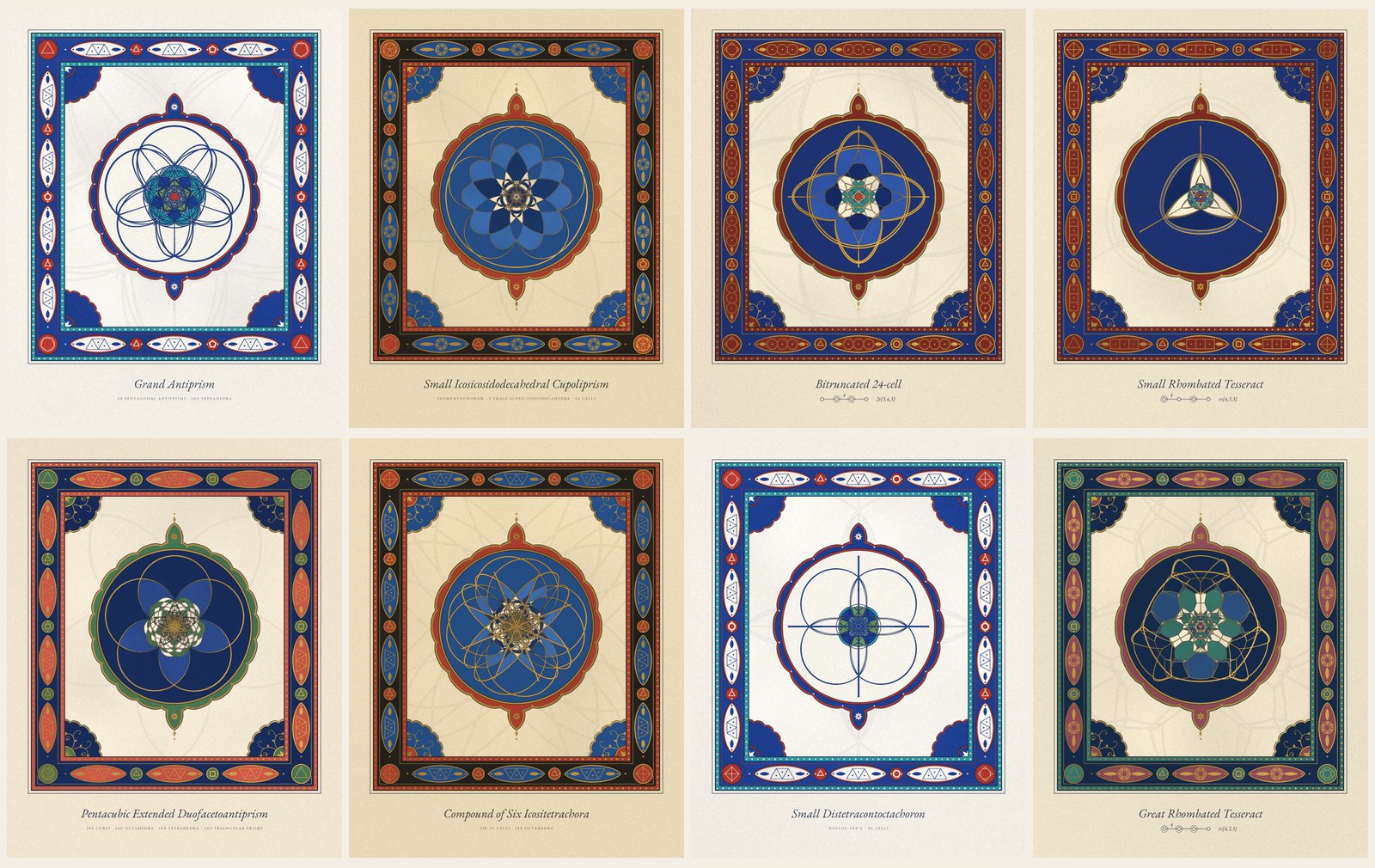
The Genesis plates are eight one-of-a-kind plates across eight polytopes. Each is a still from that polytope's axis walk: one position, recorded as a rotation angle, away from the symmetric view the open editions use. A deterministic system makes them: polytope, rotation angle and seed in, plate out. Automatic gates reject plates whose medallion crowds, breaks or loses its symmetry, and rejected seeds are logged, never fixed by hand. Every one of these eight can be regenerated from the public code.
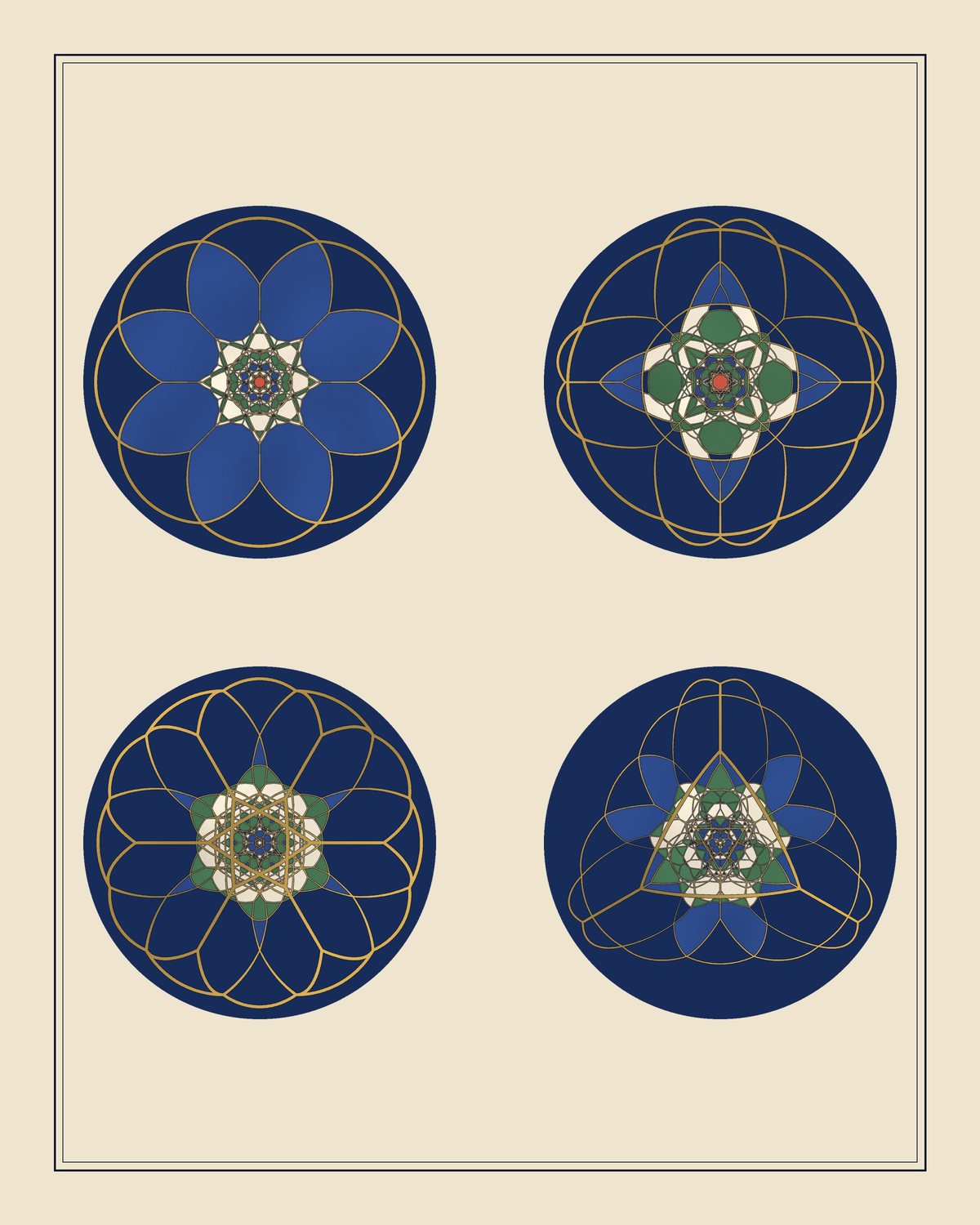
A companion sheet, Four Orders of Symmetry, shows what the axis walk does to one polytope. The bitruncated 24-cell has two such paths. On the first, the medallion keeps four-fold symmetry and rises to eight-fold at the special view; on the second, three-fold rises to six-fold. Each row shows the special view beside an ordinary one on the same path. The sheet carries no text: it is meant to stand as an image, and the mathematics goes on its label.
The decision log
This is a condensed version of the dated record kept while the plates were made. The complete one is DECISIONS.md in the repository. Each entry says who made the call.
- 24 Oct 2026, me: the direction. Push the flat 4D prints into classical compositions: the polytope as medallion, ornate borders, historical colour. Shapes with 100 to 800 edges; the camera only on a symmetry axis.
- 24 Oct, the agent's first proposal, rejected by me. It began with Blender depth and layering studies. I said they were not the direction, and asked for something closer to the original flat prints.
- 24 Oct, the reviewer: palettes. Codex ranked six palettes and put the black-line one last because it read as a technical diagram. It was dropped; five historical palettes remain.
- 24 Oct, me: ornament from the polytope. Set A had conventional borders, and I froze it as high quality. Then I asked for borders that belong to the shape. Set B makes the cartouches, seals, roundels and field from the polytope's own parts.
- 24 Oct, the reviewer: a mathematical catch. Codex pointed out that the nodes of a Coxeter–Dynkin diagram are mirrors, not cells, so the corner seals must not be keyed to them.
- 24–25 Oct, me: Plates I–V. Five plates in five palettes, as a series on the smaller sheets (11×14 to 18×24 in) and not at poster size.
- 27 Oct, me: framed, not bare, and the motion. Shown three motion studies side by side, I chose the axis walk. That choice became the concept for the one-of-a-kind plates: each is a place to stand along the axis of symmetry.
- 27 Oct, the agent, under authority I gave it: the generative system. It built the system and its gates and logged each build decision for my review. My review: "They look great."
- 28 Oct, me: a flaw seen in motion. One fill was coloured asymmetrically in the first frames of a motion test. The agent traced it to the plate code, fixed it, and re-rendered everything affected. The three shop plates with the same flaw got corrected print files the next day.
- 29 Oct, me: the overclaim. The system described each polytope as having a small, countable set of "standpoints", and the plates were captioned "Standpoint 9 of 12". I saw that the count came from our own sampling and merge tolerance, not from the polytope: every view along the walk is a rosette, so there are infinitely many. I had it removed everywhere. A second review of the mathematics confirmed it, and found that the code comments were also wrong about mirror lines, which persist along the walk.
- 31 Oct, me: art, not a document. Headings and the studio mark came off the one-of-a-kind plates and the Four Orders sheet.
- 31 Oct: a complete public instrument. Two modules borrowed from a paid Blender add-on were re-implemented so the published code stands on its own. The plates came out byte-identical.
Check it yourself
Saying an image is computed from geometry is easy. The repository makes it checkable:
github.com/Pardesco/fourth-dimension-plates
It holds the complete plate code, including the 4D mathematics, the polytope data for the eight Genesis shapes, the fonts, a manifest with the SHA-256 hash of every file and every plate, and a script that re-renders the plates and compares them with the manifest. With Python 3.10 and the pinned package versions:
pip install numpy==1.26.4 scipy==1.11.4 Pillow==12.3.0 shapely==2.1.2
python reproduce.py --all
Each plate renders at 2,400 pixels and prints MATCH if its hash equals the published one. A match means the image came from this code and this data, with nothing painted in afterwards. The exact package versions matter: a different NumPy can shift a single face in a border belt, which changes the bytes even when the eye cannot see it.
The code is published for verification and study, not as an open-source licence: the plates remain my copyright. Mathematical art made by computation has a long history, from the Bridges community and artists such as Henry Segerman, George Hart and Bathsheba Grossman, to Coxeter and the polytope enumerations the shapes come from. Nothing here claims to be first. What is new to me is the working method, and putting the whole of it on the record.
What comes next
Proof prints are on the way. Photographs of the framed plates will be added to this post when they arrive, because a print on paper is the final test of colours chosen on a screen, especially the simulated gold. For the shape behind the projection, start with what 4D art is. For the pattern side, see how algorithmic star patterns are generated.
Frequently asked questions
What is mathematical art?
Mathematical art is artwork whose form comes from mathematics: symmetry, geometry, topology or number. Here the subject is a four-dimensional polytope, and every edge of the medallion is computed from its coordinates, projected and viewed down an axis of symmetry.
Are these plates AI-generated art?
No image model was used. AI coding agents wrote the software to the artist's specifications, and the software computes each plate from the polytope's geometry. The artist set the direction and rules, judged every result and chose what to keep; the dated decision log is public.
How can I check that a plate was computed and not painted?
Download the public repository at github.com/Pardesco/fourth-dimension-plates, install the pinned Python packages and run reproduce.py --all. Each Genesis plate is re-rendered and its SHA-256 hash compared with the published manifest; a match means the image came from that code and data.
Why do the plates use Islamic and manuscript ornament?
Those traditions are built on symmetry, and a symmetric object seen from a symmetric viewpoint is a rosette. The cartouches, seals, roundels and field are computed from the polytope's own faces and cells; only the frame, cusps and corner scrolls are conventional ornament.
Can I buy the plates as prints?
Plates I to V are open-edition prints in five historical palettes, from 11 x 14 to 18 x 24 inches, print only or framed, in the classical plates section of the Geometric Wall Art collection. The eight Genesis plates are one of a kind and are not sold as prints.
Studio dispatches
New work, new writing — straight to you
Occasional letters from the studio. No spam, unsubscribe anytime.