 PARDESCO
How to Draw a Pentagram: Compass, Straightedge & Golden Ratio
To draw a pentagram, place five equally spaced points on a circle and connect every second point in the order 1 → 3 → 5 → 2 → 4 → 1. The compass-and-straightedge method below constructs the spacing exactly, so you do not need a protractor or a five-point-star template.
At a glance
- Exact method: compass and unmarked straightedge
- Quick method: circle, protractor, and 72° intervals
- Golden-ratio method: construct a regular pentagon, then draw its five diagonals
- One-stroke path: connect every second vertex without lifting the pencil
Method 1: Draw an Exact Pentagram with a Compass and Straightedge
What you need
- A compass
- An unmarked straightedge or ruler
- A sharp pencil and eraser
- Paper large enough for the construction circle
Step 1: Draw the circle and perpendicular diameters
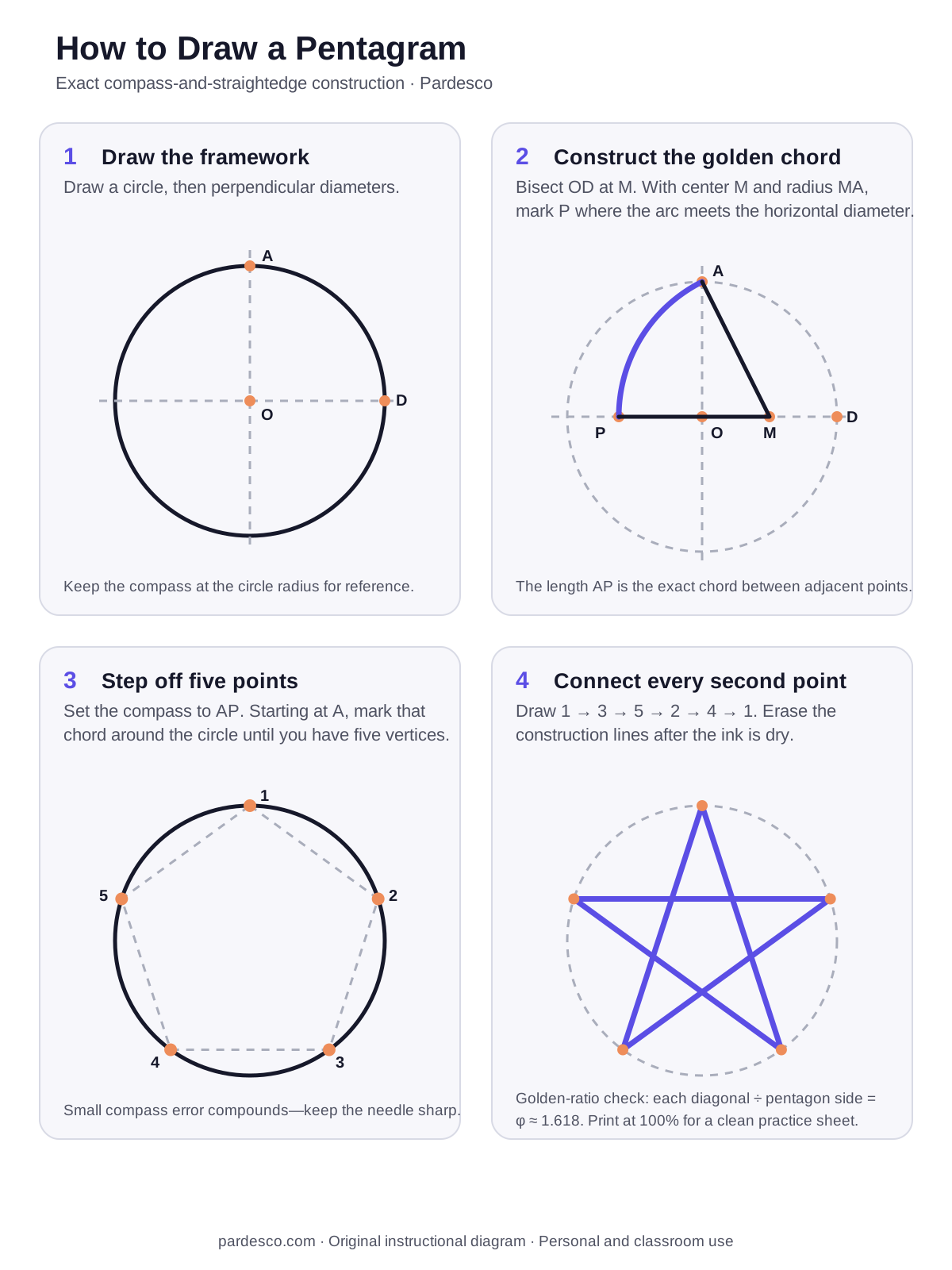
Draw a circle with center O. Draw a vertical diameter and label its top endpoint A. Draw a horizontal diameter through O and label its right endpoint D. These lines establish the center and the first pentagon vertex.
Step 2: Construct the pentagon's chord
Bisect segment OD to find its midpoint M. Place the compass needle at M and open it to A. Draw an arc until it crosses the horizontal diameter on the left side of O; label that crossing P. The distance AP is the exact chord length between adjacent vertices of a regular pentagon inscribed in the original circle.
Step 3: Mark five equal points
Set the compass opening to AP. Starting at A, step that chord around the circumference. You should land back at A after marking five vertices. If the final step misses, do not force it—recheck the midpoint M and keep the compass opening fixed.
Step 4: Connect every second point
Number the vertices clockwise from the top. With the straightedge, draw 1 → 3 → 5 → 2 → 4 → 1. This creates the regular star polygon {5/2} in one continuous path. Erase the circle and construction lines if you want the star alone, or keep them to show the geometry.
Method 2: The Quick Circle-and-72° Method
- Draw a circle and mark its center.
- Place the protractor at the center and mark points at 0°, 72°, 144°, 216°, and 288°.
- Connect every second point around the circle.
This is faster for sketches, murals, or digital layouts where measured angles are acceptable. The compass construction is better when you want an exact classical construction without angle marks.
Method 3: Build the Pentagram from the Golden Ratio
A regular pentagram is the set of five diagonals of a regular pentagon. If the pentagon side has length s, each diagonal has length φs, where:
φ = (1 + √5) / 2 ≈ 1.6180339
For a pentagram whose long stroke segment should measure d, calculate the underlying pentagon side as s = d / φ. Construct the regular pentagon at that side length, then draw all five diagonals. This is useful in CAD, woodworking layouts, and other situations where the finished star must fit a specified dimension.
Accuracy check: measure any pentagon diagonal and divide it by a pentagon side. A regular construction will be close to 1.618. The crossing diagonals also divide one another in the same ratio, which is why smaller pentagons and pentagrams recur toward the center.
Common Pentagram Drawing Mistakes
- The last compass step does not meet the first point.
- The midpoint M or intersection P is off, or the compass slipped. Reconstruct the chord instead of spreading the error among the points.
- The star looks short and wide.
- The points are not equally spaced on one circle. Build the five vertices first; do not estimate the tips independently.
- You drew a pentagon instead of a pentagram.
- Adjacent points make the outer pentagon. Skip one vertex each time to trace the star.
- The center is uneven.
- Use one unbroken straightedge alignment for each diagonal and keep every line exactly on its two target vertices.
What the Construction Reveals
The finished figure has five outer points, five inner vertices, a central pentagon, and five congruent golden triangles at its tips. Those mathematical relationships help explain why the pentagram became a symbol of proportion and harmony long before its modern pop-culture associations.
For the symbol's historical, religious, and cultural meanings, continue to Symbolism of the Pentagram. To apply the same compass-and-straightedge habits to circles, rosettes, and interlocking grids, see How to Draw Sacred Geometry.
Frequently Asked Questions
How do you draw a perfect pentagram?
Construct five equally spaced points on a circle, then connect every second point in the order 1-3-5-2-4-1. The compass construction above creates the 72-degree spacing exactly.
Can you draw a pentagram in one stroke?
Yes. Start at any outer point and continue to every second point. Five straight segments return you to the start without lifting the pencil.
Where is the golden ratio in a pentagram?
A diagonal of the underlying regular pentagon divided by its side equals φ, approximately 1.618. The intersecting diagonals divide one another in golden-ratio proportions too.
What is the difference between a pentagram and a pentacle?
The pentagram is the five-pointed star polygon itself. A pentacle is commonly a pentagram enclosed by a circle.
Studio dispatches
New work, new writing — straight to you
Occasional letters from the studio. No spam, unsubscribe anytime.