 PARDESCO
Reverse-Engineering the Envelope Extrusion: When 'New' Polyhedra Turn Out to Be Stellations
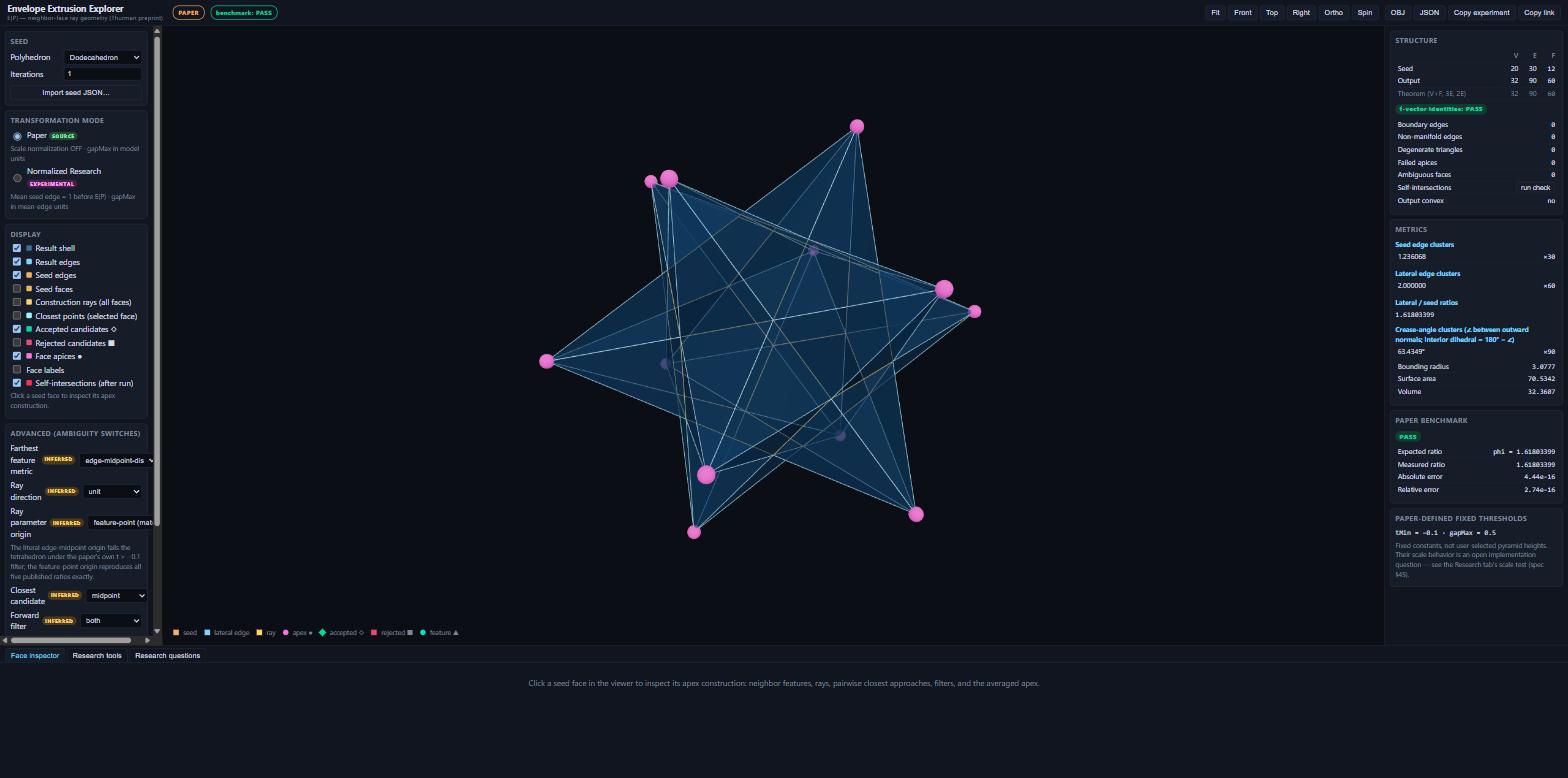
A preprint recently made the rounds proposing a new polyhedral transformation: the Envelope Extrusion, by Samuel Thurman — a zero-parameter rule that grows a pyramid on every face of a convex polyhedron, born inside a Grasshopper/Rhino pipeline for 3D-printed light sculptures. The accompanying claim, as it circulated, was a new class of polyhedra. I do computational geometry for a living, and I wanted to know: do the numbers hold up, and are the shapes actually new?
So I did the only thing that settles questions like this: I rebuilt the algorithm from scratch, from the paper's written definition alone, and tested it against every number the paper publishes. The short answer is a genuinely satisfying split. The construction is real — I reproduced every published measurement to machine precision. And the shapes are not new — they are classical stellations, some of them four centuries old, arrived at by a route nobody seems to have noticed, including the author's own verification suite. Both halves of that sentence are worth unpacking, because each is more interesting than a simple yes or no.
What the Envelope Extrusion does
Take a convex polyhedron. For each face, look across each of its edges at the neighboring face, and pick that neighbor's "farthest feature" — its farthest vertex if it has an odd number of sides, the midpoint of its farthest edge if even. Shoot a ray from that feature through the shared edge's midpoint. Do this for every edge of the face, then take all the pairwise closest approaches of those rays, filter out candidates that point backwards or miss each other badly, and average what survives. That average is the face's new apex. Replace every face with the triangles joining its rim to its apex, delete the original faces, and you have E(P).
Combinatorially this is the classical kis operation — one pyramid per face — and the paper says so plainly. Its claim to novelty is the metric rule: unlike kis, no human picks the pyramid heights. The construction has zero free parameters, which is exactly the kind of property that matters when every face has to become a printable panel that meets its neighbors cleanly.
The numbers replicate — impressively so
I implemented the whole thing as a browser-based research tool with a pure TypeScript geometry kernel and 85 automated tests. The paper's published measurements live in the test suite only as targets — nothing in the geometry code can see them. Every place the written definition is ambiguous (and there are several) became an explicit switch, and I ran an automated search over 288 combinations of interpretations, scoring each against the paper's published fingerprints: edge-ratio 1.000000 for the tetrahedron and octahedron, the golden ratio φ for the dodecahedron, √(2/5) for the icosahedron, 1/√2 for the cuboctahedron.
One family of interpretations reproduces all five to within about 10−15 relative error — machine precision. That is far too structured to be coincidence: matching 1, 1, φ, √(2/5), and 1/√2 simultaneously means the published numbers pin down the author's actual algorithm essentially uniquely. Whatever else is true, the Envelope Extrusion is a real, deterministic, reproducible construction. Most preprints never get an independent replication; this one passes it.
One sentence of the definition is wrong — by the paper's own numbers
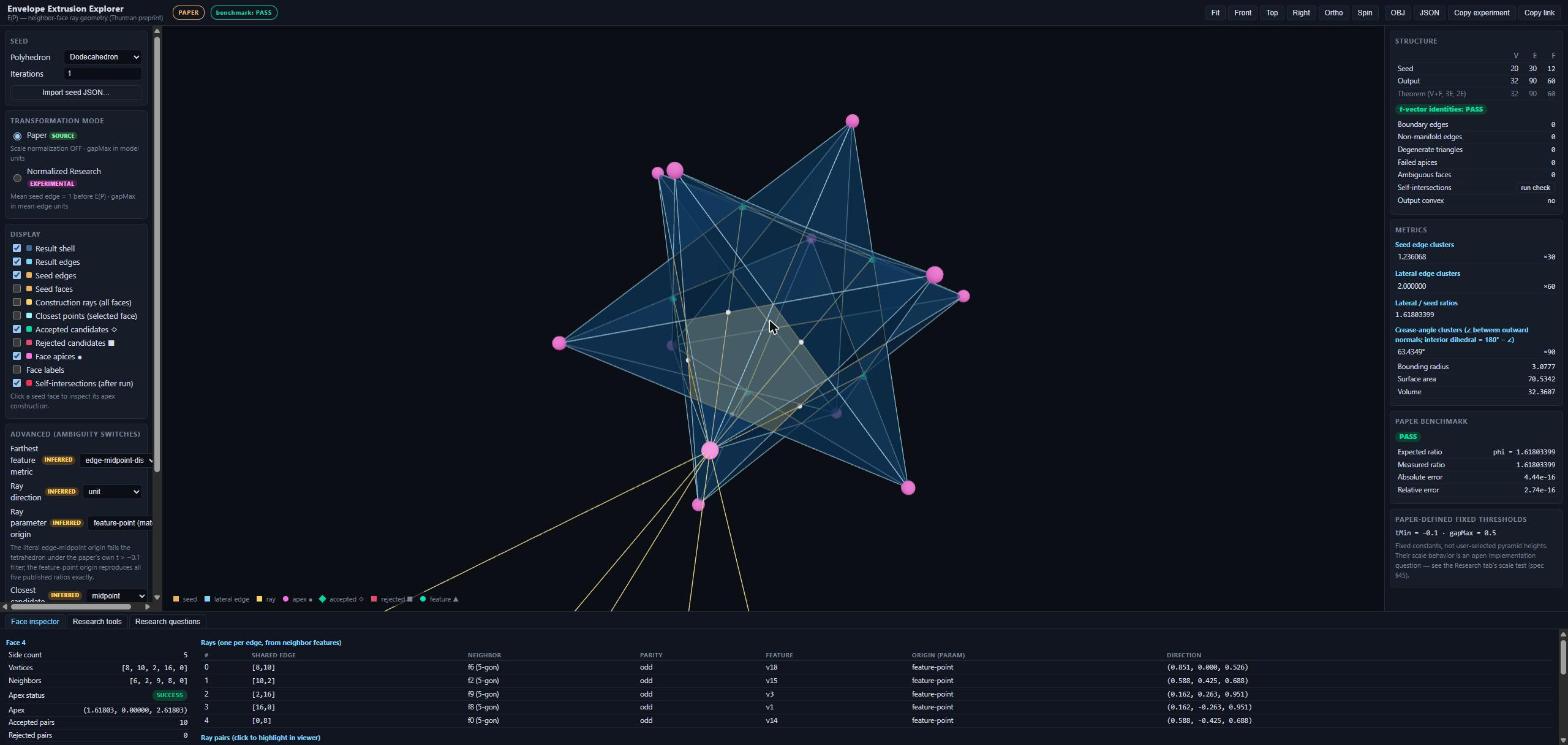
Here is the fun part. The paper's definition says each ray "originates at the midpoint" of the shared edge, and its commentary confirms the forward filter (t > −0.1) suppresses candidates "behind the ray origin." Read literally, that kills the paper's own tetrahedron.
For a regular tetrahedron, the three neighbors of any face all share the same farthest vertex — the seed vertex opposite that face. All three rays are therefore concurrent at that vertex, which sits at parameter t = −1 when measured from the edge midpoint. The paper's own filter rejects every candidate, no apex exists, and the tetrahedron fails — yet the paper reports it succeeding, edge-uniform, at ratio 1.000000.
Measure the ray parameter from the feature point instead, and everything works: all five fingerprints reproduce exactly. In my 288-variant search the result is a perfect dichotomy — all 144 variants that parameterize from the feature pass everything, and all 144 that follow the literal text fail, every single one via the tetrahedron. Better still, the paper's own Figure 1 draws the rays starting at the feature points. The text and the figure disagree with each other, and the data sides with the figure. It's a one-sentence erratum, not a broken construction.
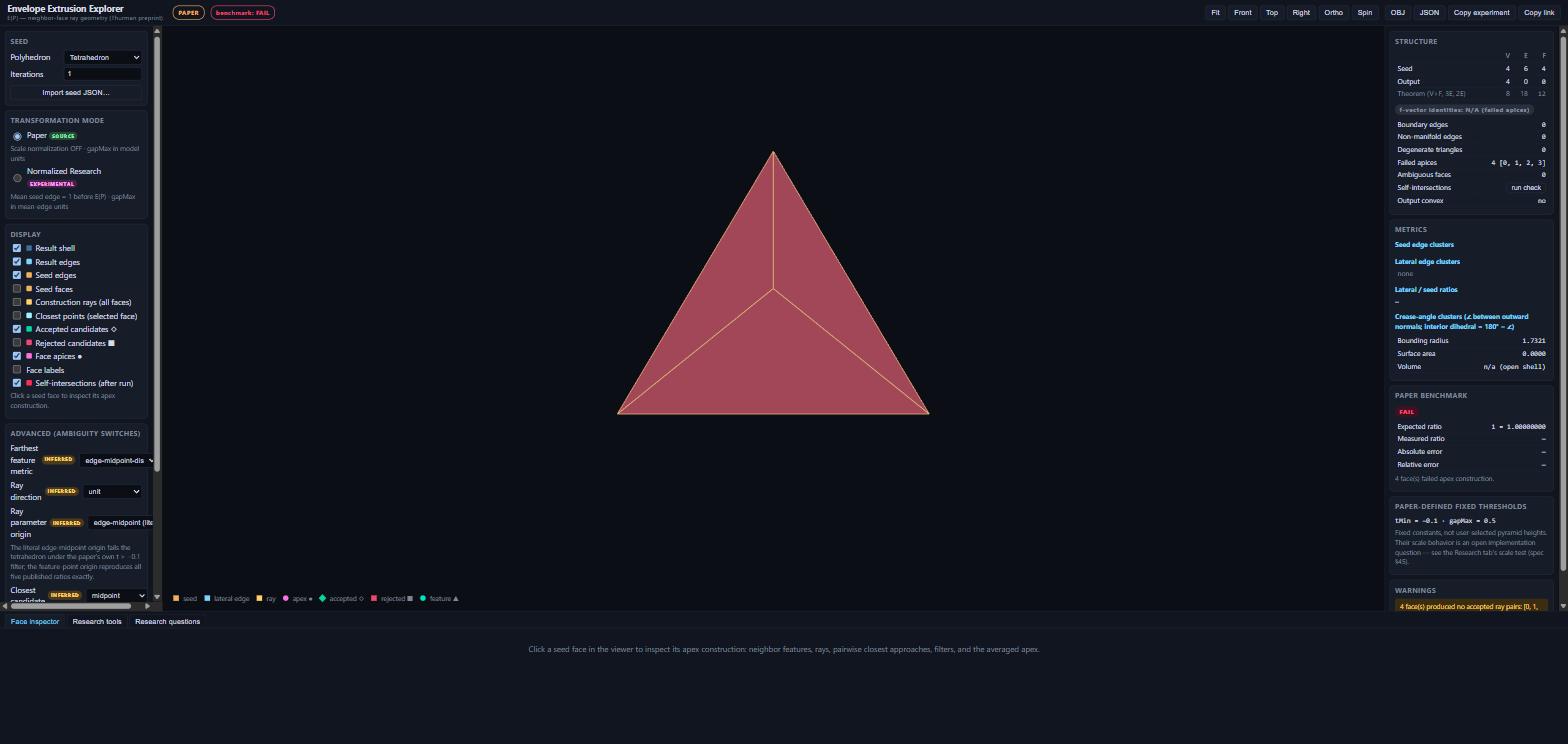
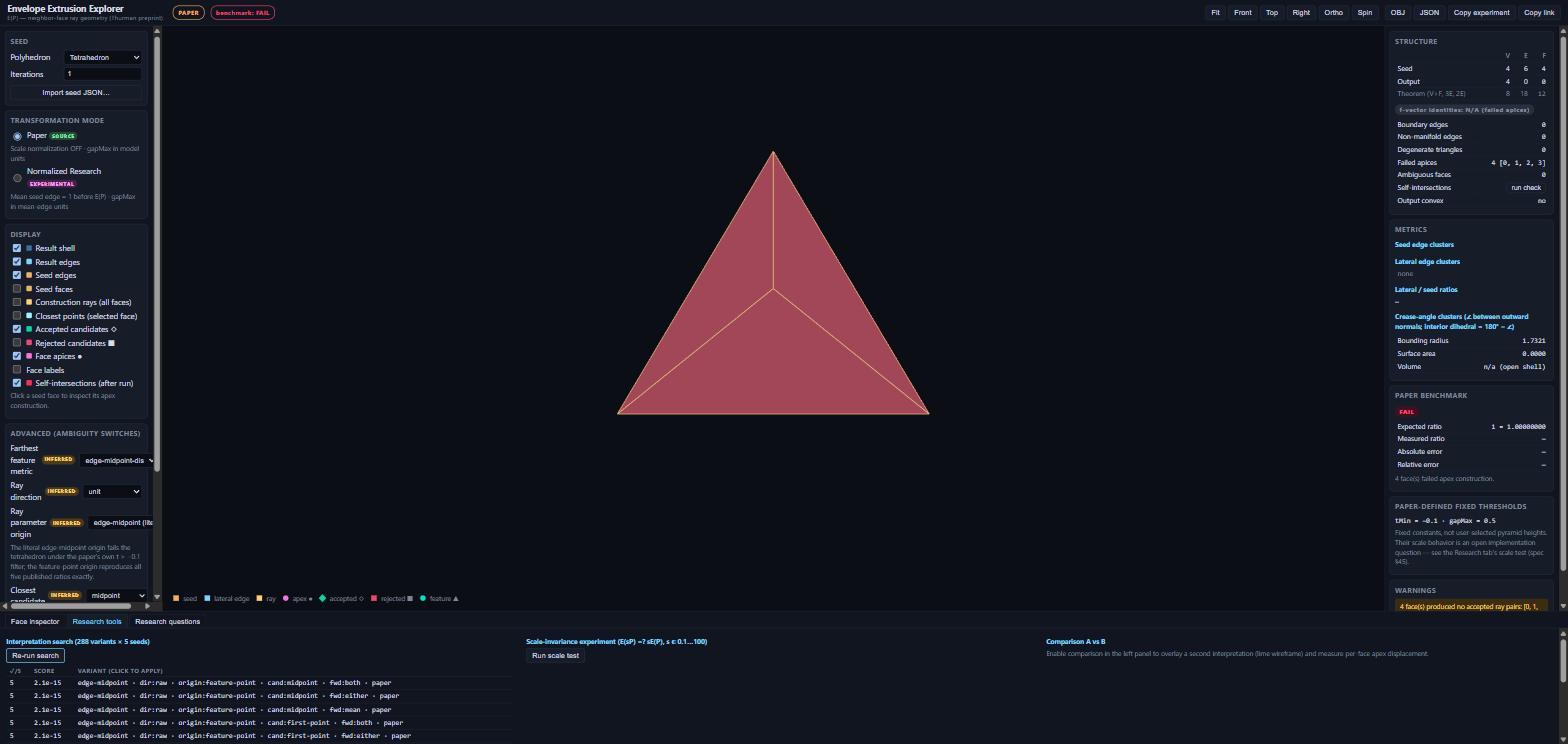
The crease angles hide a second, subtler discovery. The paper reports the tetrahedron's fold angles as 32°(6) and 109°(12). The ray rule as written can't produce that — its tetrahedron apices land exactly on the opposite seed vertices, folded inside. Reflect each apex outward through its face and you get 31.586° and 109.471°, matching the published table precisely. Since the reflection preserves every edge length, only the crease spectrum can detect it: the author's pipeline quietly orients apices outward, and the definition never mentions it. That's the kind of thing you only find by rebuilding someone's work from the text.
The closed form: it's stellation
Now the reframe. The feature point and the edge midpoint are both points of the neighboring face — so every construction ray lies entirely within its neighbor's plane. All that closest-approach machinery is a numerical routine for finding where the neighboring face planes intersect. I verified this to about 10−15 on every face of every published seed: the apex is exactly the common intersection point of the neighbor planes, and every output triangle lies exactly in an extended face plane of the original solid.
That point has a classical name: it is the vertex of the seed's first stellation. Which means the paper's published examples are, exactly:
- E(octahedron) — the stella octangula, Kepler's compound of two tetrahedra. The spikes come out as perfect regular tetrahedra, which is why the paper measures its ratio as exactly 1.
- E(dodecahedron) — the small stellated dodecahedron, a Kepler–Poinsot star polyhedron published in 1619. The golden-ratio edge measurement is the pentagram geometry showing through.
- E(icosahedron) — the first stellation of the icosahedron.
- E(cuboctahedron) — the compound of a cube and an octahedron.
- The cube fails because its neighbor planes never meet — the stellation vertex sits at infinity, and correspondingly all four rays come out exactly parallel. The paper reports the degeneracy; the stellation view explains it.
The preprint explicitly states that its construction "does not extend face planes." On every example it publishes, it does — and I can say why the author's own checks missed it. His verification scanned 3,564 output edges for coplanar adjacent triangles and found none, which is correct: the coplanar triangles in these shells never share an edge. They belong to different pyramids, separated by the deleted base face. An edge-fold scan is structurally blind to exactly this coincidence. Honest check, wrong instrument.
The identification even answers two questions the paper leaves open. It asks whether its "mystery constants" (φ, √(2/5), 1/√2, √3/2, √7…) follow a general formula: yes — for a regular n-gon face with apothem a, circumradius R, side s, and uniform dihedral angle θ to its neighbors, the ratio is √(a²·tan²(180°−θ) + R²) / s. That formula reproduces every published constant, and it predicted that the unexplained √3/2 comes from the rhombicuboctahedron's six axial squares (surrounded at exactly 135°) — a prediction I then verified through the full ray pipeline. It also asks whether E(tetrahedron) and E(octahedron) are "previously uncatalogued equilateral deltahedra": they are catalogued, one of them since 1619.
So is it a new class of polyhedra?
Credit first: the preprint itself is careful. It never uses the phrase "new class," claims no exhaustive novelty proof, and names none of its outputs as known solids — the stronger framing circulated informally alongside it. Against that informal claim, the evidence is decisive: the combinatorics are classical kis, the published shapes are classical stellations and compounds, and the apex rule is, on every published example, the defining operation of stellation performed by other means.
But there is something real here, and it deserves a better framing rather than a dismissal. Classical stellation is undefined for many seeds — the face planes simply fail to meet where a spike should go. The Envelope Extrusion's ray-averaging still returns a canonical answer there. What the paper actually built, I think, is a canonical extension of first stellation to seeds where stellation doesn't exist — its own catalogue even highlights that it "remains well-defined where classical stellation is unavailable." None of the published examples exercises that regime. Every one of them lands where the rays agree exactly. The genuinely new territory — what these shells look like precisely when they stop being stellations — is sitting right there, unexplored. That, plus a scale-dependence quirk in one of its filter thresholds that needs a one-line fix first, would make a much stronger follow-up paper than any novelty claim.
As a piece of computational making — a zero-parameter, CAM-friendly route to stellation-like shells that degrades gracefully instead of failing — it holds up well. I came away respecting the fabrication pipeline that produced it. The mathematics just turned out to be older, and stranger, than advertised: an algorithm that rediscovered Kepler's star polyhedra by shooting rays at edge midpoints, four hundred years later, without anyone realizing it.
The audit tool — an interactive explorer with the full construction debugger, benchmark dashboard, and 85-test suite shown in the screenshots — is open source: github.com/Pardesco/envelope-extrusion-explorer. Every number in this post is an automated test assertion in it. The preprint is "The Envelope Extrusion: A Deterministic Polyhedral Transformation from Neighbor-Face Ray Geometry" by Samuel Thurman. If you enjoy this kind of geometry made physical, the Platonic solids guide and the 4D shapes explainer are the natural next reads.
Studio dispatches
New work, new writing — straight to you
Occasional letters from the studio. No spam, unsubscribe anytime.