 PARDESCO
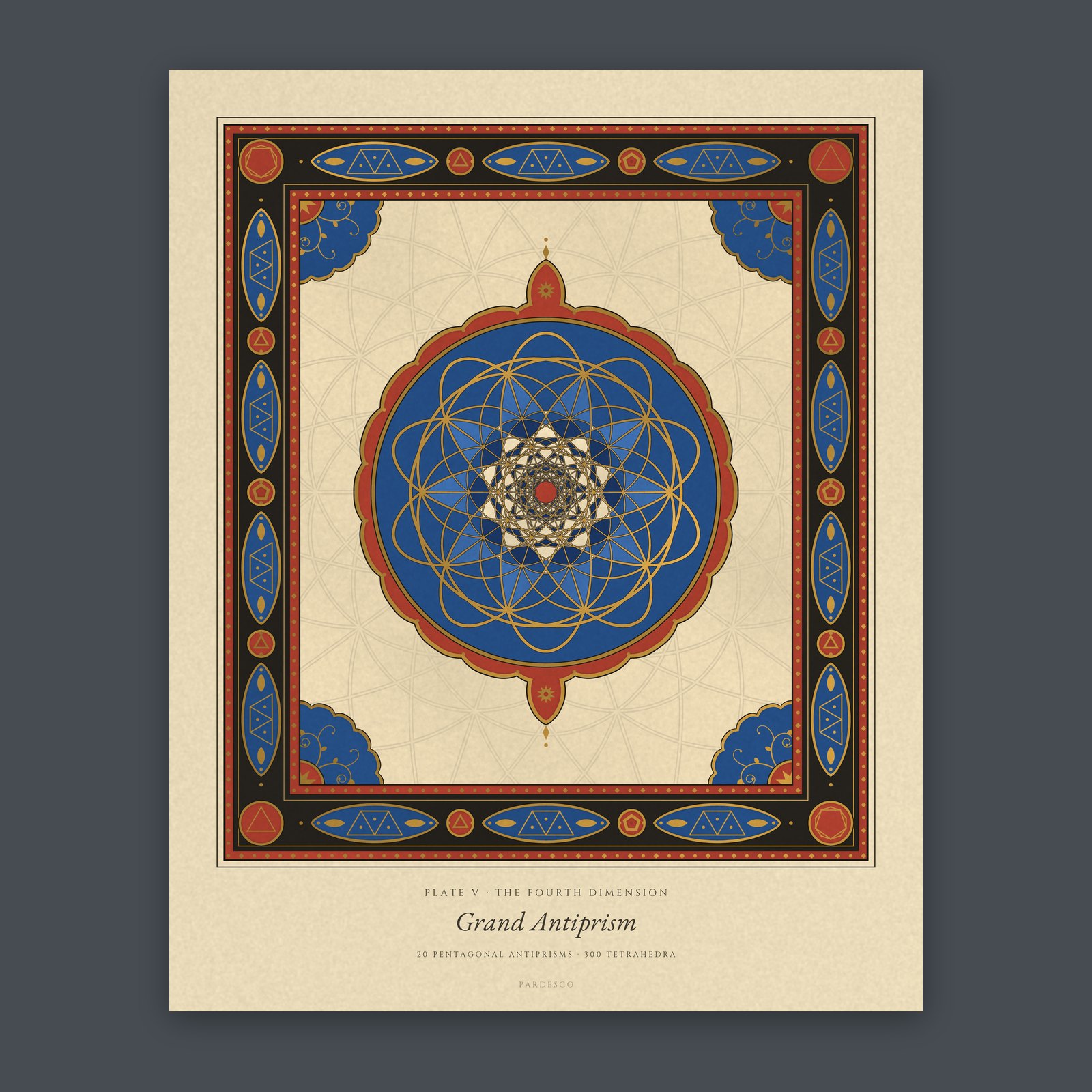
Grand Antiprism Classical Plate Art Print
- Design
- Grand Antiprism, Plate V of V (4D polytope, classical plate)
- Colourways
- Timurid, Safavid, Mamluk, Ottoman or Iznik
- Sizes
- 11 × 14, 16 × 20 or 18 × 24 inches, portrait
- Format
- Print, or framed in matte black wood, ready to hang
- Paper
- Museum-quality matte paper, 189 g/m², archival inks
- Shipping
- Printed to order; free US shipping
$44.00
Printed to order and shipped in 3–7 business days · free US shipping.
Ships in 5–10 days, insured · Shipping · 30-day returns
Grand Antiprism, Plate V
The grand antiprism: 320 cells (20 pentagonal antiprisms and 300 tetrahedra), 500 edges and 100 vertices, seen down a ten-fold axis. John Conway and Michael Guy found it by computer search in 1965. It cannot be built by Wythoff’s construction, the method behind the other plates, so its caption gives its cells where the others show a Coxeter diagram.
Composed as a classical illuminated plate. A stereographic projection of the whole four-dimensional polytope, seen straight down its axis of highest symmetry, is the central medallion, and every ornament around it is built from the polytope itself: the cartouches hold a belt of faces from one of its cells, unfolded flat; the corner seals are its cells; the small roundels are its face polygons; and the faint lattice in the field is its own outer edges, carried out to the frame. Five historical palettes: Timurid (lapis and vermilion with gold, after Timurid illumination from Herat); Safavid (midnight blue, rose and malachite with gold, after Safavid manuscripts); Mamluk (charcoal, cinnabar and blue with gold on parchment, after Mamluk Qur’an illumination); Ottoman (indigo, coral and leaf green with gold, after Ottoman illumination); Iznik (cobalt, turquoise and red on white with no gold, after Iznik pottery).
Plate V of five in The Fourth Dimension, a series of classical plates of 4D polytopes, ordered by the symmetry of the medallion from six-fold to ten-fold. Every plate shares the same frame, so any two or three hang together as a set: Small Rhombated Tesseract, Truncated 24-Cell, Great Rhombated Tesseract, Bitruncated 24-Cell. The grand antiprism also comes as a plain medallion print. To explore the shapes in motion, open the 4D polytope viewer.
| Sizes | 11 × 14, 16 × 20 or 18 × 24 inches |
| Format | Print (unframed), or framed in matte black wood with an acrylic front, ready to hang |
| Paper | Museum-quality matte paper, archival inks |
Common Questions
Your choice. Framed arrives ready to hang in a matte black wood frame (0.75 in thick) with a clear acrylic front and hanging hardware. The print fills the frame with no mat: the printed margin and caption around the plate do that job. Print ships unframed and fits a standard ready-made frame of the same size.
A museum-quality matte poster paper (189 g/m²) with archival inks. The matte surface keeps the painted texture and fine lines crisp without glare.
No. The gold is printed as a warm ochre with a soft painted sheen, the way gilding reads in a printed book plate. It is not foil or metallic ink.
The plate keeps the same proportions: the border, margin and caption scale with the sheet, and the medallion spans the same share of its width. The 18 × 24 is a slightly taller sheet, so its border runs a little longer, with a little more room above and below the medallion. Pick a size above to see it to scale on a wall.
Each print is made to order (framed ones are framed by hand) and usually ships within 2–5 business days, then about 3–7 days in transit within the US. US shipping is free.
Printed to order · Unframed or framed